LLM Engineer, RAG Engineer or MLOps Engineer: Which One Does Your Project Need?
LLM, RAG or MLOps engineer? Compare what each role owns, their skills and deliverables, which projects need which, and follow a simple decision tree to hire.
LLM Engineer, RAG Engineer or MLOps Engineer: Which One Does Your Project Need?
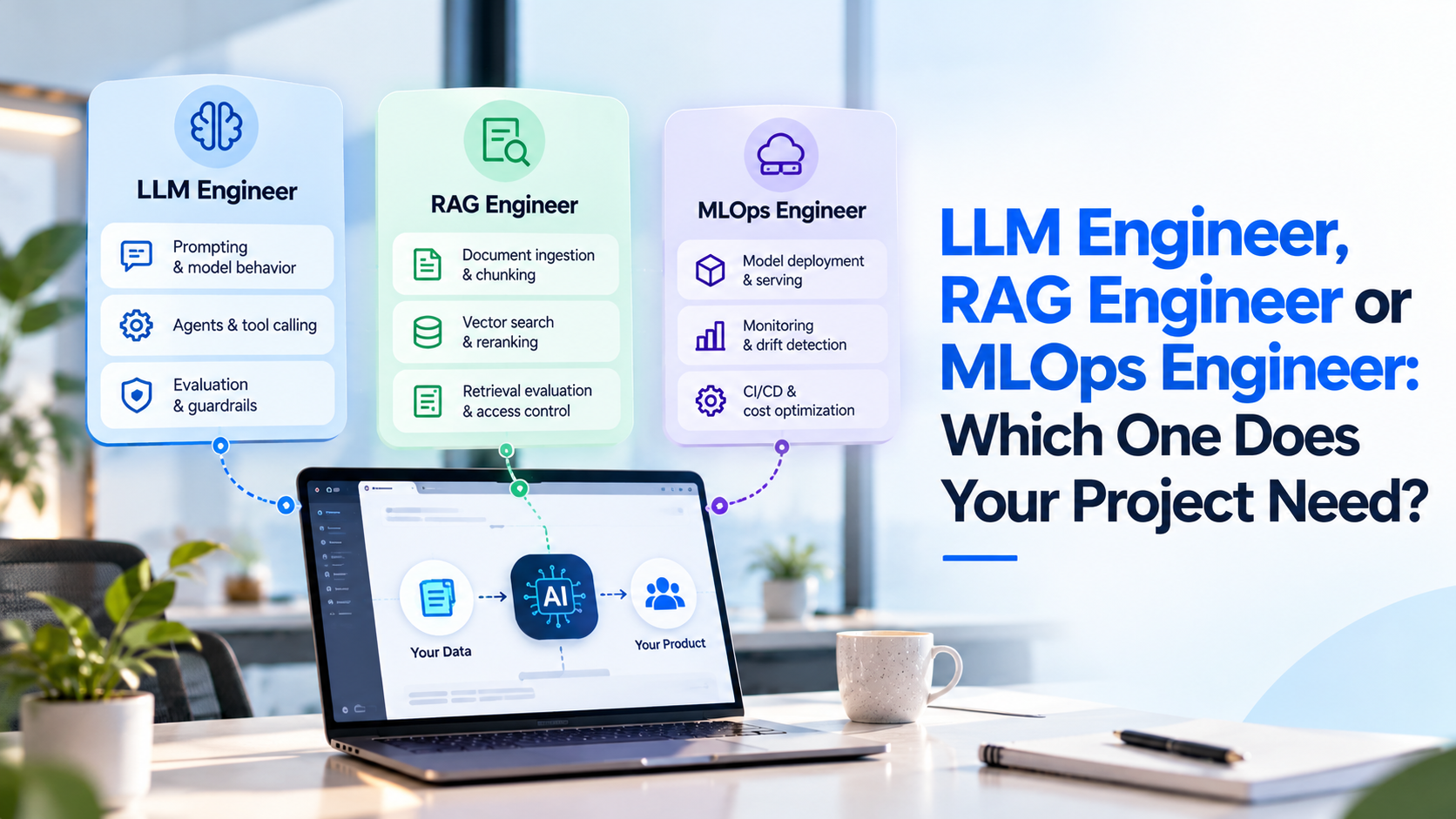
Hire LLM engineers when the hard part is model behavior: prompts, tool calls, agents and output quality. Hire RAG engineers when the answer depends on your own documents and retrieval accuracy decides success. Hire MLOps engineers when models must be deployed, monitored and retrained at scale. Most production projects need one lead role plus part-time cover from the other two.
The titles overlap on job boards, so it's easy to hire the wrong person first. Below: what each role owns, four project types, and a decision tree. (More on team design in our AI pods and engineering teams guides.)
What does each role actually own?
The cleanest way to tell the roles apart is to ask what each one gets paged for when something breaks.
LLM engineer: owns model behavior
An LLM engineer turns a foundation model into a dependable product component: prompt and context design, structured outputs, tool calling, model selection, evaluation suites and guardrails. On agent projects, they design the control loop: what the model can call, when it stops and how failures are handled.
Security sits here too. Prompt injection is the first entry in the OWASP Top 10 for LLM Applications (2025), and "excessive agency" is sixth. Both are problems of model behavior and permissions, so they land on the LLM engineer's desk.
Gets paged when: the model gives wrong, unsafe or badly formatted answers, or an agent takes an action it shouldn't.
RAG engineer: owns what the model knows at answer time
Retrieval-augmented generation was named in a 2020 paper by Lewis et al., which paired a pretrained generator ("parametric memory") with a dense vector index of Wikipedia searched by a neural retriever ("non-parametric memory"). The production version swaps Wikipedia for your contracts, tickets, policies or product docs.
A RAG engineer owns that pipeline end to end: document parsing, chunking, embeddings, hybrid search, reranking, metadata filters, access control on retrieved content and retrieval evaluation. Context assembly matters more than people expect. Research by Liu et al. (2023) found that model performance often drops when the relevant passage sits in the middle of a long context rather than at the start or end, so "just send more chunks" is rarely a fix.
Gets paged when: the answer is fluent but wrong because the right passage was never retrieved, or a user sees content they shouldn't have access to.
MLOps engineer: owns the system around the model
Google's MLOps guide defines MLOps as "an ML engineering culture and practice that aims at unifying ML system development (Dev) and ML system operation (Ops)." It describes three maturity levels, from manual processes (level 0) to automated training pipelines (level 1) to full CI/CD for pipelines (level 2), and adds continuous training as a property unique to ML systems.
The same guide notes that "only a small fraction of a real-world ML system is composed of the ML code." That point traces back to Sculley et al.'s Hidden Technical Debt in Machine Learning Systems (NeurIPS 2015). The MLOps engineer owns everything in that larger box: data and model versioning, training pipelines, model registries, serving infrastructure, GPU capacity, monitoring for drift, cost controls and rollback.
Gets paged when: latency spikes, a deployment fails, the GPU bill doubles, or model quality decays silently over weeks.
LLM vs RAG vs MLOps engineer: side-by-side comparison
| LLM engineer | RAG engineer | MLOps engineer | |
|---|---|---|---|
| Core question | Does the model behave correctly? | Does the model see the right facts? | Does the system run reliably and cheaply? |
| Typical skills | Prompt/context design, tool calling, agent frameworks, evals, guardrails, fine-tuning basics | Parsing, chunking, embeddings, vector and hybrid search, reranking, retrieval metrics | CI/CD, containers, orchestration, model serving, feature/data pipelines, observability |
| Typical deliverables | Eval suite, prompt and tool specs, agent graph, guardrail layer | Ingestion pipeline, index, retrieval API, relevance test set | Training and deploy pipelines, model registry, dashboards, runbooks |
| Primary metrics | Task accuracy, format compliance, refusal and hallucination rates | Recall@k, precision, citation accuracy, freshness | Uptime, p95 latency, cost per request, drift alerts |
| Most valuable when | The model makes decisions or takes actions | Answers must come from private or changing data | Many models, heavy traffic, retraining, or strict SLAs |
| Weak spot if hired alone | Retrieval quality and ops maturity | Agent design and production ops | Product-level output quality |
Which role does each project type need?
Four patterns cover most enterprise requests. The "lead" is the person accountable for the outcome; "support" means part-time or later-phase cover.
1. A chatbot or assistant over internal documents
Lead: RAG engineer. Support: LLM engineer. If employees ask about HR policy, wikis or contracts, retrieval sets the quality ceiling. No prompt rescues a passage that was never found. Bring the LLM engineer in for citation behavior and evals; MLOps can stay light on a hosted model API. See our post on internal knowledge assistants for this build.
2. A fine-tuned classifier or extraction model
Lead: MLOps engineer (with an ML/LLM engineer on the model). Support: LLM engineer. Routing support tickets, tagging documents or extracting fields at high volume is a classic ML system: labeled data, training runs, versioned models, scheduled retraining and drift monitoring. The modeling work is real, but the long-term risk is operational. Whether you should fine-tune at all, or use retrieval instead, is a separate question covered in our guide on when to fine-tune vs use RAG.
3. An AI agent that takes actions
Lead: LLM engineer. Support: RAG engineer (if it needs knowledge), MLOps engineer (for tracing and cost). Agents fail through bad tool choice, loops and over-broad permissions. Anthropic's Building Effective Agents separates workflows ("LLMs and tools are orchestrated through predefined code paths") from agents ("LLMs dynamically direct their own processes and tool usage"), and advises finding "the simplest solution possible." Knowing when not to build an agent is itself an LLM engineering skill. Our guide to hiring agentic AI developers goes further on this profile.
4. An AI platform running at scale
Lead: MLOps engineer. Support: LLM and RAG engineers per product line. Once several teams ship models, you need shared serving, gateways, eval pipelines, versioning and cost attribution. Without an MLOps lead, each team rebuilds the same plumbing.
Where does an AI solution architect fit?
An AI solution architect doesn't replace any of the three. They decide the shape of the system before anyone is hired: build or buy, hosted API or self-hosted model, retrieval or fine-tuning, where data lives, and which of the three specialist roles leads. On regulated or multi-system projects they also own the integration map and the non-functional requirements (security, residency, audit).
Bring one in first when:
- The project touches three or more internal systems.
- Data residency or compliance rules constrain model choice.
- You can't yet say which of the four project types above you're building.
On a single, well-scoped feature, a senior LLM or RAG engineer can usually cover the architecture. Weighing an architect against a broader technical leader? See fractional AI CTO vs solution architect.
Decision tree: which engineer should you hire first?
Run through these in order and stop at the first "yes."
- Is the architecture still undecided, or does the system span three or more internal systems or a compliance regime?
→ Yes: hire an AI solution architect first (even for 4 to 6 weeks), then return to step 2. → No: go to 2.
- Is the model already in production, and is your main pain reliability, latency, cost or retraining?
→ Yes: hire an MLOps engineer. → No: go to 3.
- Must answers come from your own documents or data that change more than a few times a year?
→ Yes: go to 4. → No: go to 5.
- Does the system also take actions (call APIs, write records, send messages) beyond answering?
→ Yes: hire an LLM engineer as lead, with a RAG engineer alongside. → No: hire a RAG engineer as lead, with part-time LLM engineer support for evals and output quality.
- Are you training or fine-tuning your own model on labeled data, with retraining planned?
→ Yes: pair an ML/LLM engineer for the model with an MLOps engineer for pipelines and monitoring. → No: go to 6.
- Is the core task generating, reasoning, classifying or acting through a hosted model API?
→ Yes: hire an LLM engineer. → No: revisit step 1. The problem may not need generative AI at all.
Whatever the tree says, plan for the other roles by production. The first hire sets direction; it rarely finishes the job alone.
Three hiring mistakes this comparison helps you avoid
Hiring an MLOps engineer for a prototype. Level-2 CI/CD for a model nobody has validated yet is infrastructure ahead of evidence. Start with the role that proves the use case works.
Asking an LLM engineer to "fix hallucinations" in a retrieval system. If the retriever misses the right passage, prompt changes only disguise the gap. Check retrieval recall before rewriting prompts.
Treating "RAG" as a weekend add-on. A demo on 50 clean PDFs says little about a large archive of scanned, permissioned, duplicated files. Parsing and access control take the effort, and OWASP lists "vector and embedding weaknesses" as its own risk category (LLM08).
For sourcing and vetting any of these profiles, see how to hire AI engineers; for how they sit on one team, see the roles inside an AI pod.
How fwdpod approaches this
Fwdpod builds dedicated AI engineering pods covering LLM development, RAG systems, AI agents and product delivery, with forward-deployed engineers and engineering delivery from India. A pod can pair a lead role with part-time cover from the other two, as the decision tree suggests. Pods are typically 4–6 experts working around a single measurable outcome, and the exact mix of roles, including MLOps coverage, is something the team can walk you through on a first call.
If you've worked through the tree and know which role you need, explore the pod pages to hire LLM engineers, RAG engineers, MLOps engineers or AI solution architects. Then configure your AI engineering pod, or talk to the team about scoping the first phase.
Frequently Asked Questions
1. Can one engineer cover LLM, RAG and MLOps work on a small project?
Yes, for a prototype or a single internal tool using a hosted model API. One senior engineer can build retrieval, prompts and a basic deployment. The gaps usually show at production scale, when retrieval evaluation, monitoring and cost control each need focused time.
2. Is a RAG engineer just an LLM engineer with a vector database?
No. A RAG engineer spends most of their time on search problems: parsing messy documents, chunking, ranking, metadata filtering and permission-aware retrieval. Those skills overlap more with search and information retrieval engineering than with prompt design.
3. Do I need an MLOps engineer if I only call the OpenAI or Anthropic API?
Often not at first. You still need logging, cost tracking, prompt versioning and evaluation in CI, but a strong LLM engineer or platform engineer can set these up. A dedicated MLOps hire becomes worthwhile once you self-host models, fine-tune regularly or run many AI features across teams.
4. What is the difference between MLOps and LLMOps?
LLMOps is MLOps applied to large language model systems. It keeps the core practices of versioning, CI/CD and monitoring, and adds concerns such as prompt versioning, token cost tracking, evaluation of free-text outputs and tracing multi-step agent calls.
5. Which role should lead an AI agent project?
An LLM engineer, because agent failures mostly come from tool design, control flow and permissions. Add a RAG engineer if the agent needs to look things up in private data, and MLOps support for tracing and cost once it handles real traffic.
6. When should I hire an AI solution architect instead of a specialist engineer?
When the design is still open: which model, where data may live, how the system connects to existing platforms, or whether AI is the right tool at all. An architect makes those calls first, which prevents hiring a specialist for the wrong problem.
7. What should I test in an interview for a RAG engineer?
Give them a small messy document set and a few questions, then ask how they would measure retrieval quality before touching prompts. Strong candidates talk about recall, reranking, chunking trade-offs and access control rather than only naming a vector database.