Agency vs Freelancer vs AI Pod: Which Delivery Model Fits Your AI Build
AI development team vs agency vs freelancer: compare cost, ownership, speed, quality, accountability, scalability, and risks.
Agency vs Freelancer vs AI Pod: Which Delivery Model Fits Your AI Build?
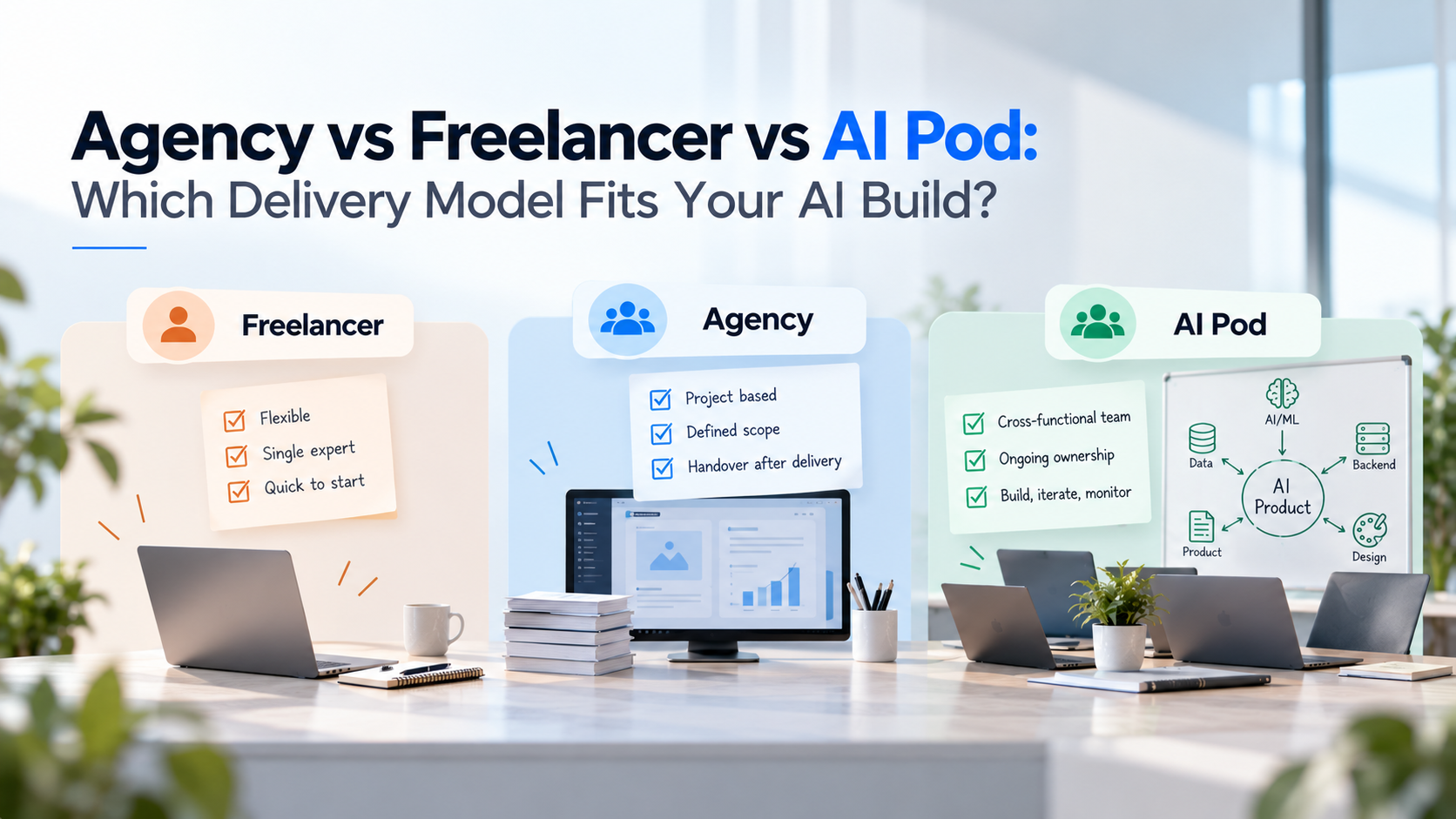
AI pod vs agency is mostly a question of what happens after launch. An agency delivers a defined project and hands it over. A freelancer gives you one skilled person, fast, with no bench behind them. An AI pod is a standing team that owns an AI system over time, including evaluation, fixes and iteration. Pick the model that matches how long the work lives.
That framing matters more for AI than for a website or a mobile app. An LLM feature isn't finished on launch day: prompts drift, retrieval quality changes as your documents change, and the evaluation set needs to grow with real user traffic. Researchers warned years ago that "it is common to incur massive ongoing maintenance costs in real-world ML systems" (Sculley et al., NIPS 2015). The model you choose decides who carries that cost.
This post compares the three options buyers most often shortlist for an outsourced AI build. If you are weighing a pod against staff augmentation or an in-house team instead, that comparison lives in our AI pod vs staff augmentation guide, and we won't repeat it here. More team-model comparisons sit in our AI Pods & Engineering Teams section.
What exactly are you comparing?
The labels get used loosely, so here are the working definitions this article scores against:
- AI agency (project agency or dev shop): a company that takes on a scoped project, usually under a statement of work (SOW) with fixed deliverables or a time-and-materials budget. It staffs the project from a shared bench, delivers, hands over and moves the team to the next client.
- Freelancer: an independent contractor you engage directly or through a marketplace. You get one person's skills and judgment, and you manage the work.
- AI pod: a small, dedicated, cross-functional team (for example AI engineers, a data or backend engineer and a delivery lead) that stays assigned to your product and is accountable for agreed outcomes on an ongoing basis. For the full anatomy, see what an AI pod is and the roles inside one.
One caution before the scores: the label on the proposal matters less than the contract. Some agencies sell dedicated teams that work like pods. Some "pods" are three contractors with a shared Slack channel. Score what the contract actually commits to.
The scored comparison table
Scores run from 1 (weak) to 5 (strong) and reflect a typical, well-run example of each model. They are our editorial judgment, not survey data. For the risk row, a higher score means lower risk.
| Criterion | What it measures | Agency | Freelancer | AI pod |
|---|---|---|---|---|
| Ownership | Who owns the outcome end to end, not just a task | 4 | 2 | 4 |
| Continuity | Same people, same context, month after month | 2 | 2 | 5 |
| Speed to start | Time from decision to productive work | 3 | 5 | 3 |
| Accountability | Contractual responsibility when something slips | 4 | 2 | 4 |
| Quality control | Code review, testing and evals beyond self-review | 3 | 2 | 4 |
| Knowledge retention | Whether context survives people leaving | 2 | 1 | 4 |
| Scale up / down | Adding or removing capacity without friction | 4 | 2 | 3 |
| Risk | Key-person, delivery and compliance exposure | 3 | 2 | 3 |
| Unweighted total | 25 | 18 | 30 |
Don't pick on the total. It assumes every row matters equally, which is almost never true. A founder testing whether a retrieval assistant is worth building should weight speed heavily and continuity barely at all, and a freelancer will usually win that case. A bank putting an agent into a regulated workflow should weight continuity, quality control and knowledge retention, and the freelancer drops out. Weight the rows first, then add up. The same weighted-scorecard method appears in our guide on how to choose an AI development partner.
How do the three models differ row by row?
Ownership and accountability
An agency owns what the SOW describes, and accountability is as good as that document. If the SOW says "deliver a chatbot" rather than "deliver a support assistant that resolves X% of tier-one tickets on our evaluation set", the agency can meet the contract and still miss the goal.
A freelancer owns their piece. Integration, architecture across pieces and the final result stay with you. That works well when you have a technical lead who can direct the work; it fails when you hoped the freelancer would be that lead.
A pod owns an outcome over time rather than a list of deliverables. That only holds if outcomes are written down: acceptance criteria, evaluation thresholds, and what happens when a milestone slips.
Continuity and knowledge retention
This is where the models separate most for AI work. The people who built the first version know why a chunking strategy was chosen, which prompts broke in testing, and which evaluation cases reflect real users. None of that is visible in the code.
- Agencies rotate staff to the next project after handover. Unless you pay for a support retainer, the context leaves with them.
- Freelancers carry the whole context in one head. A study of 133 popular GitHub projects found that 65% had a "truck factor" of two or fewer, meaning losing one or two developers would leave the project stuck (Avelino et al., 2016). With a single freelancer, your truck factor is one by design.
- Pods keep the same team on the product, and a delivery lead can be held to documentation standards: architecture decision records, runbooks and eval suites checked into your repository.
Speed to start
Freelancers win this row. A good one can start this week. Agencies usually run discovery and SOW negotiation first. Pods arrive pre-formed, but enterprise buyers often find their own security review and data access are the real bottleneck.
Quality control
A freelancer reviews their own work, which is the weakest form of review. Agencies typically have internal QA and code review, but quality depends on who they staff: the senior people in the pitch are not always the people on the project. A pod has built-in peer review, and for AI systems the stronger signal is whether the team runs automated evaluations on every change, not just unit tests.
Scaling up and down
Agencies can usually add people from their bench. Freelancers scale one person at a time, and each new freelancer is another person you coordinate. Pods scale in team-sized steps, which is less granular but keeps the new capacity inside an existing structure.
Risk
Each model carries a different risk:
- Agency: scope-change disputes, junior substitution after the pitch, and a handover that leaves you unable to run the system.
- Freelancer: key-person risk, and worker classification. In the US, the IRS looks at behavioral control, financial control and the type of relationship, and says no single factor decides status. In the UK, medium and large private-sector clients have been responsible since April 2021 for deciding a contractor's IR35 status and issuing a Status Determination Statement (HMRC flowchart for clients). A freelancer working full time under your direction for months is the classic problem case.
- Pod: vendor dependence. Reduce it by keeping code, prompts, eval data and infrastructure in repositories and cloud accounts you own.
IP is a risk in all three. Under US law, commissioned work counts as "made for hire" only in nine listed categories and only with a signed written agreement (US Copyright Office, Circular 30), so you need an explicit written IP assignment from a freelancer, an agency or a pod vendor. Our guide on who owns the IP when you outsource AI covers the cross-border details. This is general information, not legal advice; involve your counsel.
When does each model win?
An agency wins when:
- The scope is genuinely fixed and you can describe "done" in a page, such as a proof of concept, an integration or a demo for a funding round.
- You have an internal team ready to own the system after handover.
- The work mixes AI with design and front-end build, and you want one supplier for all of it.
A freelancer wins when:
- You need one specialist skill, such as an evaluation harness or a vector database migration, and you have a tech lead to direct it.
- You are testing feasibility and speed matters more than anything else.
- Nothing customer-facing depends on that one person being available next quarter.
An AI pod wins when:
- The AI system will live in production and keep changing, with new data, new use cases and model upgrades.
- No one in-house has shipped production LLM or agent systems, so you need judgment as well as hands.
- You want one team accountable for outcomes without building an AI department first. If the longer-term question is whether to build that department, read our guide to how enterprises buy AI engineering capacity, which covers what a partner owns and what stays in-house.
What red flags should you watch for?
Agency red flags
- The SOW lists features but no evaluation criteria or quality thresholds.
- Senior engineers attend the pitch; the named delivery team is vague or "to be confirmed".
- No handover plan, or handover means a zip file and one call.
- Change requests are priced before the first sprint shows how much is unknown.
Freelancer red flags
- Can't show a production system they maintained, only demos and notebooks.
- Wants to work in their own repository or cloud account "for now".
- No written IP assignment, or reluctance to sign one.
- Several concurrent clients, with no clarity on hours available to you.
AI pod red flags
- Called a pod, but no delivery lead and no commitment to outcomes. That is staff augmentation with extra steps.
- Team members change every few weeks, which removes the continuity you are paying for.
- No evals in the definition of done.
- Exit terms are missing: no handover period, no documentation standard, no access to your own artifacts.
For a fuller vetting list, see our 25 questions to ask an AI development company, and if an existing vendor is already showing these signs, our post on signs your AI vendor is failing.
Can you combine the models?
Yes, and many teams do. Common patterns:
- Freelancer to prove it, pod to run it. A specialist builds a feasibility prototype in a few weeks; a pod takes the validated approach into production.
- Agency for the product shell, pod for the AI core. The agency builds the web and mobile experience; the pod owns retrieval, agents, evals and monitoring behind an API.
- Pod plus targeted freelancers. The pod lead brings in a narrow specialist for a defined task, keeping integration responsibility inside the team.
Whatever the mix, one party should own the end-to-end outcome. Split ownership is how AI pilots stall between "works in the demo" and "works in production".
How fwdpod approaches this
Fwdpod builds dedicated AI engineering pods for startups and enterprises, covering LLM development, RAG systems, AI agents and product delivery, with engineering delivery from India for buyers in the US, UK, EU and Gulf. When a buyer is choosing between an agency, a freelancer and a pod, the first question is how long the system has to live and change after launch. If the honest answer is "a few weeks", a pod is probably more than you need. Fwdpod pods are typically 4–6 experts working around a single measurable outcome, and the solutions page lists six pods (Agent Development, RAG and Knowledge, Voice AI, Compliance AI, LLMOps and Custom). Build pods typically run 8–16 weeks; LLMOps is ongoing. Engagement length and handover terms for your build are things the team can walk you through on a first call.
Pricing depends on scope and team shape; for current terms, book a 30-minute call. We'll send matched profiles or a pod plan within 48 hours.
Frequently Asked Questions
1. Is an AI pod more expensive than hiring an AI agency?
Not necessarily. An agency prices a defined project, while a pod is a continuing team, so they are rarely quoted on the same basis. Compare the total cost of getting to a production system and keeping it working for a year, including support retainers, rework and the cost of rebuilding lost context after an agency hands over.
2. Can I hire a freelancer to build a production AI agent?
You can, if you have a technical lead who can own the architecture, review the work and take over if the freelancer leaves. Without that lead, a single freelancer becomes the only person who understands the agent's prompts, tools and failure modes, which is a fragile position for a customer-facing system.
3. What is the difference between an agency's dedicated team and an AI pod?
Sometimes nothing. If the agency assigns a stable team to your product, commits to outcomes rather than a fixed deliverable list and runs ongoing evaluation, it is operating as a pod. Check the contract for team stability, outcome commitments and exit terms rather than relying on the name.
4. How do I move from an agency or freelancer to a pod without losing work?
Before the switch, make sure all code, prompts, evaluation datasets and infrastructure definitions are in repositories and cloud accounts you own. Ask the outgoing party for architecture notes and a recorded walkthrough, and give the incoming team a short overlap period to ask questions.
5. Do UK companies need to worry about IR35 when hiring AI freelancers?
Medium and large UK private-sector clients have been responsible since April 2021 for deciding whether an off-payroll contractor falls inside IR35 and for issuing a Status Determination Statement. Small clients are exempt, and the contractor's intermediary applies the rules instead. Take advice on your specific engagement.
6. Which model is best for an AI proof of concept?
For a short, well-defined proof of concept, a capable freelancer or a fixed-scope agency project is usually the fastest route. Plan the handover before you start, because proof-of-concept code often needs to be partly rebuilt for production and someone has to own that step.
7. How many freelancers is too many for one AI project?
Once you have more than one or two freelancers on the same system, someone has to coordinate architecture, reviews and integration. If nobody on your side has time for that role, you are effectively running a team without a lead, and a pod or agency with its own delivery lead is usually the safer structure.