Is It Safe to Outsource AI Development to India? The Honest Answer
Explore India's AI vendor risks, data laws, IP protection, and AI talent depth. Get a practical checklist to assess vendors and choose with confidence.
Is It Safe to Outsource AI Development to India? The Honest Answer
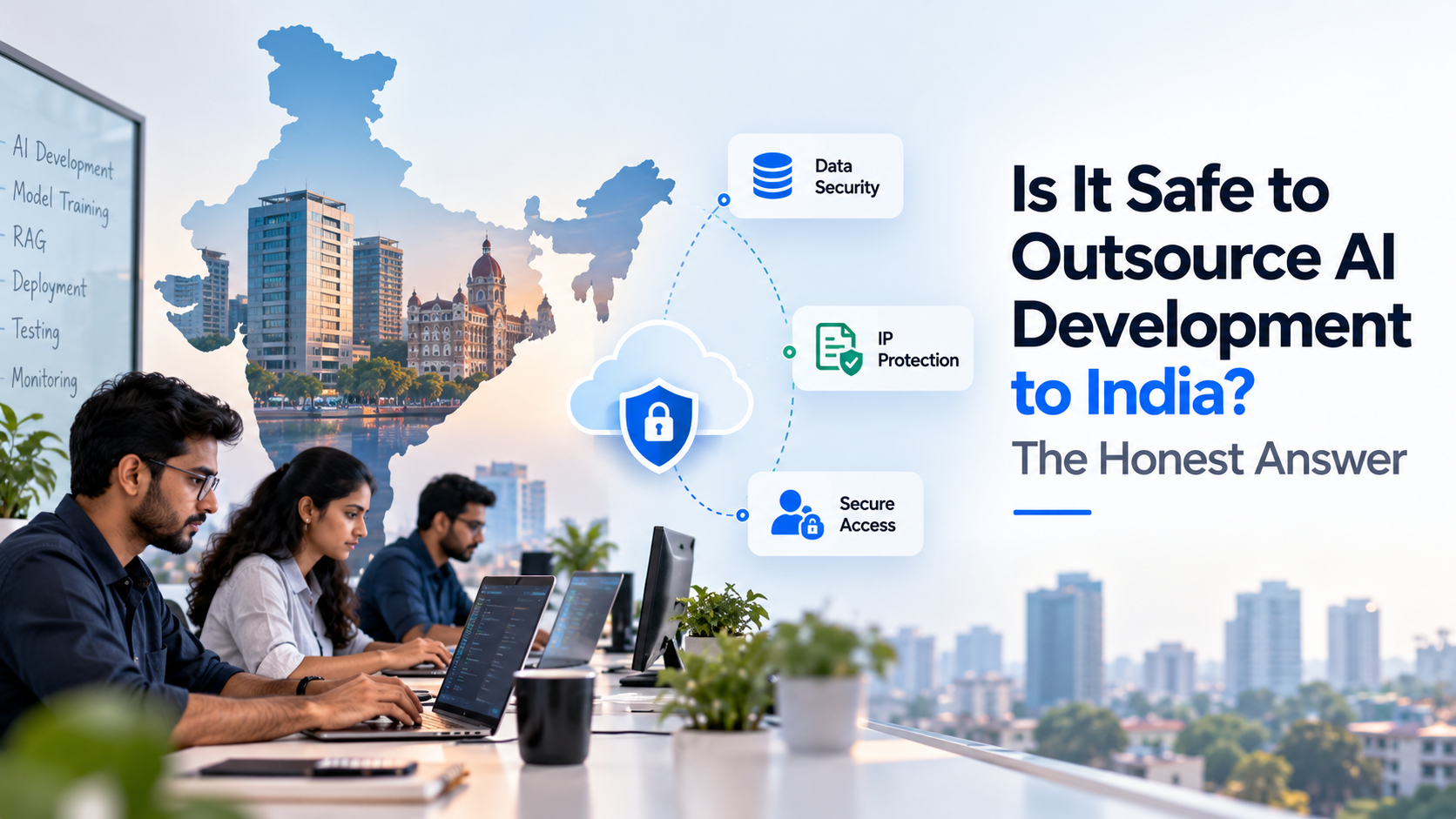
Yes, it is safe to outsource AI development to India, provided three things are true: your data stays in your own cloud, the contract assigns every piece of IP to you, and access is limited to named engineers you can revoke. The risk sits with the vendor you pick, not the country, and it can be checked before you sign.
That answer needs evidence, so this post walks through what Indian law actually says in 2026, where the real failure points are, and what to ask a vendor before you hand over a repository or an API key.
This article explains the legal position in general terms. It is not legal advice; involve your own counsel before signing.
Why is the risk vendor-specific rather than country-specific?
Because the same city can host a careless five-person shop and the engineering center of a Fortune 500 bank. NASSCOM's 2025 Strategic Review counts more than 1,750 global capability centers in India, the in-house engineering arms of foreign companies, inside a technology workforce of about 5.8 million people (NASSCOM, Feb 2025). Those companies made the country decision years ago. What they controlled was who had access, to what, under which contract. If you are still comparing locations, see our guide to the best country to outsource AI development.
The US government draws the same line. The Department of Justice's rule on bulk sensitive data names six countries of concern: China, Cuba, Iran, North Korea, Russia and Venezuela (28 CFR § 202.601). India is not on the list. That does not make any given vendor safe. It does mean the question for a US buyer is a diligence question, not a sanctions question.
What does Indian law say about your data in 2026?
Three layers matter, and they are in transition.
The DPDP Act 2023 and the 2025 Rules
The Digital Personal Data Protection Rules were notified on 14 November 2025, with an 18-month phase-in (PIB). The Data Protection Board exists now; consent-manager provisions follow in November 2026; and the core obligations (notice, consent, security safeguards, breach reporting, data principal rights) apply from mid-May 2027 (Shardul Amarchand Mangaldas). Check the current schedule before publishing any policy that depends on it, because MeitY has proposed shortening parts of it, such as a 12-month window for significant data fiduciaries (Business Standard, Jan 2026).
Three provisions are directly relevant to an offshore AI engagement (DLA Piper summary):
- Section 17(1)(d) exempts most of the Act when an India-based entity processes personal data of people outside India under a contract with a foreign party. The security-safeguard duty still applies.
- Section 16 takes a negative-list approach to cross-border transfers: data can flow anywhere except countries the government restricts.
- Breaches must be reported to the Board within 72 hours, and the top penalty, up to ₹250 crore, is reserved for failing to keep reasonable security safeguards.
For a US, UK or EU buyer, your own law (GDPR, HIPAA, state privacy laws) still governs your customers' data. The DPDP Act adds a floor for the vendor. It does not replace your obligations.
IT Act 2000, Section 43A
Before the DPDP Act, India's main data-protection hook was Section 43A, added by the IT (Amendment) Act 2008, which made companies liable to compensate people harmed by their failure to keep "reasonable security practices." The 2011 SPDI Rules treated ISO/IEC 27001 compliance as meeting that standard (IAPP). Section 43A is scheduled to be omitted when the DPDP core obligations commence in May 2027 (Shardul Amarchand Mangaldas). Until then both regimes run side by side.
CERT-In's 2022 directions
Since 28 June 2022, entities in India must report specified cyber incidents to CERT-In within six hours of noticing them, and keep ICT system logs for 180 days within India (Internet Society). This works in your favor if the vendor is actually compliant: it forces an incident process and log retention to exist. It also means the vendor's own logs are subject to Indian authority, which is one more reason to keep your production data out of the vendor's systems.
Should your data ever leave your cloud?
For most AI builds, no. The safest pattern is that the vendor works inside your environment, not the other way round.
| Access pattern | What the vendor holds | Risk level |
|---|---|---|
| Engineers use your SSO to reach your cloud tenancy, repos and LLM API accounts | Nothing, beyond their laptops | Lowest |
| Engineers develop against masked or synthetic data in a vendor sandbox; real data only in your staging | Test data, code | Low to moderate |
| You ship data extracts to the vendor's cloud for model or RAG development | Copies of real data | High |
| Vendor holds your LLM API keys or cloud credentials on its own accounts | Your keys and billing | High |
The first row is achievable for almost every RAG, agent or LLM integration project. Model API keys, vector databases, evaluation datasets and CI/CD should sit in your accounts, billed to you. If a vendor insists they need data on their own infrastructure, ask why, and get the answer in writing. Residency trade-offs across India, the EU and the US are covered in more depth in our guide to AI data residency.
Can you enforce IP ownership against an Indian vendor?
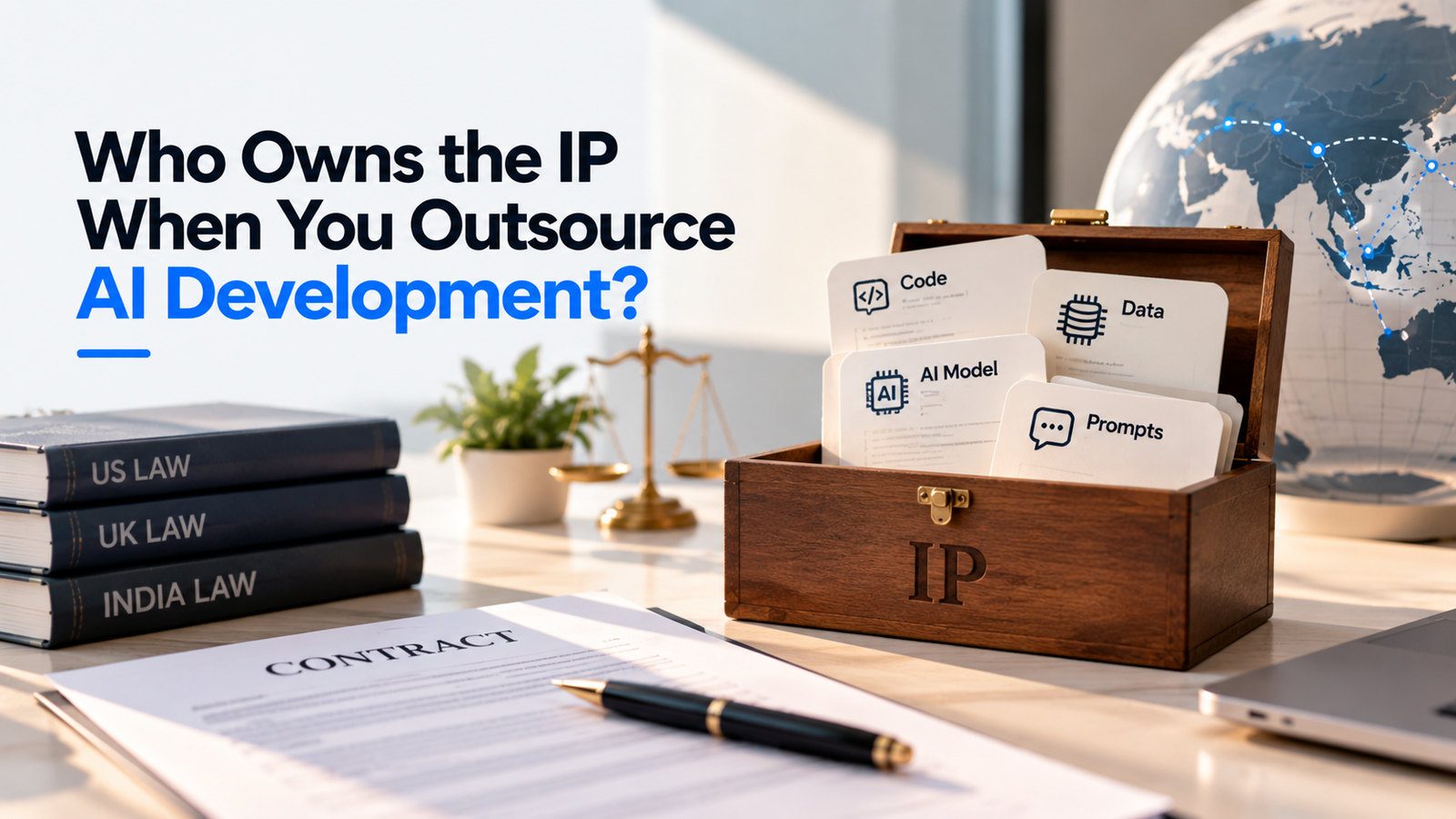
Yes, but the contract does the work, not the country. Under Section 17(c) of India's Copyright Act 1957, an employer is the first owner of work its employees create in the course of employment, "in the absence of any agreement to the contrary" (Indian Kanoon). So the vendor owns what its staff write until it assigns that ownership to you. Your contract needs a present-tense assignment of all deliverables, a matching chain from any contractor the vendor uses, and a dispute clause (usually arbitration) whose award you can enforce against the vendor.
The details, including the assignment formalities in Section 19 that catch many buyers out, are covered in who owns the IP when you outsource AI development. The short version: ownership of offshore AI work is enforceable when the paperwork is right, and fragile when it is a one-line clause in an MSA.
Is there enough AI talent to hire AI engineers in India?
The pool is large. The Ministry of Electronics and IT told Parliament in December 2025 that India leads the world in AI talent acquisition with an annual hiring rate of about 33%, and that Indian developers contributed 19.9% of GitHub AI projects in 2024, the second-largest share of any country (PIB, Dec 2025). Depth is not the same as availability for your project, though. Senior engineers who have shipped LLM systems to production are a fraction of that pool and move quickly between employers. When you hire AI engineers in India through a vendor, the question is not "does the country have talent" but "which named people will work on my system, and what have they shipped?"
What are the real risks, and how do you control them?
These four show up far more often than a legal failure does. Each has a control you can check.
| Real risk | What it looks like | Control to require | How to verify |
|---|---|---|---|
| Attrition | Your lead engineer leaves in month four, taking context with them | Named team in the SOW, notice and handover clauses, documented architecture decisions | Ask for tenure of the proposed team; review a sample handover doc |
| Subcontracting | The vendor quietly staffs your work with freelancers or a second firm | No subcontracting without written consent; IP and confidentiality flow down | Contract clause plus a right to see who has access |
| Access sprawl | Former team members keep repo, cloud or LLM console access | Access through your SSO only, quarterly access review, same-day offboarding | Pull your own access logs; compare against the current roster |
| Time zone drift | Decisions wait a day; the vendor builds the wrong thing overnight | Fixed daily overlap window, written async updates, one accountable lead | Check the proposed calendar before kickoff |
India Standard Time is UTC+5:30 with no daylight saving, so overlap with US time zones means someone shifts their day. That is solvable, but only if it is agreed up front. How a pod should actually run its day with US overlap is covered in a separate post.
The minimum bar before you sign
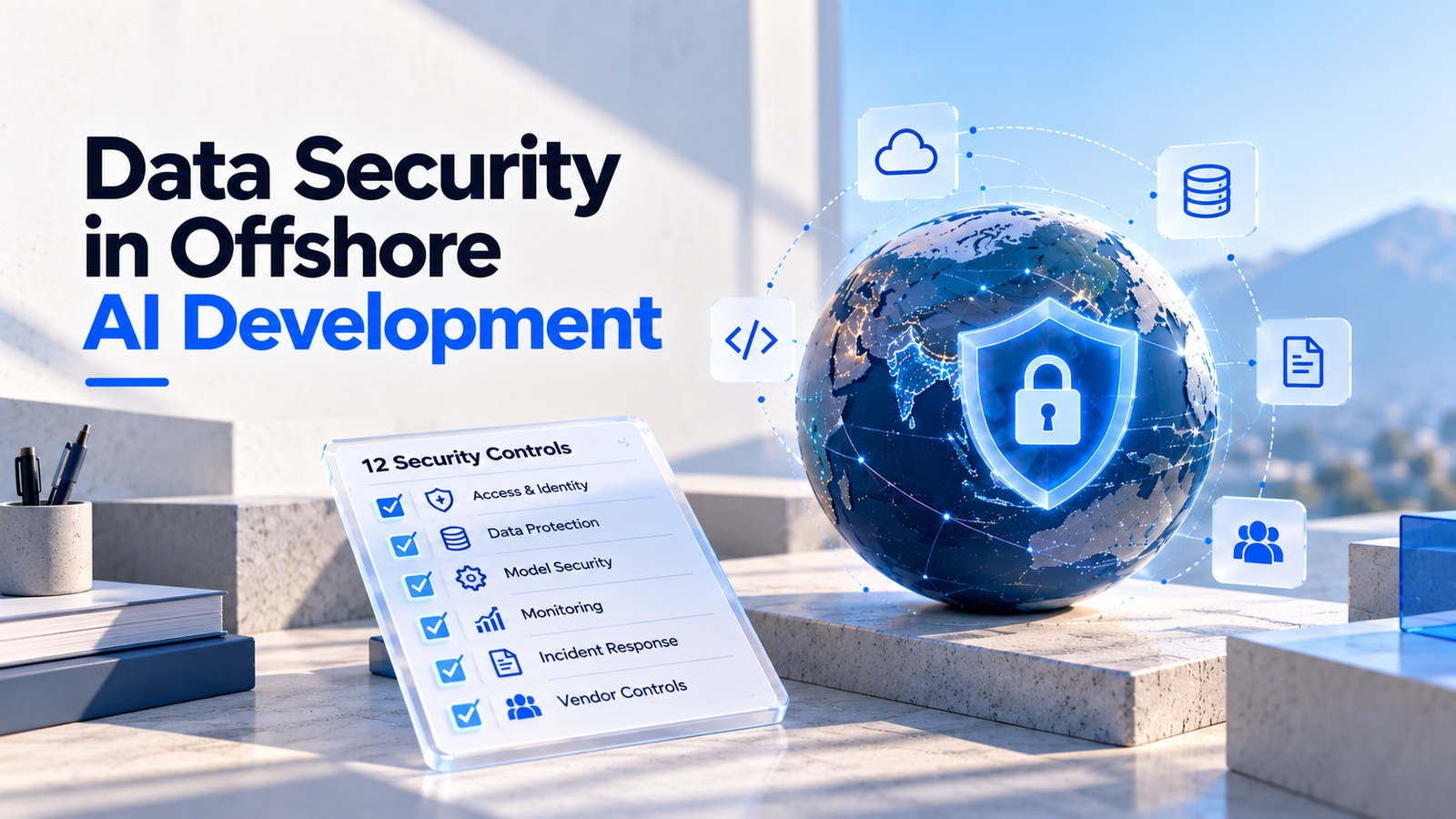
These five controls separate a safe engagement from a hopeful one. Our guide to data security in offshore AI development expands them into twelve controls you can put in writing.
- Data and model accounts stay in your cloud, under your billing.
- Access runs through your identity provider, per named engineer, with MFA.
- IP is assigned to you in present tense, with a flow-down to any contractor.
- The vendor notifies you of any incident on a defined clock, not "promptly."
- You can audit access, logs and subcontractors on request.
What should you ask an Indian AI vendor before signing?
Ask these, and treat vague answers as the answer:
- Which named engineers will work on our system, and how long have they been with you?
- Will any part of the work be subcontracted? To whom?
- Can your team work entirely inside our cloud and identity provider? If not, what data would sit on your systems?
- Show us your current security certifications and their scope. Does the scope cover the team we would get?
- What is your incident notification commitment to us, in hours?
- How do you offboard an engineer, and how quickly is access removed?
- Show us your standard IP assignment clause and your employee and contractor agreements.
- Where is the arbitration seat, and has an award from it been enforced in India?
For a longer list covering delivery and commercial terms, see the 25 questions to ask an AI development company, and for a structured way to compare vendors, our ten-point framework on how to choose an AI development partner.
How Fwdpod approaches this
Fwdpod builds dedicated AI engineering pods for enterprise buyers in the US, UK, EU and Gulf, with engineering delivery from India. The controls above are how we think an offshore AI engagement should be run. How access, IP and incident terms would be set up for your engagement is something the team can walk you through on a first call, and we would encourage you to check our answers against the controls in this article.
If you are weighing an Indian AI team and want to pressure-test the controls against your own compliance requirements, talk to us about how a pod would be set up for your environment, or configure your AI engineering pod to get a custom proposal within 48 hours. Still deciding on the delivery model itself? See agency vs freelancer vs AI pod, and browse more Security, Compliance & Offshore Delivery guides.
Frequently Asked Questions
1. Is India on the US list of countries of concern for sensitive data transfers?
No. The US Department of Justice rule at 28 CFR 202.601 names China, Cuba, Iran, North Korea, Russia and Venezuela. India is not included, although your own sector rules and customer contracts may still restrict offshore access.
2. Does India's DPDP Act apply to my US or EU customers' data if an Indian vendor processes it?
Mostly not. Section 17(1)(d) exempts most of the Act when an India-based entity processes data of people outside India under a contract with a foreign party, but the vendor must still keep reasonable security safeguards. Your home-country law continues to apply to that data.
3. Is an ISO 27001 certified Indian vendor automatically safe?
No. ISO 27001 shows the vendor runs an information security management system, and India's 2011 SPDI Rules treated it as meeting the reasonable-security standard. It does not prove the certified scope covers the team working on your project, so ask for the certificate scope and the statement of applicability.
4. Can Indian authorities access data my vendor holds?
Indian law, including CERT-In's 2022 directions, lets authorities require information and logs from entities operating in India. The practical answer is to minimize what the vendor holds: if your data, keys and logs live in your own cloud outside India, there is far less on the vendor's side to request.
5. Is outsourcing AI to India riskier than hiring remote freelancers?
Usually less risky, if you contract with a registered company. A company can be bound by IP assignment, confidentiality and audit clauses, carries its own obligations under Indian law, and can replace people. Individual freelancers spread across jurisdictions are harder to audit and to enforce against.
6. Should we start with a pilot before a full offshore AI engagement?
A short, scoped pilot is a sensible way to test a vendor's security practices, communication and code quality before committing. Run it under the same contract terms and access controls you would use for the full engagement, so you are testing the real setup.