AI POC to Production: The Gap Nobody Budgets For
Move AI POCs to production with stage-gate checklists, exit criteria, LLMOps monitoring, evaluation regression tests, security reviews, and handover plans.
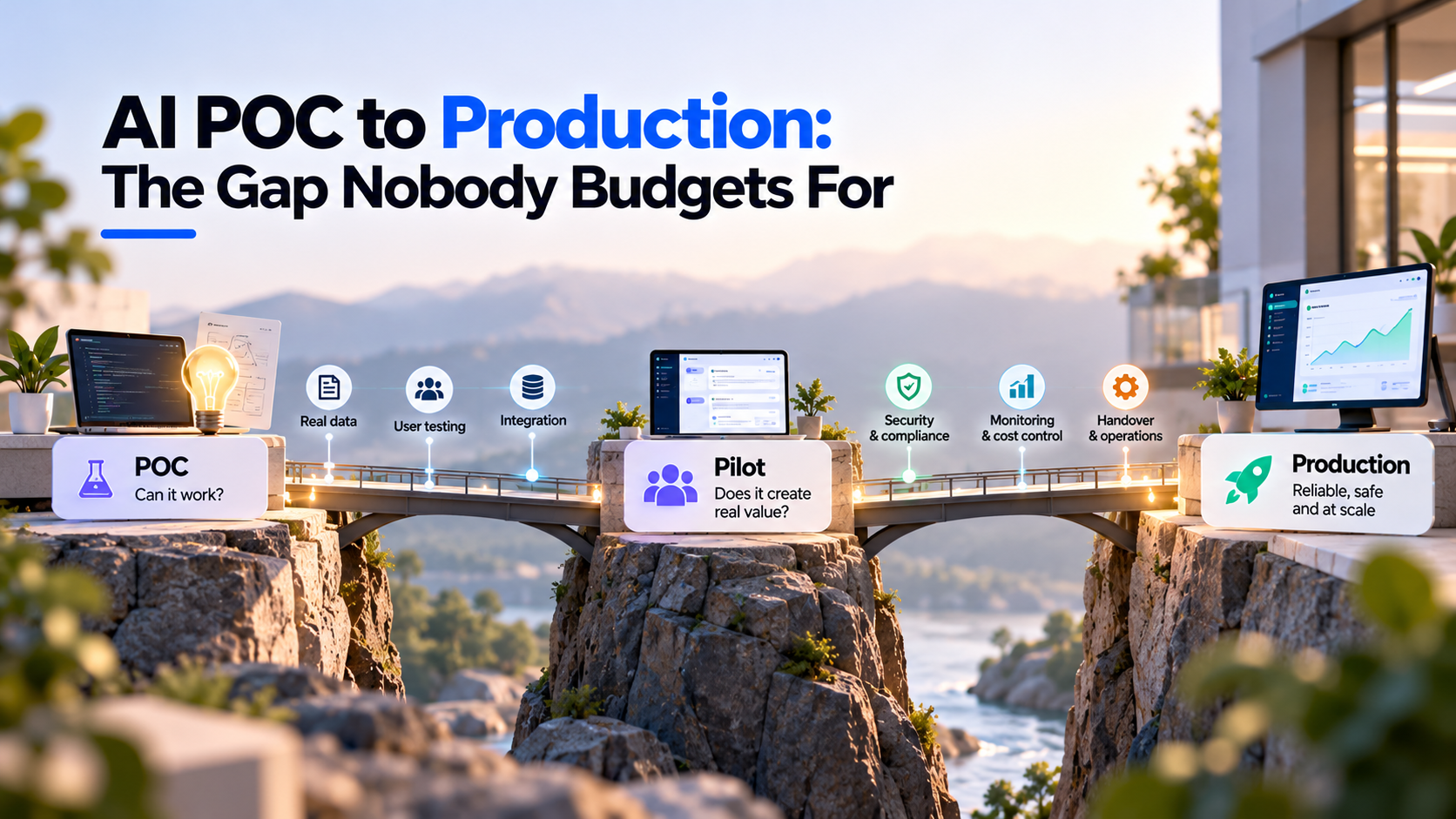
Moving an AI POC to production means passing three gates: a proof of concept that shows the task is feasible on real data, a pilot that shows real users get value under real conditions, and a production release backed by evals, monitoring, a security review, cost and latency budgets, and a named owner. Most teams budget for the first gate only.
This guide, part of our AI strategy: pilot to production series, lays out each stage, the exit criteria for every gate as a checklist you can copy, and the engineering work (evals, LLMOps, security, handover) that fills the space between a good demo and a system people depend on.
Why is the gap between POC and production so large?
A proof of concept answers one narrow question: can a model do this task at all? It usually runs on a curated sample, with one engineer watching every output, no integration with live systems and no users who can be harmed by a bad answer. Production asks a different set of questions: will it keep working on messy inputs, at volume, for months, when nobody is watching, and can you prove that to a security reviewer?
This is not a new observation. Google's 2015 paper Hidden Technical Debt in Machine Learning Systems (Sculley et al., NeurIPS) argued that quick ML wins carry "massive ongoing maintenance costs," naming risks such as entanglement, hidden feedback loops, undeclared consumers and data dependencies. Google Cloud's MLOps architecture guide makes the same point visually: "only a small fraction of a real-world ML system is composed of the ML code." The rest is configuration, data verification, testing, serving infrastructure and monitoring.
LLM applications inherit all of that and add their own surface: prompts that behave like code, retrieval pipelines, tool calls and non-deterministic outputs. The outcome shows up in forecasts such as Gartner's July 2024 prediction that at least 30% of generative AI projects would be abandoned after proof of concept by the end of 2025. The failure modes behind that number are covered in our companion piece on why AI pilots fail. This post is about the process that gets you through.
What is the difference between a POC, a pilot and production?
Treat these as three stages with different questions, not three sizes of the same project. Each needs its own success measure, and each ends in a gate where someone with authority decides to proceed, change course or stop.
| Proof of concept (POC) | Pilot | Production | |
|---|---|---|---|
| Question it answers | Can a model do this task on our data? | Do real users get value in their real workflow? | Can we run this reliably, safely and affordably at scale? |
| Users | The build team | A small, named group of real users | Everyone in scope |
| Data | A representative sample, often cleaned | Live or near-live data, access-controlled | Live data, full access controls and retention rules |
| Integration | Standalone notebook or prototype | Connected to one or two real systems | Connected to all required systems, with fallbacks |
| Quality measure | Offline eval score against a labeled set | Offline evals plus user outcomes and feedback | Continuous online and offline evals with alerts |
| Human oversight | Every output reviewed | Sampled review, easy escalation | Defined review rules, audit trail, incident process |
| Typical sign-off | Product sponsor and tech lead | Business owner, security, data owner | Business owner, security, compliance, operations |
If your organization skips the pilot, the production launch becomes the pilot, with every user as a test subject. That is the most expensive place to discover that the model struggles with a document type nobody sampled.
What are the exit criteria for each gate?
The checklist below is the core of the process. Gate 1 is the exit from POC into pilot, Gate 2 is go-live into production, and Gate 3 is the end of the post-launch hypercare period, when the build team hands over to steady-state owners. Write the criteria down before the POC starts, so nobody moves the goalposts once a demo impresses a sponsor.
| Area | Gate 1: POC → Pilot | Gate 2: Pilot → Production | Gate 3: Hypercare → Steady state |
|---|---|---|---|
| Business value | Target metric and baseline agreed in writing | Pilot users show measurable improvement against baseline | Value tracked on a dashboard the business owner reads |
| Evals | Labeled test set built from real data, including edge cases; quality bar agreed | Regression suite runs automatically on every prompt, model or retrieval change | Online evals on sampled live traffic; test set refreshed with production failures |
| Data | Data owner approves use; sensitive fields identified | Access controls, retention and deletion rules implemented | Data lineage documented; drift checks running |
| Security | Threat model drafted (prompt injection, data leakage, tool misuse) | Security review passed; red-team findings fixed or accepted with an owner | Findings closed; periodic re-test scheduled |
| Compliance and risk | Use case risk-classified; obvious blockers ruled out | Required approvals recorded; human-oversight rules defined | Audit trail verified; model and prompt versions traceable |
| Cost and latency | Rough per-task cost and response time observed | Budgets set per task; limits and alerts configured | Spend and latency within budget for a full cycle |
| Operations | None required | Tracing, logging, alerting and a rollback path in place | Runbooks tested; on-call rota and escalation agreed |
| People | Sponsor and pilot users named | Users trained; feedback channel live; support model agreed | Named product owner; knowledge transfer signed off |
A gate is a decision, not a formality. "Proceed with conditions" is a legitimate outcome, but each condition needs an owner and a date. A pilot that fails Gate 2 is not wasted money if it tells you clearly why.
How do you build evals and regression tests that survive to production?
Evals are the part of a POC most worth keeping. A labeled test set drawn from real inputs is what lets you change a prompt, swap a model or re-chunk documents and know whether you made things better or worse.
Anthropic's guidance on building evaluations gives three principles that hold up across vendors: make evals task-specific and include edge cases, automate grading where possible, and favor more test cases with slightly noisier automated grading over a handful of perfect hand-graded ones. It describes three grading methods (code-based, LLM-based and human), noting that LLM graders should be tested for reliability before you scale them.
In practice, a production-grade eval setup usually includes:
- A golden set of real inputs with expected outputs or grading rubrics, covering common cases, known hard cases and inputs the system should refuse.
- Regression runs in CI. Every change to a prompt, model version, retrieval setting or tool definition triggers the suite, and a drop below the agreed bar blocks the release, exactly as a failing unit test would.
- Pinned model versions. Hosted models change. Pin versions where the provider allows it, and treat a model upgrade as a release that goes through the same suite.
- Online evals. Sample live traffic, grade it with the same rubrics, and feed failures back into the golden set, so the test set grows toward what users actually send.
- Component tests. For RAG and agents, test retrieval quality and individual tool calls separately from end-to-end answers, so you can locate a regression instead of guessing.
Google's ML Test Score rubric (Breck et al., IEEE Big Data 2017) predates LLMs, but its framing still works as a readiness check: it sets out 28 specific tests and monitoring needs across data, model, infrastructure and monitoring. Scoring your system against it is a quick way to find gaps a POC never needed to cover. For agent-specific evals and guardrails, see the guide on how to build a production AI agent.
What should LLMOps monitoring cover?
Traditional MLOps monitoring watches model accuracy and data drift. LLMOps adds the things that make generative systems unpredictable: free-text inputs, long prompts, retrieval, multi-step tool use and per-token costs. Google's MLOps guide describes monitoring as collecting "statistics on the model performance based on live data" to decide when to intervene. For an LLM system, that means at least five signal types:
- Traces. A record of each request: the prompt version, retrieved context, model and version, tool calls, output and latency. Without traces, debugging a bad answer turns into guesswork.
- Quality signals. Online eval scores, user feedback (thumbs, edits, escalations) and the rate of refusals or fallbacks.
- Input drift. Changes in what users ask, new document types or new languages that your test set does not cover.
- Cost and latency. Tokens, calls per task and response times, broken down by feature and customer segment.
- Safety events. Suspected prompt injection, blocked outputs, sensitive data detected in prompts or responses, and unusual tool activity. For agents, these signals map to the failure modes in why AI agents fail in production.
Alerts should route to a person, and each alert type should map to a runbook entry. The NIST AI Risk Management Framework (AI RMF 1.0, released January 2023, voluntary) spells out the goal in its Manage function: post-deployment monitoring plans that include "mechanisms for capturing and evaluating input from users," along with "appeal and override, decommissioning, incident response, recovery, and change management." That list doubles as a checklist for your operations design.
What should the security and compliance review check?
Book the security review during the pilot, not the week before launch. Reviewers need time, and their findings often change architecture: where data is stored, which model endpoint is used, or how much authority an agent gets.
The OWASP Top 10 for LLM Applications 2025 is a practical agenda for the technical side. The items that most often block a go-live are:
- Prompt injection (LLM01) and excessive agency (LLM06): can crafted input make the system take actions or reveal data it should not?
- Sensitive information disclosure (LLM02) and system prompt leakage (LLM07): what can leak through outputs, logs or error messages?
- Improper output handling (LLM05): is model output validated before it reaches a database, a browser or another system?
- Vector and embedding weaknesses (LLM08): does retrieval respect the same access controls as the source documents?
- Unbounded consumption (LLM10): can a user or a loop run up cost or exhaust capacity?
On the governance side, the NIST AI RMF organizes the work into four functions (Govern, Map, Measure, Manage), and NIST's Generative AI Profile (NIST AI 600-1), released in July 2024, maps them to generative-AI-specific risks. NIST also notes that AI RMF 1.0 is being revised, so check the current version before you anchor a policy to it. Neither document is a certification, but both give security, risk and legal teams a shared vocabulary for the review.
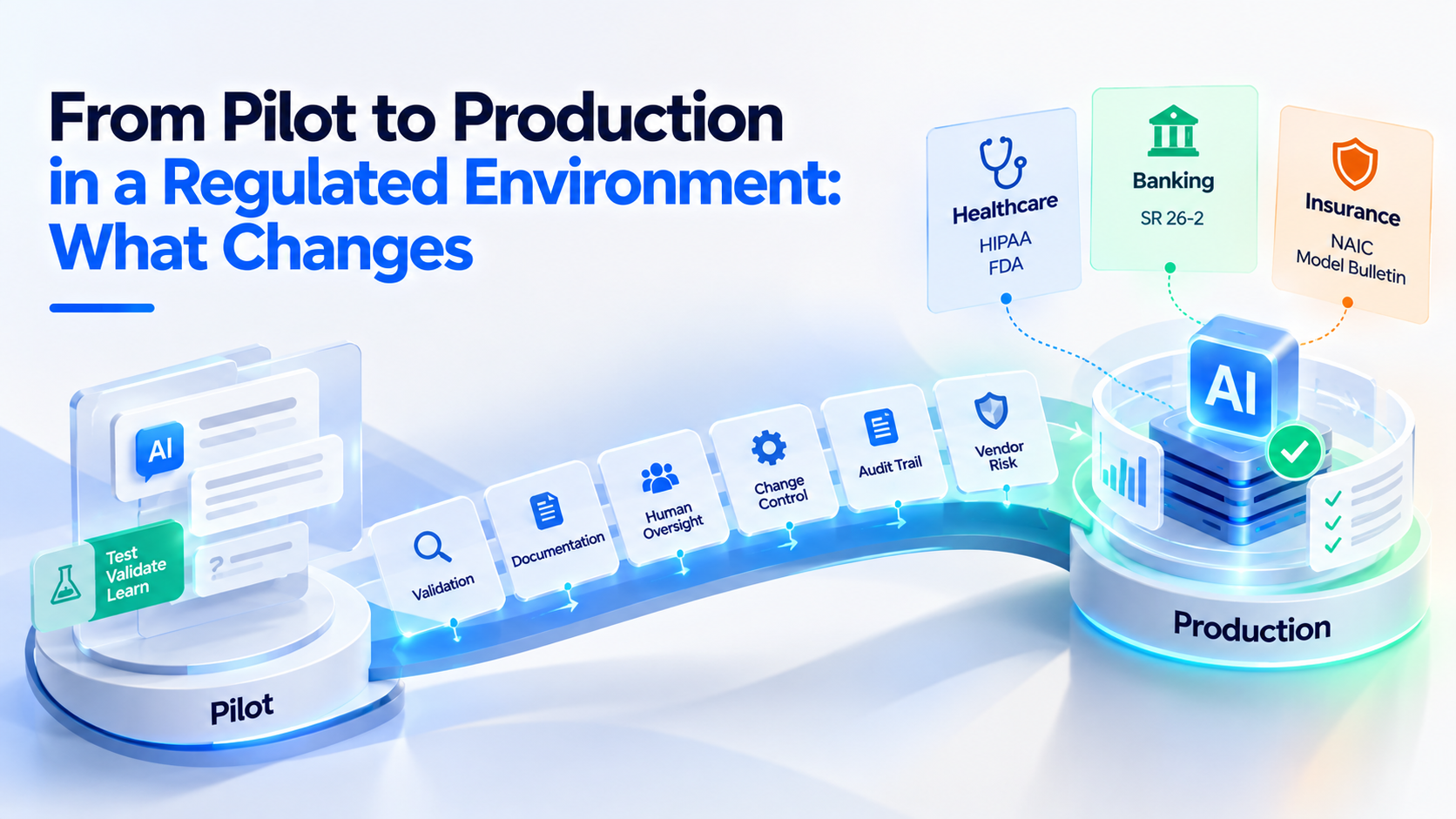
If you work in healthcare, financial services or another regulated sector, the approvals and documentation grow considerably; the dedicated guide on regulated AI pilot to production covers what changes. For data handling with an external or offshore team, see the 12 data security controls for offshore AI development, and for traceability, the post on LLM audit trail architecture. This is general guidance, not legal advice; involve your counsel and compliance team for your specific obligations.
How should you set cost and latency budgets?
Set budgets per task, not per month. "Each support ticket summary should cost under an agreed amount and return within an agreed time for 95% of requests" is testable in a pilot; "keep the AI bill reasonable" is not.
A few practices keep budgets honest without inventing numbers up front:
- Measure in the pilot, then commit. POC costs are misleading because volumes are tiny and inputs are clean. Use pilot traffic to set the production budget.
- Budget the whole path. Retrieval, re-ranking, retries, guardrail checks and tool calls all add latency and cost on top of the main model call.
- Set hard limits. Cap tokens per request, steps per agent run and spend per user or tenant. This is also the fix for OWASP's unbounded consumption risk.
- Route by difficulty. Many systems send easy requests to a smaller, cheaper model and reserve the larger one for hard cases, but only adopt routing if your evals show quality holds.
- Cache what repeats. Stable instructions and frequently retrieved context are candidates for caching where your provider supports it.
- Review at Gate 3. A full cycle of real traffic is the first honest test of your budget.
Architecture choices such as fine-tuning versus retrieval also shape cost and latency; the post on when to fine-tune vs RAG walks through that trade-off. For how fwdpod prices its own engagements, contact the team.
How do you handle change management and handover?
Technically sound systems still fail when nobody changes how work gets done. Change management and handover are the two halves of making the system someone's responsibility.
For the people using it:
- Redesign the workflow, not just the screen. Decide which steps the AI does, which a human checks, and what happens when the two disagree.
- Train pilot users first and turn them into internal champions for the wider rollout.
- Give users a one-click way to flag bad outputs, and show them that flags lead to fixes.
- Tell users plainly what the system can and cannot do, and when they must verify its output.
For the people running it:
- Name a product owner who is accountable for quality and value after the build team steps back.
- Hand over runbooks for the common alerts, rollback steps, and the process for updating prompts, models and the golden set.
- Document the architecture, data flows, model and prompt versions, and every accepted risk from the security review.
- Run a supervised period where the receiving team handles incidents with the build team on call, and sign off only when they have done it without help.
If you are inheriting a system that skipped these steps, the AI codebase audit guide explains what to check first.
How fwdpod approaches POC to production
Fwdpod builds dedicated AI engineering pods for startups and enterprises, covering LLM development, RAG systems, AI agents and product delivery, as a forward deployed engineering and AI pod delivery service for buyers in the US, UK, EU and Gulf with engineering delivery from India. Our view is that the gates, evals and handover plan should be agreed before the first line of POC code, so the POC produces assets that carry forward rather than a demo you rebuild later. Pods are typically 4–6 experts working around a single measurable outcome, and how gates and handover would be structured for your system is something the team can walk you through on a first call.
If you have a POC that works and no clear path past Gate 1, configure your AI engineering pod and we will scope the pilot and the production plan together.
Frequently Asked Questions
1. How long does it take to move an AI POC to production?
It depends on integration depth, data readiness and how many approvals the use case needs. The security and compliance review is often the longest single item, so start it during the pilot. Be wary of any estimate given before the Gate 1 exit criteria are written down.
2. Can we skip the pilot and go straight from POC to production?
You can, but then your launch becomes the pilot, with all users exposed to problems a small group would have caught. A short, tightly scoped pilot with named users is usually cheaper than a rollback, a support backlog or a security incident.
3. Who should own the go/no-go decision at each gate?
A business owner accountable for the outcome should chair it, with written input from the tech lead, security, the data owner and, for Gate 2 onward, operations and compliance. The decision and any conditions should be recorded with owners and dates.
4. What is the difference between MLOps and LLMOps?
MLOps covers the pipelines, testing and monitoring that keep trained models reliable in production. LLMOps applies the same discipline to LLM applications and adds prompt and model version control, evals for free-text outputs, retrieval quality, token cost tracking and safety monitoring for issues such as prompt injection.
5. How big should the eval set be before the pilot?
Big enough to cover the common cases, the known hard cases and the inputs the system should refuse, drawn from real data rather than invented examples. Anthropic's eval guidance favors more automated test cases over a few hand-graded ones. Grow the set continuously with failures found in the pilot and in production.
6. What happens to a POC that fails its gate?
Record why it failed: data quality, accuracy, cost, risk or lack of user value. Some failures point to a fixable gap, such as missing data access, and justify a second attempt with changed conditions. Others show the use case is not worth pursuing, and stopping early is the cheapest outcome.
7. Do we need to comply with the NIST AI RMF to go to production?
The NIST AI RMF is voluntary, so it is not itself a legal requirement. Many organizations use it, along with the Generative AI Profile, to structure risk reviews because it gives technical, risk and legal teams a common vocabulary. Your actual obligations depend on your sector and jurisdiction, so confirm them with counsel.