Why AI Pilots Fail: Six Root Causes and What to Do Instead
Discover why AI pilots fail, explore 6 root causes identified by MIT, Gartner and RAND, and learn how to move AI projects from pilot to production.
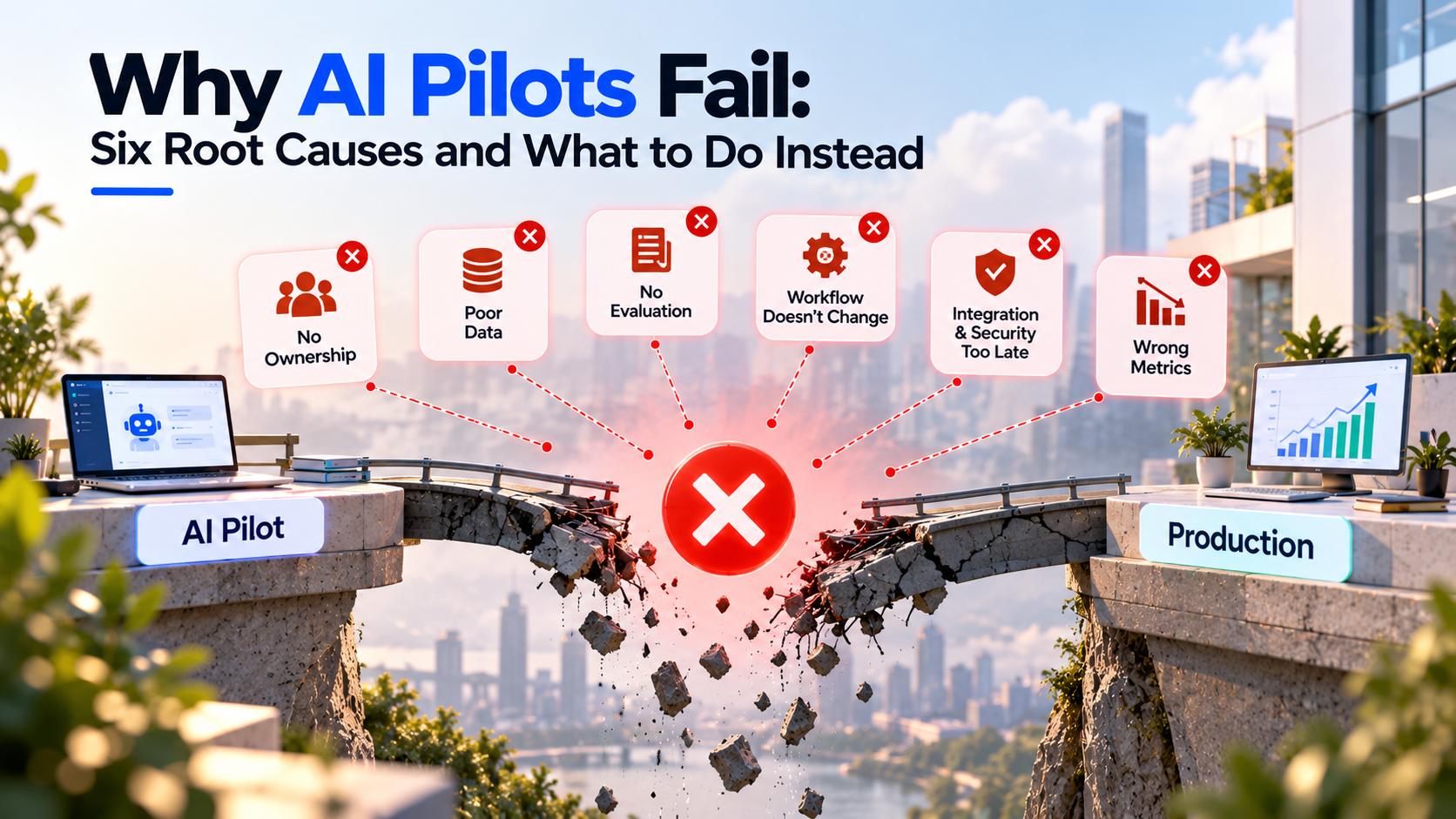
AI pilots fail mostly for organizational reasons, not model reasons. The pattern behind why AI pilots fail is consistent: nobody owns the business outcome, there is no evaluation baseline, the data is not production-ready, the workflow around the model never changes, integration and security arrive too late, and the pilot is judged on the wrong metric.
The research agrees on the direction, if not the exact number. MIT's NANDA initiative found that just 5% of task-specific enterprise GenAI tools reached production in its 2025 sample. IDC found that only 4 of every 33 AI proofs of concept graduated to production. RAND interviewed 65 practitioners and traced failure mostly to leadership, data and infrastructure, not to algorithms.
This post, part of our AI strategy: pilot to production series, explains what those studies measured, then walks through the six root causes and the fix for each. The step-by-step path from proof of concept to production lives in our companion guide on AI POC to production, and agent-specific failure modes are covered in why AI agents fail in production.
Key takeaways
- The most-quoted failure rates (95%, 88%, 80%, 46%, 42%, 30%) measure different things. Quote them with their definitions or not at all.
- Every major study points at the same short list of causes, and almost none of them are "the model was not smart enough."
- Five of the six root causes can be fixed before a single line of code is written.
- A pilot designed to be demonstrated and a pilot designed to be deployed are different projects. Most organizations fund the first and expect the second.
What percentage of AI projects fail, and what did each study actually measure?
There is no single, authoritative percentage of AI projects that fail. There are several well-sourced numbers, each measuring a different event: no P&L impact, abandonment after proof of concept, failure to reach wide deployment, or a practitioner estimate. Here is what each one says.
| Source | Headline number | What it actually measured | Sample and date |
|---|---|---|---|
| MIT NANDA, The GenAI Divide: State of AI in Business 2025 | 95% of organizations "getting zero return"; 5% of task-specific tools reached production | Organizations with no measurable P&L impact from GenAI. For embedded or task-specific tools, 60% of organizations evaluated them, 20% reached pilot and 5% reached production | Review of 300+ public AI initiatives, interviews with 52 organizations, survey of 153 senior leaders; January to June 2025 |
| IDC with Lenovo, reported by CIO | 88% | For every 33 AI POCs a company launched, only 4 reached widescale deployment | Published March 2025 |
| RAND Corporation | "More than 80 percent" | Not RAND's own measurement. RAND cites it as an existing estimate ("by some estimates"), twice the failure rate of non-AI IT projects | Report based on interviews with 65 AI practitioners; August 2024 |
| S&P Global Market Intelligence, reported by CIO Dive | 42% and 46% | 42% of companies abandoned most of their AI initiatives in 2025, up from 17% in 2024. The average organization scrapped 46% of AI POCs before production | 1,000+ respondents in North America and Europe; March 2025 |
| Gartner | At least 30% | A prediction that at least 30% of GenAI projects would be abandoned after proof of concept by the end of 2025 | Press release, July 2024 |
| Gartner | 60% | A prediction that through 2026, organizations will abandon 60% of AI projects unsupported by AI-ready data | Press release, February 2025, citing Gartner surveys of data management leaders (1,203 in July 2024; 248 in Q3 2024) |
Two cautions before you put any of these in a board deck.
First, the MIT report describes its own findings as "directionally accurate" and based on individual interviews rather than official company reporting. Its 95% figure is about measurable P&L impact, not about whether software shipped. It is a useful signal, not a census.
Second, the RAND "80%" is widely repeated as a RAND finding. It is not. RAND's contribution is the why, drawn from practitioners with at least five years of AI/ML experience, and that is the more useful part.
What the numbers share is the shape of the funnel. Lots of organizations evaluate. Fewer pilot. Very few reach production with a measurable result. The drop happens between "the demo worked" and "the business changed."
What do the major studies agree causes AI pilot failure?
When you line up the stated causes side by side, they collapse into a short list.
- RAND (five root causes): leaders misunderstand or miscommunicate the problem; not enough high-quality data; teams chasing technology over the business problem; underinvestment in data and deployment infrastructure; and problems beyond what AI can currently do.
- Gartner (post-POC abandonment): poor data quality, inadequate risk controls, escalating costs and unclear business value.
- IDC: unclear ROI, data that is not AI-ready, missing in-house expertise, low organizational readiness and underfunded POCs. IDC's Ashish Nadkarni called many initiatives "panic-driven."
- MIT NANDA: "brittle workflows, lack of contextual learning, and misalignment with day-to-day operations."
- McKinsey (March 2025 State of AI): "the redesign of workflows has the biggest effect on an organization's ability to see EBIT impact from its use of gen AI" (McKinsey, 2025).
Grouped by what you can act on, those findings give six root causes.
| Root cause | Where the research points | When it bites |
|---|---|---|
| 1. No owner of the outcome | RAND (leadership), McKinsey (CEO oversight of governance), IDC (panic-driven starts) | Week one, invisibly |
| 2. No evaluation baseline | Gartner (unclear value), IDC (unclear ROI) | At the go/no-go meeting |
| 3. Data not ready | RAND, Gartner (twice), IDC | Mid-pilot, when real data arrives |
| 4. Workflow not redesigned | MIT NANDA, McKinsey | After launch, when usage flatlines |
| 5. Integration and security late | Gartner (risk controls), RAND (infrastructure) | At the production gate |
| 6. Wrong success metric | Gartner (value, cost), MIT (P&L vs. activity) | At the budget review |
Root cause 1: Why does a pilot with no outcome owner fail?
A pilot without a named business owner fails because nobody has the authority, or the incentive, to change how work gets done once the model works.
What it looks like. The pilot is sponsored by an innovation team, a CIO office or a "center of excellence." The operations leader whose team would use the system attends the kickoff and then sends a delegate. When the pilot ends, the question "who will run this?" produces silence.
Why it kills the pilot. RAND's most common root cause was leadership: leaders misunderstanding the problem, or failing to communicate it clearly to the technical team. When the owner is a technology function, the team optimizes the thing it controls, which is the model. The thing it does not control, the workflow and the people in it, stays the same. MIT's finding that successful deployments empowered line managers, rather than only central AI labs, points the same way (Fortune coverage of the MIT report).
What it costs. Mostly credibility. A pilot that "worked but went nowhere" makes the next AI proposal harder to fund, even when the next idea is better.
Do this instead.
- Name one business owner (a person, not a committee) who will own the production metric and the process change. Their name goes on the pilot charter.
- Give them a veto on scope. If they would not change their team's work based on the result, do not start.
- Keep the technical lead accountable for delivery, and the business owner accountable for adoption. Write both down. (Our guide to AI team structure and roles covers how those responsibilities split in a larger program.)
Root cause 2: What happens when there is no evaluation baseline?
Without a baseline, you cannot tell whether the pilot improved anything, so the go/no-go decision becomes a matter of opinion and demo quality.
What it looks like. The team measures the AI system but not the current process. "The model answers 82% of questions correctly" sounds good until someone asks what the human team scores today, how long it takes them, and what an error costs.
Why it kills the pilot. Gartner lists unclear business value among the top reasons GenAI projects are abandoned after proof of concept. Unclear value is often unmeasured value. LLM output also varies by input, so a handful of hand-picked demos proves very little. Anthropic's guidance for building on its models puts it plainly: "Building a successful LLM-based application starts with clearly defining your success criteria and then designing evaluations to measure performance against them" (Anthropic documentation). The same guidance says success criteria should be specific, measurable, achievable and relevant.
Do this instead.
- Measure today's process first: accuracy, time per task, cost per task, error rate and the cost of an error.
- Build an evaluation set from real, messy cases, including the edge cases your experts dread, before building the system. A few hundred graded examples beat a dozen curated demos.
- Agree the pass threshold in writing before kickoff. "Beats the current process on X at no worse than Y" is a decision rule; "looks promising" is not.
Root cause 3: Why does unready data sink so many pilots?
Data sinks pilots because the pilot runs on a clean extract, and production runs on the real thing: incomplete, inconsistent, permissioned and changing.
What it looks like. The pilot uses a spreadsheet someone prepared, or a document folder copied to a sandbox. It works. Then the team tries to connect to the live source and discovers missing fields, conflicting versions, access rules nobody documented, and a data owner who was never asked.
Why it kills the pilot. Data is the most cited cause across the research. RAND lists insufficient high-quality data as a root cause. Gartner names poor data quality as a reason for post-POC abandonment, and separately predicts that through 2026 organizations will abandon 60% of AI projects unsupported by AI-ready data. In a separate Gartner survey of 248 data management leaders (Q3 2024), 63% of organizations either lacked, or were unsure whether they had, the right data management practices for AI.
Do this instead.
- Pilot on the production data source, or a faithful, permissioned copy of it, from day one. If that takes three weeks to arrange, those three weeks are part of the pilot, not a delay to it.
- Name the data owner and get their sign-off on access, classification and retention before kickoff.
- Budget time for data work explicitly. For a retrieval system, that means document cleanup, chunking and access control mapping; for a prediction task, labeling and history. Our guide on when to fine-tune, use RAG or do neither covers how the data shape changes the build.
Root cause 4: Why doesn't a working model change the business?
Because the business is a workflow, not a model. If the steps, handoffs, approvals and incentives around the AI system stay the same, the system becomes an optional extra tab that people stop opening.
What it looks like. Adoption spikes in week one and decays. Users copy output into the old system by hand. Managers still review everything the old way, so no time is saved. Meanwhile, according to MIT, workers at over 90% of the companies it surveyed reported regularly using personal AI tools for work, while only 40% of companies said they had bought an official LLM subscription. People will use AI that fits how they work; they route around AI that does not.
Why it kills the pilot. McKinsey found workflow redesign had the biggest effect on whether organizations saw EBIT impact from gen AI, while only 21% of respondents whose organizations use gen AI said they had fundamentally redesigned at least some workflows. MIT's explanation for failed enterprise tools is similar: brittle workflows and misalignment with day-to-day operations.
Do this instead.
- Map the current workflow step by step and mark exactly which steps the system removes, shortens or changes. If you cannot point to a removed step, you do not have a business case yet.
- Put the output where the work already happens (the CRM, the ticketing tool, the claims system), not in a new interface.
- Redesign the review step. Decide what the human checks, what they no longer check, and how disagreements with the system are captured as feedback.
Root cause 5: What goes wrong when integration and security come last?
A pilot built outside your identity, logging, data protection and deployment standards has to be substantially rebuilt to pass the production gate, and many are cancelled at that point instead.
What it looks like. The pilot runs on a developer's cloud account with a shared API key. There is no single sign-on, no audit log, no data processing agreement with the model provider, and no threat model for prompt injection. Security review starts after the steering committee says yes, and takes a quarter.
Why it kills the pilot. Gartner names inadequate risk controls as a reason for abandonment, and RAND names underinvestment in data and deployment infrastructure. The pilot looked cheap because it skipped the expensive parts. Those parts did not go away; they moved to the moment when enthusiasm is highest and patience is lowest.
Do this instead.
- Bring security, legal and platform engineering to the kickoff, not the sign-off. Agree the minimum controls the pilot must run under.
- Build on the target environment: your cloud tenancy, your identity provider, your logging. Treat it as the first iteration of production, not a disposable prototype.
- Decide early which data classes the model may see and which providers or hosting regions are acceptable. For a deeper list, see our guide to data security in offshore AI development; for regulated sectors, our post on pilot to production in a regulated environment.
Root cause 6: How does the wrong success metric doom a pilot that works?
Pilots are often judged on activity (queries answered, users onboarded, accuracy on a demo set) when the budget holder cares about cost, revenue, risk or cycle time. A pilot can hit every activity target and still lose its funding.
What it looks like. The final readout celebrates usage numbers. The CFO asks what it saved and gets an estimate built on assumptions. Gartner's Rita Sallam made the point directly when announcing the 30% prediction: "costs aren't as predictable as other technologies," and GenAI often requires tolerance for indirect, future financial benefits that many finance leaders resist.
Why it kills the pilot. MIT's 95% figure is itself a statement about the metric: it counts organizations without measurable P&L impact, not organizations without working software. The report also found that roughly half of GenAI budgets went to sales and marketing, while some of the clearest returns came from back-office automation such as reduced outsourcing and agency spend. Teams chose visible use cases over measurable ones.
Do this instead.
- Pick one business metric the budget holder already tracks (cost per case, handling time, days to close, error-driven rework) and tie the pilot to it.
- Include run costs in the metric: model usage, hosting, human review time and maintenance. A pilot that saves ten hours but needs twelve hours of review is a loss.
- Prefer use cases where the before-and-after is countable. Back-office processes with clear volumes are often better first pilots than customer-facing ones.
Isn't the real reason that the models just aren't good enough?
Sometimes, but less often than post-mortems claim. RAND lists "applying AI to problems too difficult for AI to solve" as one of its five root causes, so it is real. It is also the most comfortable explanation, because it blames the technology rather than the decisions around it.
A quick test: if a stronger model arrived tomorrow, would the pilot go to production? If the honest answer is "no, because we still would not have the data access, the process owner or the security sign-off," then model quality was not the constraint. MIT's framing supports this: its researchers attribute the divide to a learning and integration gap, not to model quality.
When the task genuinely is beyond current capability, the right move is to narrow it. Reduce the scope to the sub-task the system handles well, keep humans on the rest, and measure that.
What should you do instead? The pre-pilot charter
Most of the six root causes are set before kickoff. That makes the cheapest intervention a one-page charter that the business owner, technical lead, data owner and security lead all sign. If any row cannot be filled in, the pilot is not ready to start.
| Charter question | Root cause it prevents | Who answers it |
|---|---|---|
| Who owns the production outcome, by name, and what will their team do differently if this works? | No owner | Business owner |
| What does the current process score today on accuracy, time and cost, and what threshold must the pilot beat? | No baseline | Business owner + technical lead |
| Which production data source will the pilot use, who owns it, and is access approved? | Data not ready | Data owner |
| Which workflow steps change, and where will the output appear? | Workflow unchanged | Business owner + process lead |
| Which environment, identity, logging and data controls will the pilot run under? | Integration/security late | Security + platform lead |
| Which business metric decides funding, including run costs? | Wrong metric | Budget holder |
| What result stops the project, and by what date? | All six | All signatories |
The last row matters most. A pilot with a pre-agreed kill condition fails cheaply and teaches something. A pilot without one drifts until it is quietly defunded.
If you want to score your organization before writing the charter, our 30-point AI readiness assessment covers data, ownership and infrastructure in more detail. The detailed sequence from signed charter to production release, including hardening, rollout and handover, is the subject of our guide on AI POC to production.
How can you tell if a pilot you are running is already failing?
Look for these signals. Two or more usually means one of the root causes above is active.
- The business owner has stopped attending reviews and sends a delegate.
- Nobody can state the pass threshold without looking it up, or it has changed since kickoff.
- The pilot still runs on an extract or a sandbox copy of the data.
- Usage is falling week over week, and users are pasting output into another system.
- Security review has not started, or has started without an architecture diagram.
- The status report leads with activity metrics, not the business metric.
- The team's plan for the next phase is "improve the model."
If you recognize your project here, you have three options: fix the missing charter items and continue, narrow the scope, or stop. Our decision guide on when to rescue an AI project and when to start over helps with that call, and our 30-day triage process for rescuing a failed AI project covers the first month of recovery. If the problem is the delivery partner rather than the plan, see six signs your AI vendor is failing.
Do AI agent pilots fail for the same reasons?
Yes, and then some. Agent pilots inherit all six root causes, plus failure modes that come from autonomy: multi-step error compounding, tool calls with real side effects, and behavior that is harder to evaluate than a single answer. Those deserve their own treatment, which you will find in why AI agents fail in production. If you are still pinning down what makes a system an agent, start with what is agentic AI.
How fwdpod approaches pilots
Fwdpod builds dedicated AI engineering pods for startups and enterprises, covering LLM development, RAG systems, AI agents and product delivery. Several of the root causes above (data access, workflow redesign, security integration and the business metric) sit at the boundary between vendor and client. That is the case for a forward deployed engineering model: engineers who work inside the client's environment and alongside the business owner are better placed to surface those issues in week one than a team working from a specification.
Fwdpod pods are typically 4–6 experts working around a single measurable outcome, which keeps the business metric in view from the start of a pilot.
If you are planning a pilot, or trying to move one that has stalled, talk to the team about a forward deployed team or a dedicated AI engineering pod, or configure your AI engineering pod with our five-question intake, and bring the charter questions above to the first call.
Frequently Asked Questions
1. Is it true that 95% of AI pilots fail?
Not in the way the headline suggests. MIT NANDA's 2025 report found that 95% of organizations in its sample reported no measurable P&L impact from GenAI. That is a statement about financial return, based on interviews, surveys and public case reviews, which the authors call directionally accurate. It does not mean 95% of pilots produced broken software.
2. What is the difference between an AI proof of concept and an AI pilot?
A proof of concept tests whether something is technically possible, usually on sample data and outside real workflows. A pilot tests whether it works for real users, on real data, in a live process, for a limited time or scope. Many projects fail because a proof of concept is presented as a pilot and then expected to go straight to production.
3. How long should an AI pilot run before deciding to scale or stop?
Long enough to measure the chosen business metric against the baseline with real users, and no longer. For many internal workflow use cases that is weeks to a few months rather than a year. The more important rule is to set the decision date and kill condition before kickoff, so the pilot cannot drift.
4. Is buying an AI tool more likely to succeed than building one?
MIT's 2025 research found purchased tools and external partnerships reached deployment about 67% of the time, versus about 33% for internal builds. The authors note this may reflect organizational capability rather than the approach alone. Either way, the six root causes still apply; a bought tool with no owner or baseline fails the same way.
5. Who should own an AI pilot: IT or the business?
The business should own the outcome and the process change, while IT or engineering owns delivery, security and operations. When a technology function owns both, teams tend to optimize the model and leave the workflow untouched, which is one of the most common reasons pilots never change results.
6. Can a failed AI pilot still be worth the money?
Yes, if it fails fast against a pre-agreed threshold and leaves something reusable: a cleaned data pipeline, an evaluation set, a documented integration, or a clear finding that the use case is not viable. A pilot that ends with no measurement and no decision is the expensive kind.
7. What is the single best predictor that a pilot will reach production?
No single factor guarantees it, but a named business owner who has committed to changing their team's workflow if the pilot passes is the strongest early signal. RAND and McKinsey research both point to leadership clarity and workflow redesign as the factors most tied to results.