Best AI Development Companies in 2026: How the Market Actually Segments
Discover the best AI development companies in 2026, including AI labs, consultancies, product studios, and engineering pods, with sourced rankings.
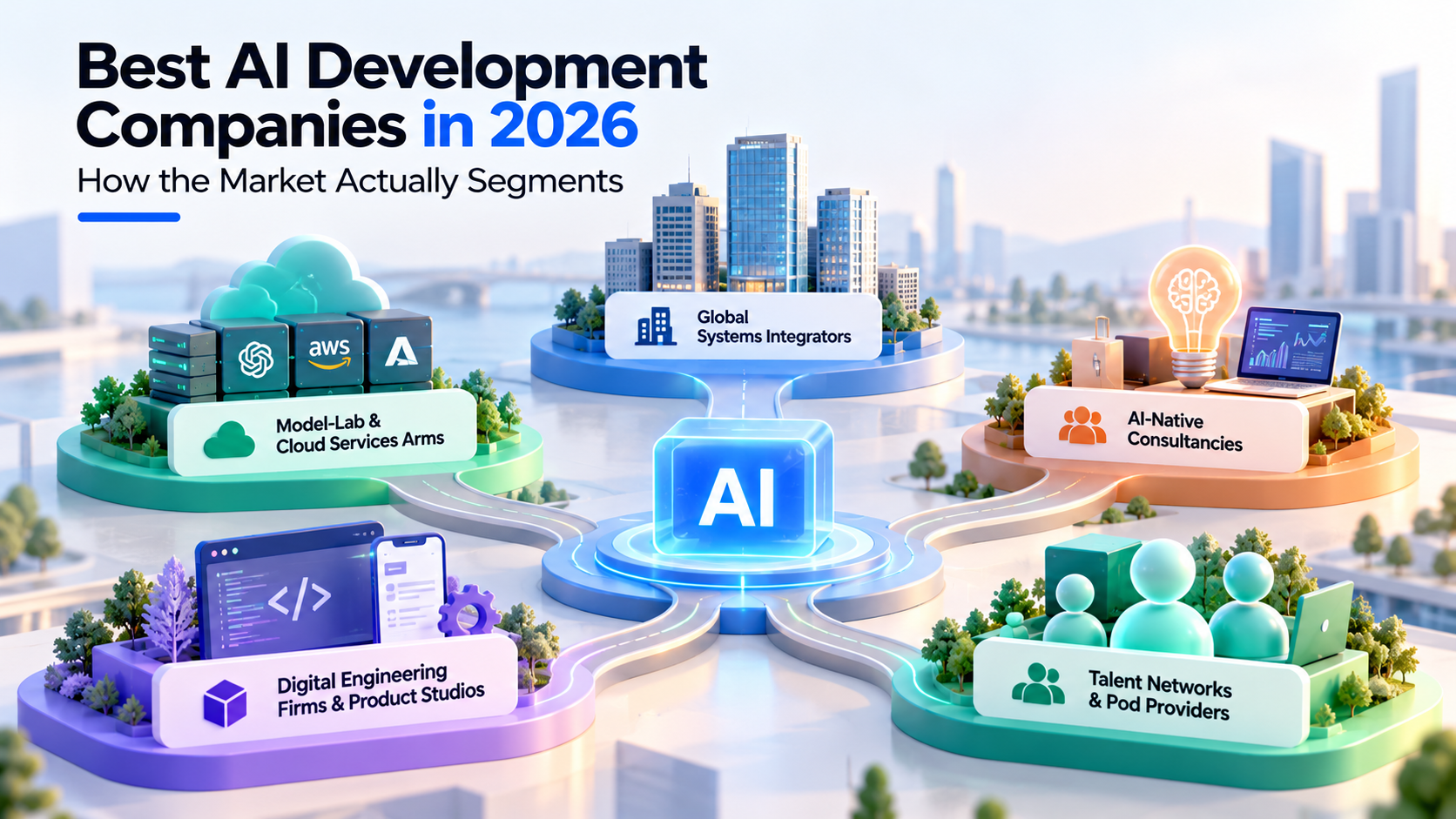
The best AI development companies in 2026 sit in five segments, and the right one depends on your project. Global integrators such as Accenture, IBM Consulting and Infosys suit large programs. Model-lab and cloud services arms suit buyers committed to one vendor. AI-native consultancies, product studios and pod or talent providers cover everything from strategy to a small dedicated team.
No neutral, methodology-backed ranking of AI development companies exists, and most "top 10" lists are published by a company that appears on them. This one is too: it is Fwdpod's own blog, and Fwdpod appears once, in its segment, with only facts it has published. So instead of a ranking, this page gives you a sourced shortlist per segment, what each segment is actually selling, and how to decide which segment to evaluate first. It belongs to our AI Strategy: Pilot to Production series.
Freshness note: Every company detail below is cited to the company's own announcement or website and was checked in October 2026. This list should be refreshed every six months (next review: April 2027), because the market is consolidating quickly. Names, ownership and offerings will change.
Why segment AI development companies instead of ranking them?
A ranking assumes every buyer wants the same thing. They do not. A bank modernizing hundreds of applications, a mid-market insurer that wants its first production AI system, and a SaaS company adding an AI feature to its product need different partners. Comparing a 400-person AI consultancy with a global integrator on one scale produces a list that helps nobody.
Segmenting also exposes what you are really buying. Some companies sell their own platform with engineers attached. Some sell a model vendor's technology. Some sell judgment and a method. Some sell people. Knowing which one you need removes most of the shortlist before you take a single sales call.
There is also evidence that the choice to work with a partner matters. MIT's NANDA initiative, in its 2025 report The GenAI Divide: State of AI in Business 2025, found that buying AI tools from specialized vendors and building partnerships succeeded about 67% of the time, while internal builds succeeded only about a third as often (as reported by Fortune). That finding is about buying versus building, not about which vendor wins. For that broader decision, see our framework on whether to build or buy AI capability.
The five segments at a glance
| Segment | Verified examples | What you are mainly buying | Typical best fit | Main thing to check |
|---|---|---|---|---|
| 1. Global systems integrators | Accenture, IBM Consulting, Infosys | Scale, industry depth, an internal AI platform | Multi-year, multi-country programs | Who actually staffs your project |
| 2. Model-lab and cloud services arms | OpenAI Deployment Company, Ode with Anthropic, AWS Generative AI Innovation Center | Deep knowledge of one vendor's models or cloud | Buyers committed to that vendor | Neutrality and portability |
| 3. AI-native consultancies | Quantiphi (plus Faculty, Fractional AI and Tomoro, now acquired or being acquired by larger firms) | AI specialists who design and build | Ambitious first or second production system | Bench depth after acquisitions |
| 4. Digital engineering firms and product studios | Thoughtworks, EPAM, Globant | Software engineering discipline with AI built in | AI inside a product or modernization effort | Real AI production work, not relabeled projects |
| 5. Talent networks and pod providers | Toptal, Andela, Turing, Fwdpod | Engineers or a small dedicated team | Speed, a defined scope, and you keep control | Who owns delivery and quality |
Segment 1: Global systems integrators
Global systems integrators (SIs) sell large, governed programs. Their advantage is breadth: they can run AI alongside cloud migration, data platforms, change management and regulatory work, in many countries at once.
Accenture. In June 2023, Accenture announced a $3 billion investment in its Data & AI practice over three years and said the practice would double its AI talent to 80,000 people through hiring, acquisitions and training (Accenture newsroom). In March 2026 it completed the acquisition of Faculty, a UK-based applied AI company, bringing more than 400 AI professionals and Faculty's decision intelligence product, Frontier, into Accenture. Faculty's co-founder and CEO, Marc Warner, became Accenture's chief technology officer (Accenture press release).
IBM Consulting. IBM introduced IBM Consulting Advantage in January 2024, describing it as an AI services platform and library of assistants for its consultants (IBM newsroom). At Think 2026 in May, IBM announced IBM Enterprise Advantage, a consulting service that helps clients build and run their own hybrid-AI platforms, and said Consulting Advantage is now FedRAMP authorized and available on AWS GovCloud (U.S.). Both run on IBM watsonx (IBM newsroom).
Infosys. Infosys launched Infosys Topaz in May 2023 as "an AI-first set of services, solutions and platforms using generative AI technologies" (Infosys press release).
What to know: integrators are strongest when AI is one workstream in a wider transformation. For a single, well-scoped AI system, you may pay for coordination you do not need. Ask to meet the delivery team, not only the account team, and ask which parts of the work go to subcontractors.
Segment 2: Model-lab and cloud services arms
In 2026 the model labs moved into services directly, and the cloud providers have run similar programs for longer. These arms know their own technology better than anyone. Their incentive is also to make that technology succeed in your account.
OpenAI Deployment Company. Launched on 11 May 2026 with more than $4 billion of initial investment, majority-owned and controlled by OpenAI, to help organizations "build and deploy AI systems they can rely on every day." OpenAI also agreed to acquire the applied AI consulting firm Tomoro to staff it (OpenAI).
Ode with Anthropic. Introduced on 15 July 2026 by Anthropic, Blackstone and Hellman & Friedman as a standalone enterprise AI services firm that pairs Anthropic's models with experienced engineers, aimed at mid-size companies moving from AI experiments into operations. Ode is built on Fractional AI, an applied AI services firm acquired in May 2026, whose co-founders lead Ode (Business Wire).
AWS Generative AI Innovation Center. Announced in June 2023 with $100 million of funding, the center connects AWS machine learning and AI experts with customers to build and deploy generative AI solutions (Amazon press release).
What to know: these arms suit a buyer that has already chosen its model or cloud vendor and wants the shortest path to production on it. If you want the freedom to switch models later, ask how portable the architecture, prompts and evaluation sets will be. The forward deployed engineering teams inside these labs are covered in our sourced list of the best forward deployed engineering companies, so we will not repeat them here.
Segment 3: AI-native consultancies
AI-native consultancies were founded around machine learning and generative AI rather than adding it to an existing IT services business. They tend to bring senior specialists, strong opinions on evaluation and data, and less overhead than an integrator.
Quantiphi. Founded in 2013, Quantiphi describes itself as "an AI-native services company" and lists Google Cloud, AWS and NVIDIA among its partners, with offices in the United States, Canada, India, London, Amsterdam and Singapore (Quantiphi).
The consolidation story. Three of the best-known independent AI-native consultancies were acquired, or agreed to be acquired, in the first half of 2026:
- Faculty joined Accenture (completed March 2026).
- Tomoro agreed to be acquired by OpenAI for the OpenAI Deployment Company (announced May 2026; closing was subject to regulatory approval, and we could not confirm completion as of October 2026).
- Fractional AI was acquired in May 2026 and became the foundation of Ode with Anthropic.
What to know: consolidation means the independent firm you shortlisted last year may now belong to an integrator or a model lab. That can be good (more resources) or not (less neutrality, changed priorities). Ask any AI-native consultancy who owns it today, whether that changed in the last year, and whether the people who did the work in its case studies are still there.
Segment 4: Digital engineering firms and product studios
These firms come from software product engineering. They are a natural fit when AI has to live inside a product, a platform or a legacy modernization program, because they bring the engineering habits (testing, CI/CD, architecture) that AI features still need.
Thoughtworks. In January 2026, Thoughtworks launched AI/works, an agentic development platform for modernizing legacy systems and building new technology products. It uses AI-enabled reverse engineering to turn legacy applications into structured specifications, then supports code generation and testing (Thoughtworks).
EPAM. EPAM describes itself as a global provider of digital engineering, cloud and AI-enabled transformation services, founded in 1993. In October 2025 it launched AI/Run.Transform, a consulting and delivery offering that combines methodologies, delivery teams and proprietary tools to help enterprises become AI-native (EPAM press release).
Globant. In June 2025, Globant introduced AI Pods, which it called the first subscription model for AI-powered engineering. Clients subscribe monthly, each subscription includes token-based metered capacity, and the work is AI-assisted under the supervision of Globant experts on its model-agnostic Globant Enterprise AI platform (Globant).
What to know: check for genuine AI production work. Ask for an AI system they built that is live today, how they evaluated it before launch, and what broke after it went live. A strong software studio without that evidence is still a software studio.
Segment 5: Talent networks and pod providers
This segment sells engineers: individually through a talent network, or as a small dedicated team. It is the fastest route to capacity and keeps product ownership with you, but you carry more of the delivery management. Our comparison of an agency, a freelancer and an AI pod explains where accountability sits in each model.
Toptal. Toptal markets on-demand AI developers, says clients can typically hire in about 48 hours, and offers a trial of up to two weeks with no obligation to pay if unsatisfied. The "top 3%" screening figure on its site is Toptal's own claim about its process (Toptal).
Andela. Andela describes itself as "a global talent and training platform that helps enterprises train and deploy AI systems," supplying AI-native engineers who join client teams (Andela).
Turing. Turing says it helps frontier labs improve their models and brings that expertise to Fortune 500 enterprises "for production deployment and scaling of agents." Its enterprise line, Turing Intelligence, offers embedded AI engineers, advisory work and industry-specific solutions (Turing).
Fwdpod. Disclosure: this is Fwdpod's own blog. Fwdpod builds dedicated AI engineering pods for startups and enterprises, covering LLM development, RAG systems, AI agents and product delivery. It describes a pod as 4–6 experts working around a single measurable outcome, offers pod templates for Voice AI, Agentic Operations, RAG and Knowledge, Compliance AI and Custom work ranging from 8 to 16 weeks, and delivers engineering from India for buyers in the US, UK, EU and Gulf.
What to know: a talent network gives you individuals, and you manage them. A pod provider gives you a team with a shared outcome. Either way, confirm in writing who owns code and IP, who replaces an engineer who leaves, and what the team is accountable for. If you are scoping a specific build, compare offers like these with dedicated team augmentation and project-based AI development services.
Which segment fits your project?
Pick the segment first, then compare two or three names inside it. These pairings cover most buyers:
| Your situation | Start with | Why |
|---|---|---|
| AI is one part of a multi-year, multi-country transformation | Segment 1: global SIs | Program governance and change management at scale |
| You have committed to one model family or cloud | Segment 2: lab or cloud services arms | Fastest path on that stack |
| You need a first ambitious production system and a strong point of view | Segment 3: AI-native consultancies | Senior specialists, evaluation-first habits |
| AI must ship inside your product or a legacy modernization | Segment 4: digital engineering firms | Engineering discipline around the AI |
| You have a clear scope and want speed while keeping control | Segment 5: talent networks or pods | Capacity without a large program wrapper |
| You are unsure what to build yet | A short AI consulting engagement in any segment | Define the outcome before buying delivery |
Two warnings apply across segments. First, a company can sit in more than one segment: Globant sells pods and Accenture now owns an AI-native consultancy. Judge the offer in front of you, not the logo. Second, if your system involves autonomous agents that take actions in your tools, read our separate list of top agentic AI development companies, because that work needs evidence this broader list does not test.
How to choose an AI development partner once you have a segment
Segmenting narrows the field. Choosing still needs evidence. Three moves do most of the work:
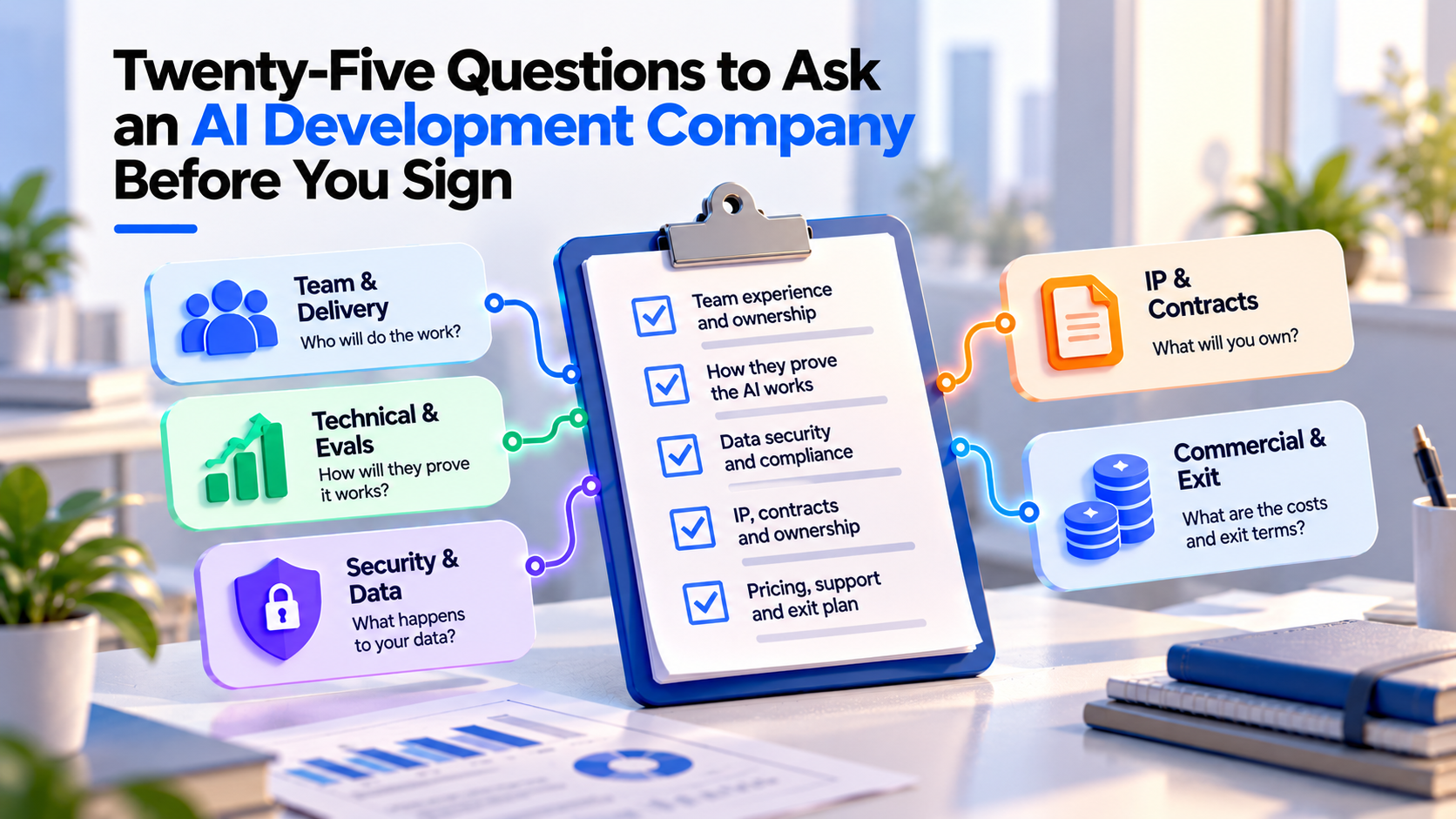
- Ask every finalist the same questions. Use a fixed set, in writing, so answers can be compared. Our list of 25 questions to ask an AI development company is a ready-made set.
- Score them on the same criteria. Production evidence, evaluation discipline, data security and IP terms should carry the most weight. The full method, with a weighted scorecard, is in our guide on how to choose an AI development partner.
- Run a short paid pilot with the top one or two. Watch how they define success, report progress and handle a failed experiment. That tells you more than any list, including this one.
Also ask each company, whatever its segment, three questions this market makes newly important: Who owns you today, and did that change in the past year? Which model and cloud providers do you have commercial ties to? Will the people we meet in the pitch be the people who build? Ask for the security and IP terms in writing before the pilot starts.
How Fwdpod approaches this
We would rather you pick the right segment than pick us by default. If AI is one workstream in a global transformation, an integrator is a sensible first call; if you are standardized on one lab's models, its services arm deserves a look. Fwdpod is built for buyers who want a dedicated pod of 4–6 people focused on one measurable outcome, with engineering delivered from India. To see whether that fits, configure your AI engineering pod: answer five questions and receive a custom pod proposal within 48 hours. For pricing or anything else, talk to the team.
Frequently Asked Questions
1. What are the best AI development companies in 2026?
It depends on your project. Verified examples by segment include Accenture, IBM Consulting and Infosys (global integrators), the OpenAI Deployment Company and Ode with Anthropic (lab services arms), Quantiphi (AI-native consultancy), Thoughtworks, EPAM and Globant (digital engineering) and Toptal, Andela and Turing (talent networks).
2. Is there an independent ranking of AI development companies?
Not one with a published, neutral methodology that covers the whole market. Many ranked lists are written by a company that appears in them, or rely on paid placements or self-submitted reviews. Treat any ranking as a starting list and verify each company yourself.
3. Why did so many AI consultancies get acquired in 2026?
One likely reason is that large firms and model labs want experienced applied AI engineers quickly. In the first half of 2026, Accenture completed its purchase of Faculty, OpenAI agreed to acquire Tomoro, and Fractional AI was acquired to form the base of Ode with Anthropic. Buying a consultancy is faster than hiring hundreds of specialists.
4. Should a mid-sized company work with a global systems integrator?
Sometimes, if AI is part of a wider transformation that needs program management across many teams. For a single, well-scoped AI system, a mid-sized company often gets more senior attention from an AI-native consultancy, a product studio or a dedicated pod.
5. Is a vendor-aligned AI partner a bad choice?
No. If you have committed to one model family or cloud, a vendor-aligned partner can be the fastest route to production. The trade-off is neutrality. Ask how portable your prompts, evaluation sets and architecture will be if you change providers later.
6. How do I check whether an AI development company has real production experience?
Ask for one AI system they built that is live today, a walkthrough of how they evaluated it before launch, and a reference who can describe what went wrong after go-live. Prototypes, demos and projected savings are not production evidence.
7. How often should a list of the best AI development companies be updated?
At least every six months. In 2026 alone, two model labs launched services firms and three well-known AI consultancies were acquired or agreed to be acquired, so a list written at the start of the year was already out of date by mid-year.