Best Country to Outsource AI Development in 2026: An Honest Comparison
A sourced 2026 comparison of AI talent depth, time-zone overlap, data law, English and risk. Get the trade-offs before you commit budget.
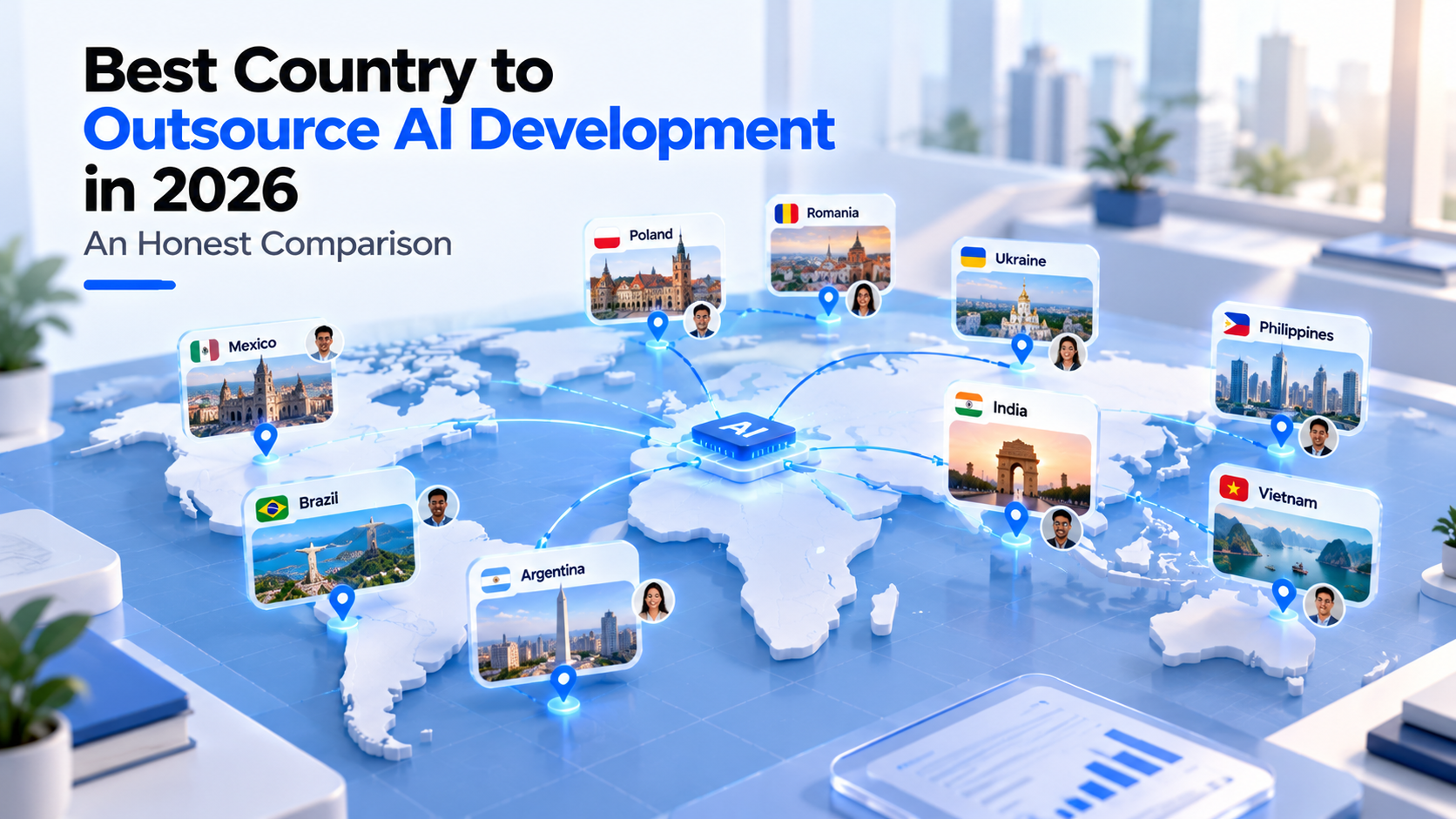
There is no single best country to outsource AI development. India has the deepest AI talent pool, Latin America the best US time-zone overlap, Eastern Europe the simplest data-law position for EU buyers, and Southeast Asia sits in between. The right choice depends on where your users, your data and your working hours are.
A disclosure before you read further. Fwdpod delivers its engineering from India, so we have a stake in this answer. We have tried to offset that by using only third-party data (Stanford's AI Index, GitHub's Octoverse, the EF English Proficiency Index, government and law-firm sources) and by saying plainly where India is the weaker option. Judge the evidence, not the author.
This guide compares regions on five things that change outcomes: talent depth, time-zone overlap, data-protection regime, English proficiency and stability. It deliberately leaves out rates and pricing, which move too fast to publish responsibly. For the India-specific security and legal questions, see our separate answer to whether it is safe to outsource AI development to India.
This article explains data-protection law in general terms. It is not legal advice; involve your own counsel before choosing a delivery location.
How do the main offshore AI regions compare at a glance?
The table summarizes the evidence covered in the rest of this post. "Overlap" assumes both sides work a standard 9-to-5 in winter with nobody shifting hours, which is the honest baseline before any accommodation.
| Region (examples) | AI talent depth (verified signals) | Workday overlap with US East / UK / Central Europe | Data-protection regime | English (EF EPI 2025 band) | Stability notes |
|---|---|---|---|---|---|
| India | #2 on GitHub by developers (21.9M); #2 in AI skill penetration (AI Index 2025) | 0h / ~2.5h / ~3.5h | DPDP Act 2023, Rules phasing in to 2027; no EU adequacy decision | Low (rank 74) | Large, mature delivery market; not a US "country of concern" |
| Poland, Romania | EU member states; Romania's ICT share of employment is among the EU's lowest | ~1–2h / 6–7h / 7–8h | GDPR (same law as EU buyers) | Very high (Romania 11, Poland 15) | EU and NATO members |
| Ukraine | Large outsourcing sector that kept delivering through the war | ~1h / ~6h / ~7h | 2010-era personal data law; GDPR-aligned bill pending | Moderate (rank 45) | Martial law since 2022, renewed every 90 days (current term to 31 Oct 2026) |
| Brazil, Argentina | Brazil #4 on GitHub (6.89M); AI hiring growth 30.8% (AI Index 2025) | ~6h / ~5h / ~4h | LGPD with mutual EU adequacy (Jan 2026); Argentina has long-standing EU adequacy | Brazil low (75); Argentina high (26) | Check currency and policy volatility per country |
| Mexico, Colombia | Named by GitHub as LATAM standout growth markets; no AI-specific figures found | 7–8h / 2–3h / 1–2h | Mexico's new 2025 federal law; Colombia's Law 1581 of 2012 | Colombia low (76); Mexico very low (103) | USMCA neighbor (Mexico) |
| Vietnam, Philippines | No comparable AI-specific talent data found | 0h / 0–1h / 1–2h | Vietnam PDPL in force Jan 2026; Philippines Data Privacy Act 2012 | Philippines high (28); Vietnam moderate (64) | Vietnam's transfer impact assessments add paperwork |
Two caveats sit under every row. National averages say little about the specific engineers you will get, and the vendor's controls matter more than the flag. Our guide on how to choose an AI development partner covers vendor-level diligence.
Where is AI engineering talent actually deepest?
On the verified numbers, India and Brazil stand out, with India well ahead on scale.
- Developer volume. GitHub's Octoverse 2025 counts about 21.9 million developers in India, second only to the United States, up from 4.5 million in 2020. Brazil is fourth at about 6.89 million. GitHub projects India will reach 57.5 million developers by 2030 (GitHub, Oct 2025).
- AI-specific activity. The same report ranks India second in contributions to generative AI repositories, at roughly 12.5% of the total, behind the US at 31.8% (GitHub, Oct 2025).
- AI hiring and skills. Stanford's AI Index 2025, using LinkedIn data, found India had the highest year-over-year growth in its relative AI hiring rate in 2024 at 33.4%, with Brazil second at 30.8%. India ranked second to the US on relative AI skill penetration for 2015–24. The report itself cautions that LinkedIn covers a smaller share of India's workforce, so India's figures deserve extra care (Stanford HAI, Apr 2025).
The honest limits: none of Poland, Romania, Ukraine, Mexico, Colombia, Argentina, Vietnam or the Philippines appears in GitHub's top ten countries by developer count. GitHub does name Brazil, Mexico and Colombia as Latin America's standout growth markets. For Vietnam and the Philippines we found no comparable, primary-source AI talent data, so we make no claim either way.
Eastern Europe's case has always been depth of senior engineering rather than raw headcount. That pool is smaller than many buyers assume: Eurostat data for 2024 put Romania's ICT specialists at 2.8% of employment, the second-lowest share in the EU (Eurostat, reported Jul 2025). A small pool can still be excellent, but it fills up faster when demand spikes.
Scale also cuts both ways. A large pool makes it easier to find people, and harder to tell who has shipped production LLM systems from who has completed a course. Screening matters more than geography, which is why the criteria in our guide on how to hire AI engineers apply wherever you build.
How much working-day overlap will you actually get?
This is where India is weakest for US buyers, and where Latin America wins clearly.
| Delivery location (UTC offset, winter) | Overlap with US Eastern (UTC−5) | Overlap with US Pacific (UTC−8) | Overlap with London (UTC+0) | Overlap with Berlin (UTC+1) |
|---|---|---|---|---|
| India (UTC+5:30, no DST) | 0h | 0h | ~2.5h | ~3.5h |
| Poland (UTC+1) | ~2h | 0h | ~7h | Full day |
| Romania, Ukraine (UTC+2) | ~1h | 0h | ~6h | ~7h |
| Brazil, Argentina (UTC−3) | ~6h | ~3h | ~5h | ~4h |
| Colombia (UTC−5) | Full day | ~5h | ~3h | ~2h |
| Mexico City (UTC−6, no DST since 2022) | ~7h | ~6h | ~2h | ~1h |
| Vietnam (UTC+7) | 0h | 0h | ~1h | ~2h |
| Philippines (UTC+8) | 0h | 0h | 0h | ~1h |
Figures assume a 9:00–17:00 local day on both sides with nobody moving hours. Daylight saving shifts several of them by an hour between March and November. Mexico ended daylight saving time in October 2022 outside its northern border areas, so Mexico City now sits on Central Standard Time all year (timeanddate.com).
Zero overlap is not a deal-breaker. Most offshore AI teams serving US clients shift part of their day, and asynchronous handoffs suit some AI work well: evaluation runs, data pipeline jobs and test suites can complete overnight. What breaks projects is unagreed overlap, where decisions wait a day. How a pod should structure its day around US hours is covered separately.
Which data-protection regime is easiest to work with?
It depends on where your users are. The regime in the delivery country matters less than whether your own law lets data flow there, and whether your vendor works inside your cloud.
For EU buyers: Eastern Europe has a structural advantage
Poland and Romania apply the GDPR directly, so an EU company using a Polish or Romanian team is not making an international transfer at all. Ukraine is different. Its current law dates from 2010, and a GDPR-aligned replacement (draft law No. 8153, with 72-hour breach notification and expanded data-subject rights) has been in the parliamentary pipeline, tied to Ukraine's EU candidacy (Vox Ukraine, Feb 2024). Check its status before relying on it.
Latin America: two EU adequacy routes
The European Commission adopted an adequacy decision for Brazil on 26 January 2026, and Brazil recognised the EU in return the next day, so personal data can flow both ways without extra safeguards (eucrim, Mar 2026). Brazil's own law is the LGPD. Argentina and Uruguay have held EU adequacy for years, and the Commission confirmed in January 2024 that both decisions stay in place (Covington, Jan 2024).
Mexico replaced its private-sector data law with a new federal law published on 20 March 2025, which also moved oversight from the independent INAI to a federal ministry (Basham, Mar 2025). Colombia's Law 1581 of 2012, enforced by the Superintendence of Industry and Commerce, generally restricts transfers to countries it considers adequate (CMS).
India and Southeast Asia: contract-based transfers
India has no EU adequacy decision, so EU and UK buyers rely on standard contractual clauses or an equivalent mechanism. India's own DPDP Act 2023 has Rules notified in November 2025 that phase in through 2027 (PIB, Nov 2025), and it largely exempts Indian vendors processing foreign residents' data under contract. The detail, including what still applies, is in the India safety guide linked above.
The Philippines' Data Privacy Act of 2012 contains a similar carve-out for information collected from residents of foreign jurisdictions under their own laws (National Privacy Commission). Vietnam is the outlier: its Law on Personal Data Protection took effect on 1 January 2026 and carries over transfer impact assessment filings, with fines for cross-border transfer breaches of up to 5% of prior-year revenue (Tilleke & Gibbins, Aug 2025). That is manageable, but it is paperwork your vendor must own.
For US buyers, the key federal screen is the Justice Department's list of "countries of concern" for bulk sensitive data: China, Cuba, Iran, North Korea, Russia and Venezuela (28 CFR § 202.601). None of the countries compared here is on it.
Whatever the country, the strongest single control is keeping data, model API keys and logs in your own cloud. Our guide to data security in offshore AI development lists the twelve controls to write into the contract, and the residency trade-offs are covered in AI data residency.
How much does English proficiency vary?
More than most buyers expect, and not in the direction many assume. The EF English Proficiency Index 2025 ranks 123 countries and regions on adult test-taker data:
- Very high: Romania (11th) and Poland (15th).
- High: Argentina (26th) and the Philippines (28th).
- Moderate: Ukraine (45th) and Vietnam (64th).
- Low: India (74th), Brazil (75th) and Colombia (76th).
- Very low: Mexico (103rd).
Read this with care. EF's index measures people who chose to take its test, not the engineers you would hire, and professional software teams in India and Brazil typically work in English daily. Still, it is a fair signal for one practical question: how much written specification and review will your team need to avoid misunderstandings? Run a paid trial sprint and judge written communication directly.
What stability and delivery risks should you weigh?
Country risk is real but narrower than headlines suggest. Three things are worth checking.
- Conflict exposure. Ukraine has been under martial law since the full-scale invasion in 2022, renewed in 90-day extensions, the one in force at the time of writing running to 31 October 2026 (Censor.net, Jul 2026). Its IT sector has kept delivering: IT companies earned $6.2 billion in revenue in 2024, roughly level with 2021, with the US the largest buyer (The Register, Apr 2025). The practical questions are continuity: backup power, connectivity, and what happens if a named engineer is mobilized.
- Regulatory churn. Mexico, Vietnam, India and Ukraine all changed or are changing their data laws between 2025 and 2027. That is not instability, but it means your vendor's compliance stance needs refreshing during a multi-year engagement.
- Vendor concentration. In a small market, one vendor losing two senior people can stall your project. In a large market the bigger risk is subcontracting you were not told about. Both are vendor issues, not country issues, and the contract terms for them are in our guide to who owns the IP when you outsource AI development.
So which country should you choose?
Start from your constraints, not from a ranking.
- US buyer who needs real-time collaboration: Latin America, specifically Colombia, Mexico, Brazil or Argentina. Weigh Mexico's and Colombia's lower English scores against their full-day overlap.
- EU buyer handling sensitive personal data: Poland or Romania keep you inside the GDPR with no transfer mechanism. Brazil is now a credible second option thanks to mutual adequacy.
- Buyer who needs a large team, rare AI specializations, or the ability to scale fast: India, on talent depth. Plan the overlap window deliberately and keep data in your cloud.
- UK buyer: Eastern Europe gives the most overlap. India gives a few morning hours and the largest pool. Check the UK's own transfer rules, which sit apart from the EU's.
- Gulf buyer: India's time zone sits close to Gulf working hours, which removes the overlap objection entirely.
Many buyers end up with a mixed model: a small nearshore lead for daily decisions and a larger offshore team for build and evaluation work. How each engagement model splits risk is explained in AI pod vs staff augmentation vs in-house, and if you just need individual engineers placed in your team, see AI team augmentation.
How Fwdpod approaches this
Fwdpod builds dedicated AI engineering pods for buyers in the US, UK, EU and Gulf, with engineering delivery from India, which is why we disclosed our bias at the top. Our view, based on the evidence above, is that India is a strong choice when talent depth and team scale matter, and a weaker one when you need a full working day of real-time overlap with the US. Pods are built as 4–6 experts around a single measurable outcome. How overlap hours, data access and IP terms would be set up for your project is something the team can walk you through on a first call.
To see what a pod would look like for your use case, configure your AI engineering pod by answering five questions and get a custom proposal within 48 hours. For pricing, or to test whether India fits your constraints at all, talk to the team. More guides on offshore risk and compliance are in Security, Compliance & Offshore Delivery.
Frequently Asked Questions
1. Is nearshore always better than offshore for AI development?
No. Nearshore buys working-hour overlap, which matters most during discovery, design reviews and incident response. Offshore can win on talent depth and the ability to staff specialist roles quickly. Many teams combine a nearshore or onshore lead with an offshore build team.
2. Which country is best for outsourcing AI development if my users are in the EU?
Poland or Romania are the simplest legally, because they apply the GDPR directly and no international transfer occurs. Brazil and Argentina also have EU adequacy decisions. India and Vietnam work too, but need standard contractual clauses and stronger access controls.
3. Does the EF English Proficiency Index tell me how well my offshore engineers will speak English?
Not directly. EF scores national samples of people who took its test, not professional software engineers. Treat it as a rough signal and assess written and spoken communication in a paid trial sprint with the named people who would work on your project.
4. Is Ukraine still a viable place to outsource AI work in 2026?
Many companies still use Ukrainian teams, and the sector reported 2024 revenue close to its pre-war level. Martial law remains in force, so ask the vendor for its continuity plan covering power, connectivity and replacement of staff who are mobilized.
5. Should I split an AI team across two countries?
It can work if roles are split cleanly, for example a product lead and architect near your time zone and model, data and evaluation engineers offshore. It fails when decision rights are unclear, so name one accountable lead and fix a daily overlap window in the contract.
6. Is the country or the vendor the bigger risk?
Usually the vendor. Data access, IP assignment, subcontracting and staff turnover vary far more between vendors in the same city than between countries. Country choice sets the time-zone and legal baseline; vendor diligence decides whether the engagement is safe.
7. How do I compare outsourcing costs between countries?
Rates change quickly and vary by seniority and engagement model, so compare written proposals for the same scope rather than published averages. Ask each vendor to price the same outcome, team shape and overlap window, and include the cost of your own management time.