AI Pod vs Staff Augmentation vs In-House: The Build-vs-Buy Decision
AI pod vs staff augmentation vs in-house: compare accountability, management load, speed, knowledge retention, cost drivers, risk and IP in one decision matrix.
AI Pod vs Staff Augmentation vs In-House: The Build-vs-Buy Decision
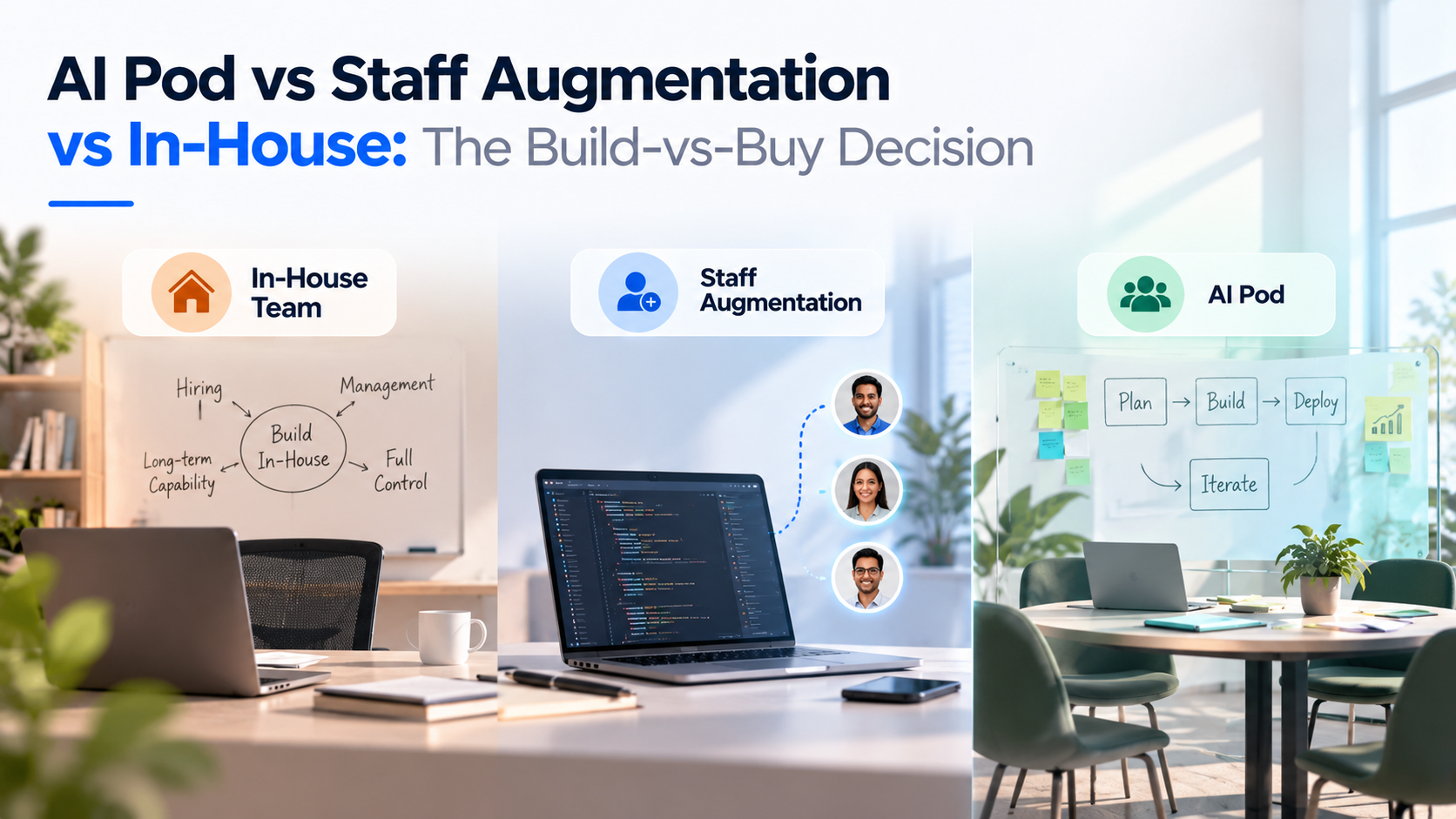
AI pod vs staff augmentation comes down to who owns the outcome. Staff augmentation rents you individual engineers who work under your management, so delivery risk stays with you. An AI pod is a small cross-functional team that takes responsibility for shipping a defined result. An in-house team gives you full control and long-term capability, but you carry recruiting, ramp, attrition and management costs yourself.
None of the three is "best". Each fits a different mix of what you already have (an engineering manager, AI experience) and what you need (a shipped feature, extra hands, or a permanent capability). Below: a decision matrix, the reasoning behind each row, "choose X when" rules and common hybrids. It is part of our AI Pods & Engineering Teams series.
What is the real difference between the three models?
The easiest way to separate them is to ask one question: if the project slips, whose problem is it?
- In-house team. You hire employees. You own hiring, management, delivery and retention. Everything they learn stays with you, as long as they stay.
- Staff augmentation. A vendor supplies engineers who slot into your team, follow your process and take direction from your managers. You buy capacity, not results. The vendor is accountable for providing a qualified person; you are accountable for what that person ships.
- AI pod. A vendor supplies a small, pre-formed team (typically some mix of AI engineers, a backend or data engineer and a delivery lead) that works toward an agreed outcome, such as a retrieval-augmented assistant in production. You set priorities and accept the work; the pod runs its own day-to-day delivery. If you want the full anatomy, see our explainer on what an AI pod is and the roles inside one.
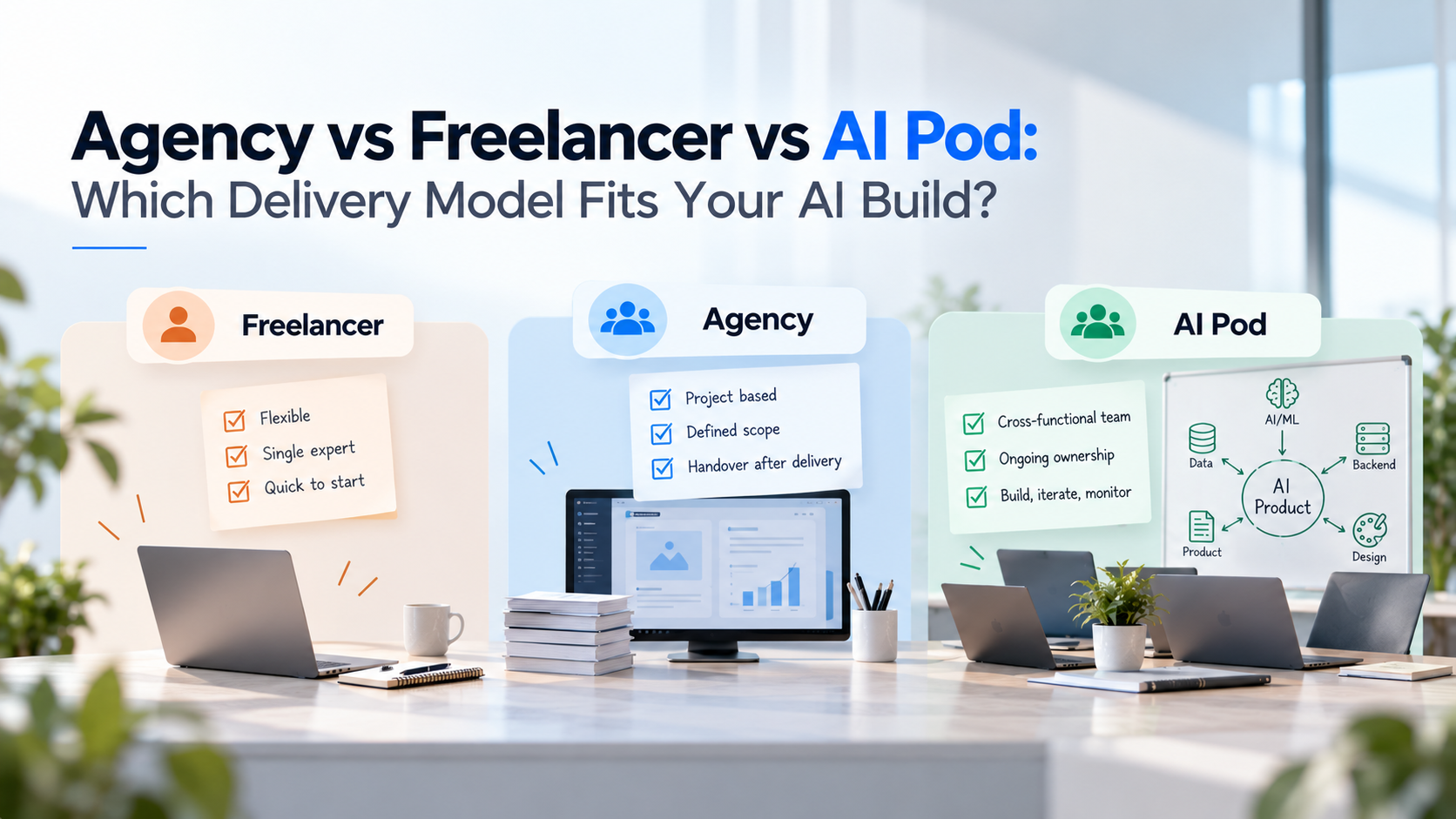
A fourth option, hiring an agency on a fixed-scope project, sits close to the pod model but usually ends at handover. We compare that separately in our agency vs freelancer vs pod breakdown.
The decision matrix
Use this table as a first pass. Read across the row that matters most to you, not down a column.
| Criterion | In-house team | Staff augmentation | AI pod |
|---|---|---|---|
| Accountability for delivery | Fully yours | Yours; vendor owns only the seat being filled | Shared; pod owns delivery against agreed outcomes |
| Management overhead on your side | High: hiring, 1:1s, career paths, process | High: you assign, review and manage daily work | Lower: you own priorities and acceptance, pod lead runs the team |
| Speed to start | Slowest: full recruiting cycle per role | Medium: depends on vendor bench and your onboarding | Medium to fast: team already formed |
| Knowledge retention | Strongest, if people stay | Weak by default; leaves with each contractor | Moderate; depends on documentation and handover terms |
| Cost structure | Salary + benefits + recruiting + ramp + attrition + management time | Hourly or monthly rate per person; your management time on top | Monthly team fee; less of your management time |
| Flexibility to scale up or down | Low; hiring and exits are slow and costly | High, person by person | High, but in team-sized steps |
| Main risk | Mis-hires, attrition, slow start | Nobody owns the architecture; co-employment and IP gaps | Vendor dependence; handover quality |
| IP ownership | Generally automatic for employees' in-scope work (US) | Must be assigned in the contract | Must be assigned in the contract |
The rest of this article unpacks each row.
Who is accountable when an AI project does not ship?
With staff augmentation, you are buying hours from qualified people. If an augmented LLM engineer builds exactly what your tech lead asked for and the system still fails evaluation, the vendor has done its job. That is fine when your team knows how to build production AI and lacks only capacity. It is a problem when the missing piece is judgment: which retrieval strategy, how to evaluate outputs, when a prompt is ready to ship.
With an in-house team, accountability is unambiguous but concentrated. If your first AI hire is also your only AI hire, one person is carrying architecture, delivery and on-call.
An AI pod splits it differently. You stay accountable for the business decision (what to build, what "done" means), and the pod is accountable for getting it built to that definition. That only works if "done" is written down: acceptance criteria, evaluation thresholds, and what happens if a milestone slips. If a pod vendor will not commit to outcomes in writing, you are buying staff augmentation with extra steps.
How much management does each model need from you?
- In-house: someone has to hire, onboard, run 1:1s, write performance reviews, plan careers and keep people engaged. If you do not already have an engineering manager who understands AI work, you need to hire one first.
- Staff augmentation: you skip the HR work, but the daily management load stays. Augmented engineers need tickets, code review, architectural direction and context. Adding three contractors to a team with one tech lead often slows that lead down.
- AI pod: the pod's delivery lead handles sprint planning, task breakdown and internal review. Your side still needs a product owner who can make decisions quickly, access to data and systems, and someone to accept the work. Plan for a few hours a week of senior time, not zero.
A useful test: count the hours your best engineer currently spends unblocking other people. Staff augmentation tends to add to that number. A pod tends to hold it flat.
How fast can each model start?
In-house is the slowest to start because every role runs through a full recruiting cycle, then notice periods, then ramp-up. Roles that combine LLM, retrieval and production engineering experience are a narrow pool, so expect the search to take time. Our guide on how to hire AI engineers covers that process in detail.
Staff augmentation can move quickly when the vendor has the right person on the bench, and slowly when it has to recruit for you. Either way, each individual still needs onboarding to your codebase and process.
An AI pod arrives as a pre-formed team, so it skips most of the team-building phase. The limiting factor usually shifts to your side: security reviews, data access and environment setup. Our post on how fast an AI pod can start walks through the first weeks.
What happens to knowledge when people leave?
AI systems carry context that is not in the code: why a chunking strategy was chosen, which evaluation set reflects real users, which prompts broke in production and why.
- In-house retains that context best, but only while people stay. Every departure takes some of it with them.
- Staff augmentation is weakest here by default. Contractors rotate, and nobody is contractually required to leave the system understandable.
- AI pods sit in between. Retention depends on what you write into the contract: architecture decision records, runbooks, evaluation suites checked into your repository, and a defined handover period.
Whichever model you choose, insist that evaluation datasets, prompts and infrastructure-as-code live in repositories you own from day one.
What actually drives cost in each model?
We are not quoting pod prices here: rates vary by scope, seniority, region and contract length. For current pricing, contact the team (details at the end of this article). Here is where the money goes, using published figures.
| Cost component | In-house | Staff augmentation | AI pod | Published reference point |
|---|---|---|---|---|
| Base pay | You pay salary | Built into vendor rate | Built into team fee | BLS reports a US median of $135,980 for software developers (May 2025). Roles requiring AI skills typically pay more: PwC's 2025 Global AI Jobs Barometer found an average 56% wage premium over similar roles without them (2024 data). |
| Benefits and payroll costs | You pay on top of salary | Vendor's cost | Vendor's cost | Benefits were 30.0% of total compensation for US private industry workers in June 2026 (BLS ECEC). |
| Recruiting | You pay per hire | Mostly vendor's cost | Vendor's cost | SHRM benchmarking puts average cost per hire at nearly $4,700 (SHRM, 2022), excluding most of the manager time spent interviewing. |
| Ramp-up time | Paid, low output | Paid, low output per person | Paid, but shorter if the team is pre-formed | No reliable published benchmark for AI roles. |
| Attrition and replacement | You absorb it | Vendor replaces the person; you absorb lost context | Vendor replaces within the team; continuity depends on the pod | Gallup estimates replacing an employee costs one-half to two times annual salary. |
| Management time | High | High | Lower | Rarely costed, but real. |
Salary is not the cost of an in-house engineer. Add benefits (roughly 30% of total compensation, per the BLS figure above), recruiting, a ramp period, and the risk of paying for a replacement. The SHRM article quotes one HR consultant estimating that total hiring cost can reach three to four times the position's salary once soft costs are counted. Treat that as one expert's view, not a benchmark.
Vendor rates look expensive until you compare like with like. A staff augmentation or pod rate bundles salary, benefits, recruiting, bench time and replacement risk. Comparing it against a bare salary is the most common error in build-vs-buy spreadsheets.
Where are the risk and IP differences?
Co-employment and classification. With staff augmentation, your managers direct the contractor's daily work, which is the classic set-up for classification questions. The IRS assesses whether someone is an employee or independent contractor based on behavioral control, financial control and the type of relationship, weighing the whole relationship rather than any one factor. Engaging through a vendor that employs the engineers reduces, but does not remove, this question. Pods, where the vendor directs the work, generally sit further from it.
IP ownership. Under US copyright law, work created by employees within the scope of their jobs is generally a "work made for hire" owned by the employer. Commissioned work from contractors is different: it qualifies only if it falls into one of nine statutory categories and there is a signed written agreement (US Copyright Office, Circular 30), and software is not among the nine categories listed. In practice that means a staff augmentation or pod contract needs an explicit written IP assignment, and when the engineers are in another country, local law also applies. Our post on who owns the IP when you outsource AI covers the cross-border details.
This section is general information, not legal advice. Involve your counsel before signing.
Architecture risk. Staff augmentation's specific risk is that nobody owns the whole system. Five capable contractors reporting to a busy tech lead can produce five well-built parts that do not fit together. Pods reduce this by owning the architecture as a team; in-house teams reduce it by having a staff engineer or architect in charge.
Vendor dependence. Pods and augmentation both create it. Mitigate with your own repositories and cloud accounts, documented decisions and a tested handover clause.
Choose X when: the rules
Choose an in-house team when:
- AI is core to your product's long-term differentiation, not a single feature.
- You can afford a slow start and already have an engineering leader who can hire and manage AI engineers.
- The work involves data or systems you cannot expose to a third party under any contract.
Choose staff augmentation when:
- Your team already knows how to build and run production AI and simply needs more hands.
- You have a strong tech lead with spare management capacity.
- The gap is a specific skill for a bounded period, such as an MLOps engineer to set up monitoring.
Choose an AI pod when:
- You need a working AI capability shipped and nobody in-house has done it before.
- You want one party accountable for delivery, not a set of individuals to manage.
- You plan to decide later whether to build internally, and want production experience first.
If you are still weighing whether AI capability should be built or bought at all, our build vs buy AI capability guide steps back to that earlier question.
What do hybrid models look like?
Most organizations mix models over time, and each mix shifts risk differently; AI development engagement models explained covers who carries it under each contract type. Common hybrids:
- Pod builds, in-house inherits. A pod ships version one while you hire; your first internal hires pair with the pod before a planned handover, scoped from the start.
- In-house core, augmented edges. Your team owns architecture and product decisions, and augmented engineers take well-defined workstreams like integrations or data pipelines.
- Pod plus internal product owner. One senior internal person acts as product owner and technical counterpart. It is the lightest way to keep knowledge in the building.
- Build, operate, transfer. A vendor stands up a team, runs it, then transfers the engineers or the capability to you under pre-agreed terms. Check the transfer, notice and non-solicit terms carefully.
Common mistakes in this decision
- Comparing a vendor rate with a bare salary. Compare fully loaded cost against fully loaded cost.
- Buying augmentation to fix a leadership gap. Extra engineers do not supply missing AI judgment.
- Signing a "pod" contract with no outcomes. If nothing is defined as done, you have hired individuals.
- Skipping the IP assignment. For contractors, US law will not fill the gap for you.
How fwdpod approaches this
Fwdpod builds dedicated AI engineering pods for startups and enterprises, covering LLM development, RAG systems, AI agents and product delivery, with engineering delivery from India for buyers in the US, UK, EU and Gulf. Pods are typically 4–6 experts working around a single measurable outcome. When a buyer is choosing between models, the first question is whether they need capacity or an outcome. Engagement structure, handover and IP assignment terms are things the team can walk you through on a first call.
When you are ready to scope a project, configure your AI engineering pod to get a custom pod proposal within 48 hours, or talk to the team about pricing for your scope.
Frequently Asked Questions
1. Is an AI pod just staff augmentation with a different name?
No, if the contract is written properly. Staff augmentation sells you individual engineers who take direction from your managers. A pod is a pre-formed team with its own delivery lead that commits to agreed outcomes. If a so-called pod contract has no acceptance criteria or delivery commitments, it functions as augmentation.
2. Is an AI pod cheaper than hiring an in-house team?
It depends on duration and scope. In-house engineers carry costs beyond salary, including benefits, recruiting, ramp-up and replacement risk, while a pod fee bundles these. Over a short or uncertain horizon, a pod often costs less in total; over many years of stable work, in-house can win. Model both on fully loaded cost.
3. Can I convert pod engineers into full-time employees later?
Sometimes. Some vendors offer build-operate-transfer or conversion terms, usually with a fee or a minimum engagement period. Check the non-solicit and conversion clauses before signing, because many standard contracts prohibit hiring the vendor's staff.
4. Who manages an AI pod day to day?
The pod's own delivery lead runs sprints, assigns tasks and reviews work. The client typically provides a product owner who sets priorities, answers domain questions, grants system access and accepts completed work.
5. What should I ask a staff augmentation vendor before signing?
Ask how engineers are vetted for production AI experience, how quickly a departing engineer is replaced, who owns code and IP created on the engagement, whether engineers are the vendor's employees or subcontractors, and what the notice period is for scaling down.
6. When should a startup use staff augmentation instead of a pod?
When the startup already has a technical lead with production AI experience and needs extra capacity on clearly defined work. Without that lead, augmented engineers usually lack the direction to deliver a coherent AI system.
7. Does using an offshore pod change IP ownership?
It can. Contractor work generally needs an explicit written assignment to transfer ownership under US law, and the law where engineers are based also applies. Make sure the contract assigns all IP to you and that the vendor has matching agreements with its own staff. Involve your counsel.