Fractional AI CTO vs AI Solution Architect: Who Do You Bring In First?
Fractional AI CTO vs. AI Solution Architect: Compare roles, costs, and expertise to choose the right AI strategy and technical leadership for your business.
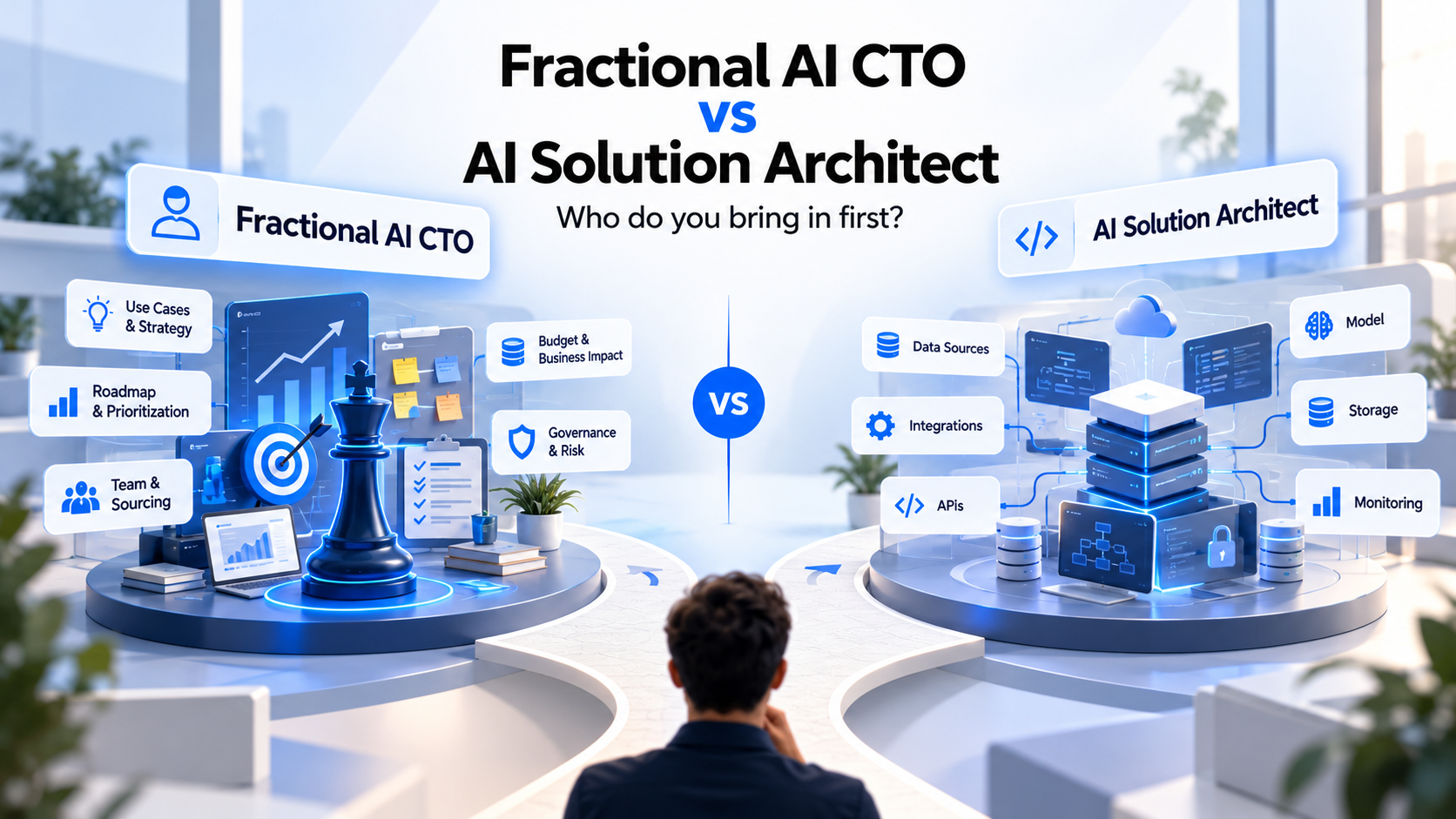
Hire a fractional AI CTO first when the open question is what to do with AI: which use cases, in what order, with what budget, risk appetite and team. Bring in an AI solution architect first when that is settled and the open question is how: models, data flows, integrations and security for one defined system. If both are open, start with the CTO.
The two titles get used interchangeably on proposals, which is how companies end up with a strategist drawing system diagrams or an architect being asked to set the AI budget. This guide separates the roles by scope, deliverables and decision rights, then covers sequencing, red flags and how each one works alongside a delivery pod. (More on team design in our AI pods and engineering teams guides.)
What does a fractional AI CTO actually own?
A fractional AI CTO is a senior technology leader who works part-time, across a fixed engagement, to set AI direction for an organization that doesn't yet need (or can't yet hire) a full-time AI executive. The scope is the portfolio, not a single system.
In practice that covers five things:
- Use-case selection and sequencing. Which problems are worth solving with AI, which go first, and which get killed.
- Build, buy or partner calls. Whether a capability comes from a vendor product, a delivery partner or an internal team.
- Team and sourcing plan. What to hire, what to contract and when to stop relying on outside help.
- Governance set-up. Who approves AI risk, how use cases pass phase gates, and which policies apply to data and model use.
- Board and executive translation. Turning engineering progress into business terms, and business pressure into realistic engineering scope.
The governance piece matters more than it looks. In McKinsey's March 2025 State of AI survey, CEO oversight of AI governance was one of the attributes most correlated with higher self-reported bottom-line impact from generative AI. A fractional CTO can't replace that executive ownership, but they can design the structure so it works without them.
What does an AI solution architect own?
An AI solution architect designs one AI system, or a small set of related ones, so it can be built, secured, run and paid for. The scope is a defined problem with an approved owner.
Their work typically includes:
- Model and hosting choices (hosted API, open-weight, or a mix) within the constraints the business has set.
- Retrieval, data flow and integration design with the systems of record.
- Non-functional requirements: security, data residency, latency, availability and cost per transaction.
- The evaluation approach: what "correct" means and how it will be measured before launch.
- Architecture decision records. Martin Fowler describes an ADR as "a short document that captures and explains a single decision," a format Michael Nygard named in 2011.
Cloud providers have codified much of this checklist. The AWS Well-Architected Generative AI Lens, updated in November 2025, reviews generative AI workloads across six pillars, from operational excellence to sustainability, and lists architects first in its intended audience. A good architect works through that kind of review whether or not you run on AWS.
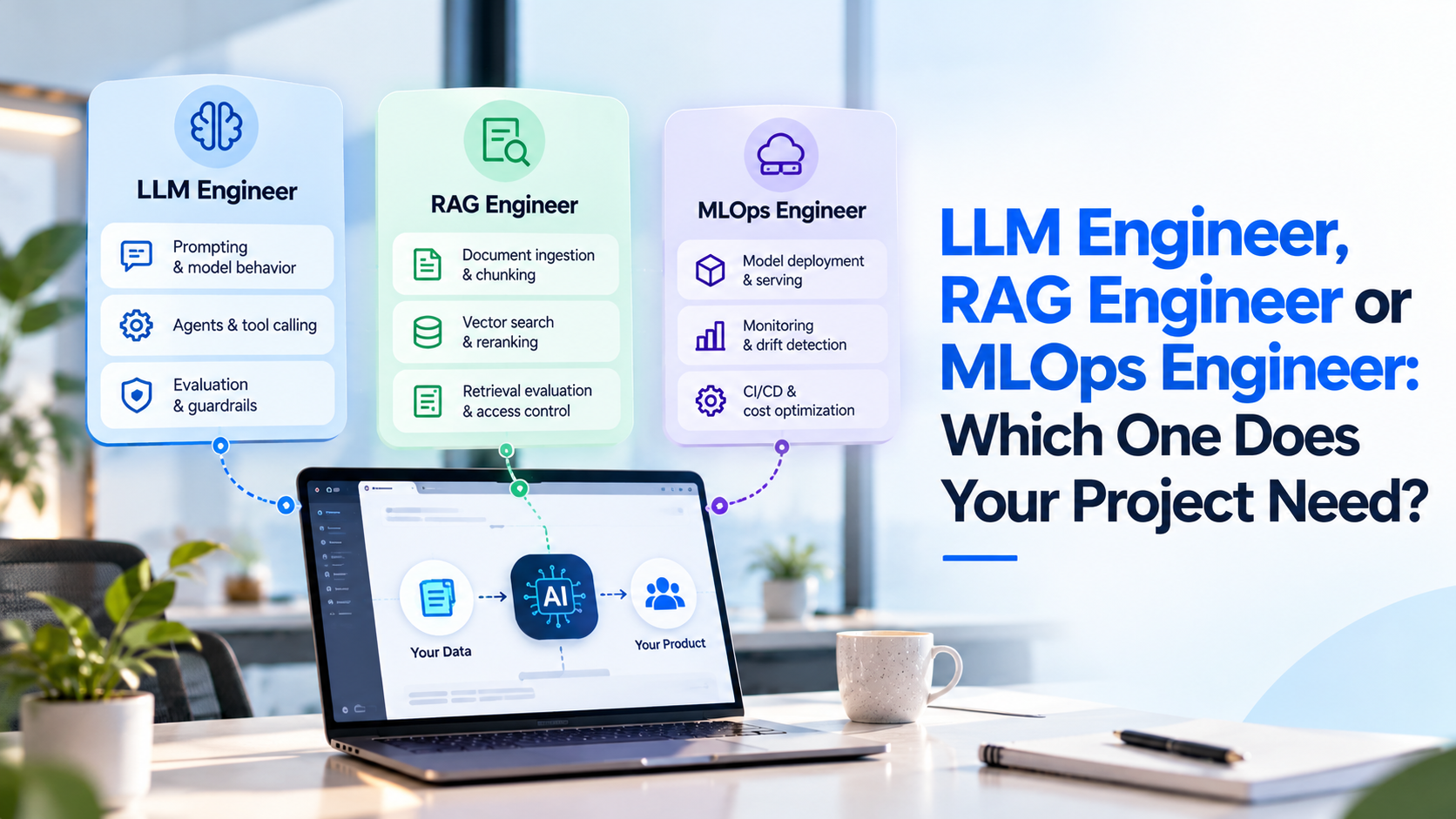
If you need a view on which specialist engineers sit under the architect, see our comparison of LLM, RAG and MLOps engineers.
Fractional AI CTO vs AI solution architect: side by side
| Fractional AI CTO | AI solution architect | |
|---|---|---|
| Core question | What should we do with AI, and in what order? | How should this system be built? |
| Scope | Portfolio of use cases, budget, team, governance | One system or a related set |
| Typical deliverables | AI roadmap, prioritized use-case list, build-vs-buy decisions, sourcing plan, governance model, phase-gate criteria | Reference architecture, integration map, ADRs, non-functional requirements, evaluation plan, build estimate inputs |
| Usual time shape | Part-time over months; steering cadence | Intensive during design, then reviews during build |
| Reports to | CEO, COO or existing CTO | CTO, head of engineering or the product owner |
| Success looks like | The right projects funded, the wrong ones stopped early | A system that passes security review and ships without redesign |
| Weak spot if used alone | Strategy with no buildable design | Good design for the wrong problem |
Who holds which decision rights?
Decision rights are where most engagements go wrong, because nobody writes them down. NIST's AI Risk Management Framework asks organizations to make sure roles, responsibilities and lines of communication for managing AI risk "are documented and are clear to individuals and teams throughout the organization" (GOVERN 2.1). Do that before either person starts.
A workable split:
| Decision | Fractional AI CTO | AI solution architect | Your executive |
|---|---|---|---|
| Which use cases get funded | Recommends | Advises on feasibility | Decides |
| Build, buy or partner | Decides within delegated budget | Advises | Approves above threshold |
| Model and hosting choice | Sets constraints | Decides | Informed |
| Integration and data flow design | Reviews | Decides | Informed |
| Accepting residual AI risk | Recommends | Documents | Decides |
| Go or no-go at each phase gate | Recommends | Confirms technical readiness | Decides |
The last column is deliberate. NIST's GOVERN 2.3 says "executive leadership of the organization takes responsibility for decisions about risks associated with AI system development and deployment." A fractional leader can prepare those decisions; a permanent executive has to own them.
Which one should you bring in first?
Work through these in order and stop at the first match.
- You can't name the business outcome, owner and budget for AI this year. Bring in a fractional AI CTO. Pairing that with an AI readiness assessment gives the engagement a factual starting point on data, skills and governance.
- Several AI ideas are competing for the same budget, or the board wants an AI plan. Fractional AI CTO. Ranking a portfolio is not an architecture problem.
- One use case is approved and funded, but nobody knows how it fits your systems, data and compliance rules. AI solution architect.
- The use case and architecture are both clear. Neither. Hire the builders, or a pod with a strong technical lead, and use a senior reviewer for design checkpoints.
- You're regulated, it's your first major AI build, and the project touches several systems. Both, staggered: the CTO a few days a month for governance and phase gates, the architect closer to full-time through design.
Gartner's July 2024 prediction is a useful sanity check. It expected at least 30% of generative AI projects to be abandoned after proof of concept by the end of 2025, due to "poor data quality, inadequate risk controls, escalating costs or unclear business value." Unclear value is a CTO problem; data quality and risk controls are mostly architecture problems; cost overruns usually involve both. Whichever failure you fear most points to who comes first. Our breakdown of why AI pilots fail goes deeper on each cause.
What are the red flags for each role?
Red flags when you hire a fractional AI CTO
- Undisclosed vendor ties. Ask directly whether they resell, refer for or hold equity in any platform they might recommend.
- A roadmap with no kill criteria. If nothing can be stopped, nothing has been prioritized.
- No exit plan. A fractional engagement should end with a permanent owner in place, internal or hired. Ask who takes over and when.
- Reluctance to put decision rights in writing. Advice without defined authority turns into either paralysis or overreach.
- Wanting to write the code. Hands-on prototypes have a place, but a CTO who disappears into a build stops doing the portfolio job.
Red flags when you hire AI solution architects
- Diagrams without decisions. Boxes and arrows with no ADRs or stated trade-offs.
- The stack arrives before the questions. A preferred framework or vector database named before they've seen your data or constraints.
- No evaluation plan. If they can't say how quality will be measured, the design isn't finished.
- Silence on non-functional requirements. No mention of residency, access control, latency or cost per request.
- Design for imagined scale. Kubernetes clusters and multi-region failover for an internal tool with forty users.
- Leaving at the build line. An architect who hands over a document and leaves can't answer the questions the build team raises in week three.
How do they work with an AI pod?
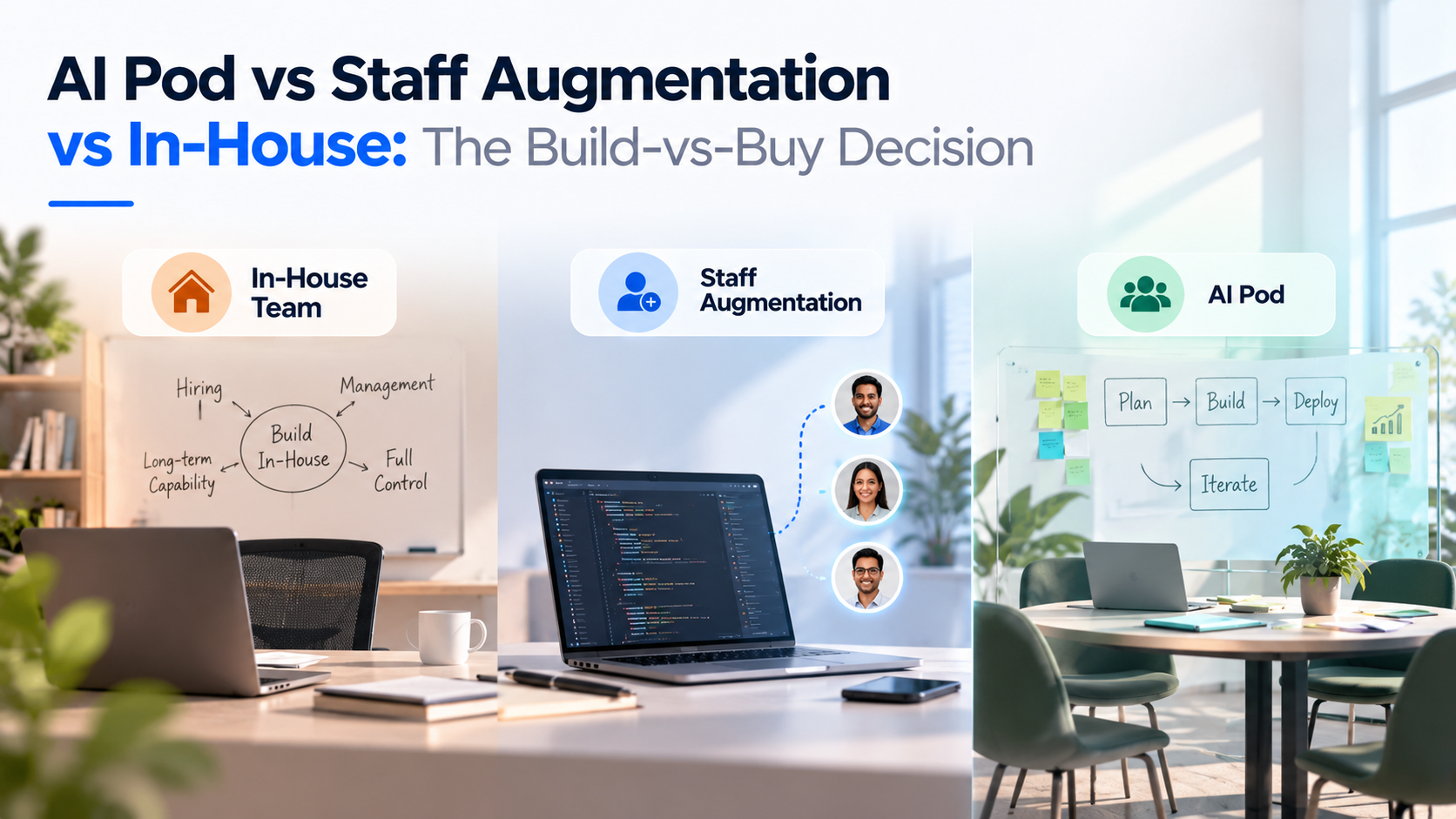
An AI pod is a small cross-functional team that ships one outcome; our explainer on what an AI pod is covers the model. The CTO and architect plug into it at different levels.
The fractional AI CTO sits on the sponsor side. They define the outcome and success metric the pod is accountable for, attend steering reviews every few weeks, approve phase gates and decide what happens after the engagement: scale, hand over, or stop. They should not direct day-to-day pod work; that belongs to the pod's delivery lead. Where the build-or-partner question is still open, our build vs buy decision framework is the CTO's starting tool.
The AI solution architect works at the pod's technical level. Most pods already include a technical lead or AI architect seat, as our guide to the roles inside an AI engineering pod explains. If you also bring in your own architect, agree up front who holds the pen on ADRs. Two architects with equal authority produce slow decisions or quiet rework. The cleanest pattern is your architect sets constraints and reviews, while the pod's technical lead owns the detailed design and the evaluation harness.
Either way, keep a single written record of who decides what. The pod reads it on day one.
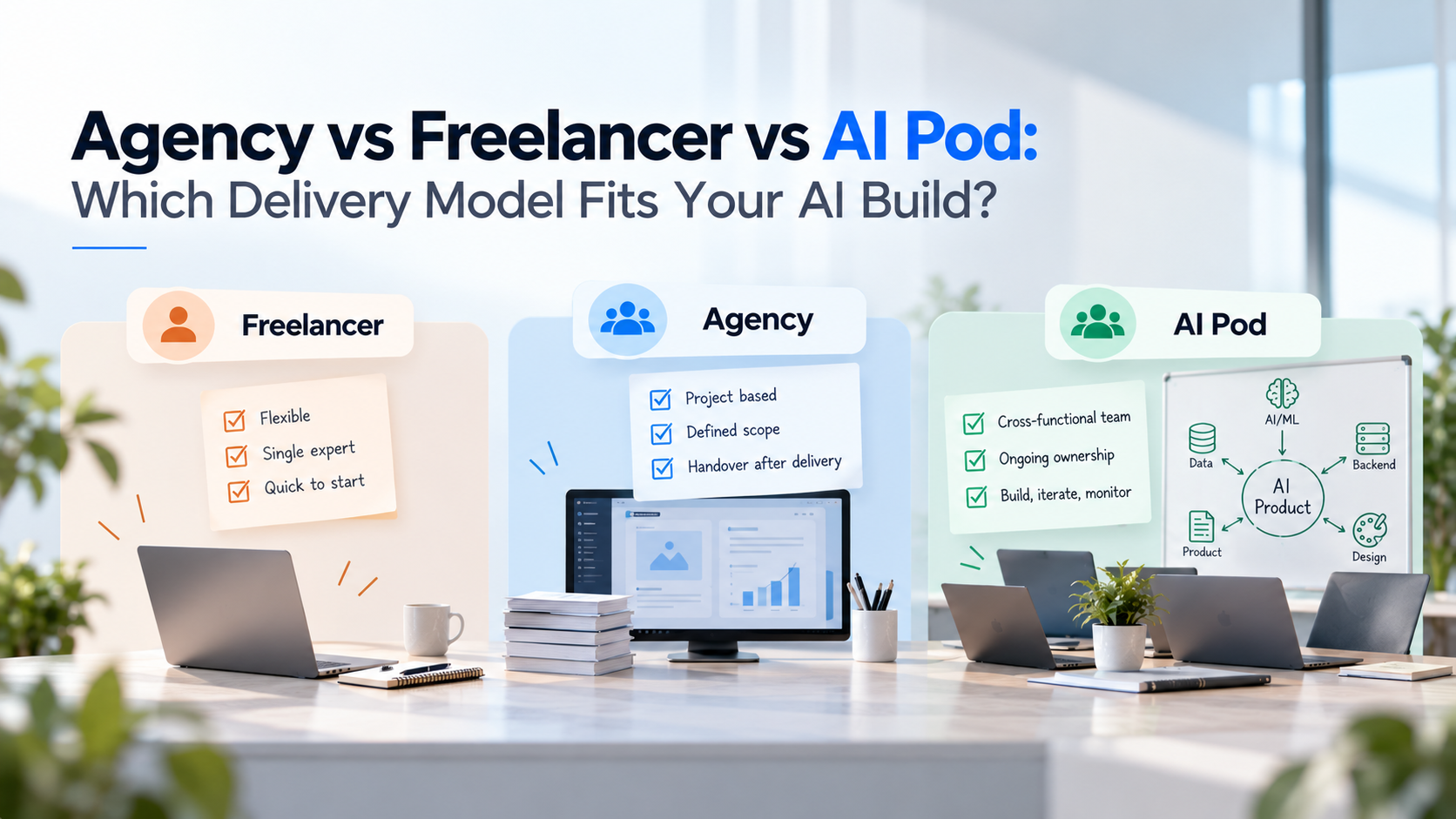
If you're still deciding whether to bring in outside leadership at all, fractional AI CTO services and broader AI consulting are worth comparing against a single senior hire.
How fwdpod approaches this
Fwdpod builds dedicated AI engineering pods for startups and enterprises, covering LLM development, RAG systems, AI agents and product delivery, with engineering delivery from India. Each pod is 4 to 6 experts working around a single measurable outcome, which is the outcome a fractional CTO should be defining. How a pod works alongside your own technical leadership is something the team can walk you through on a first call. To see how a pod is scoped, configure your AI engineering pod by answering five questions and receive a custom proposal within 48 hours, or talk to the team about engagement terms and pricing.
Frequently Asked Questions
1. What is a fractional AI CTO?
A fractional AI CTO is a senior technology leader engaged part-time, for a defined period, to set an organization's AI direction: which use cases to pursue, how to source the work, how to govern AI risk and when to hire permanent leadership. They advise and decide within delegated limits rather than joining as a full-time executive.
2. Can an AI solution architect replace a fractional AI CTO?
Not usually. An architect designs how a defined system will be built; they rarely have the mandate to rank competing use cases, set budget or define governance. In a company with one clearly approved AI project and an engaged executive sponsor, an architect may be enough on their own.
3. How long does a fractional AI CTO engagement usually last?
Most are structured around milestones rather than a fixed term: an initial assessment and roadmap, then a period of steering while the first projects run, ending when a permanent owner takes over. Agree the exit condition at the start so the engagement does not drift into an open-ended retainer.
4. Should a fractional AI CTO run the AI readiness assessment?
It is a good fit, because the assessment's findings on data, skills and governance feed directly into the roadmap the CTO will own. What matters most is that the person who runs it is independent of any platform they might later recommend.
5. What should I ask in an interview for an AI solution architect?
Give them a real use case with constraints, such as data residency and an existing CRM, and ask them to talk through the first three decisions they would record and what they would need to know first. Strong candidates ask about data, users and evaluation before naming any tools.
6. Do I still need an AI solution architect if my delivery partner has one?
Not always. If the partner's technical lead documents decisions and your team reviews them, that can be sufficient. An independent architect on your side is worth it when the system touches several core platforms, carries regulatory risk, or will be handed back to your engineers to run.
7. Is a fractional AI CTO the same as an AI consultant?
No. A consultant typically delivers a report or recommendation and leaves. A fractional AI CTO takes on an ongoing leadership role with defined decision rights, attends steering reviews and is accountable for whether the roadmap is followed, not only for writing it.