AI Team Structure and Roles: Org Design That Actually Ships
Explore 4 AI team structure models, compare their strengths, and learn how to assign governance roles, choose reporting lines, and scale AI delivery.
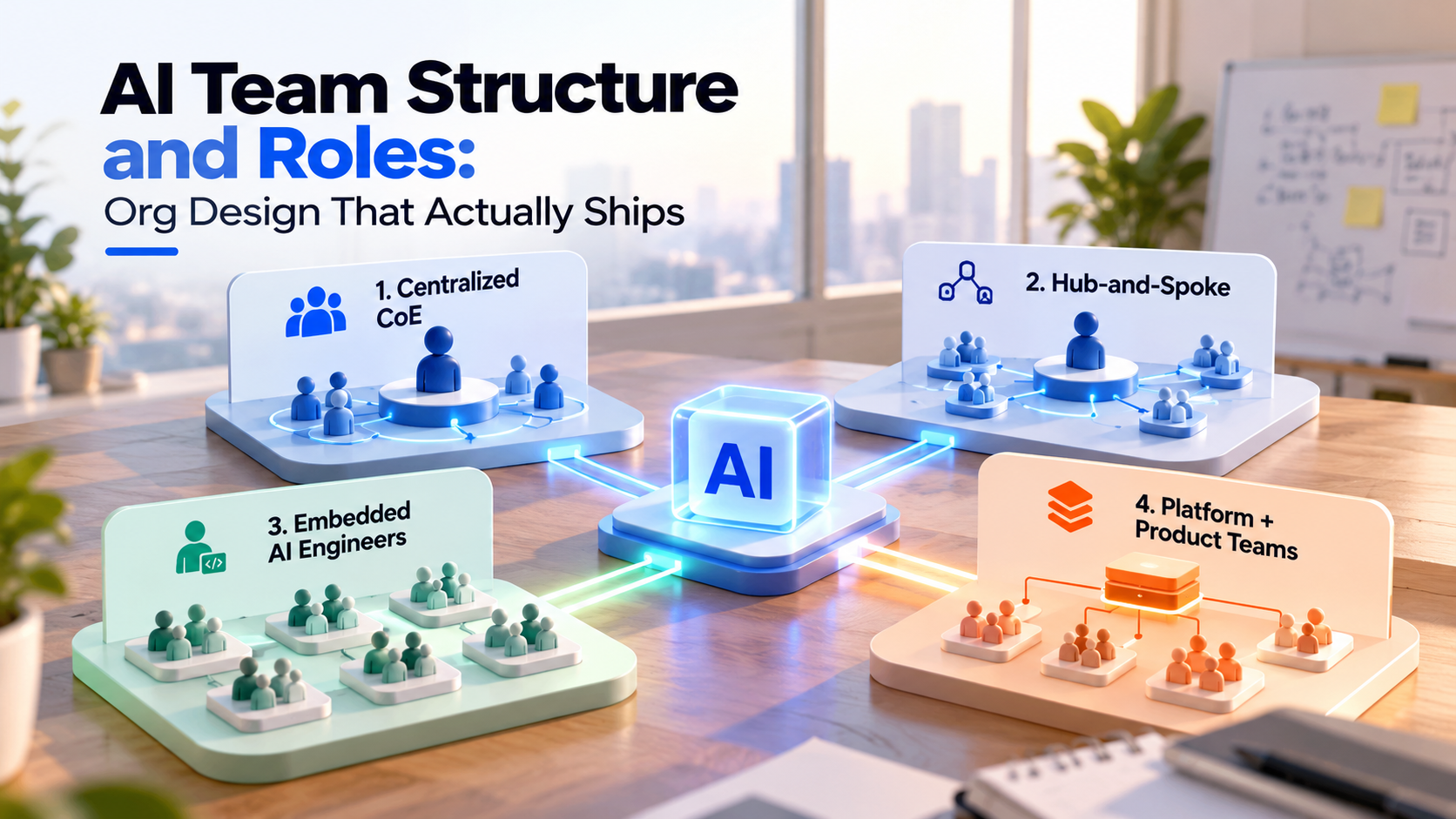
The right AI team structure and roles depend on how many AI use cases you run and how much risk they carry. Most companies choose between four models: a centralized center of excellence (CoE), hub-and-spoke, AI engineers embedded in product teams, or a central AI platform team serving product teams. Most mature organizations end up with hub-and-spoke or platform-plus-product teams, with governance kept central.
This guide works at the level of the whole organization: where AI teams sit, who they report to, which governance roles you need and how external capacity plugs in. It doesn't cover the seats inside a single delivery team; those are in the six roles inside an AI engineering pod. Headcount for a specific project is covered in how many AI engineers you need. Both sit alongside this guide in our AI Pods & Engineering Teams section.
What are the four ways to structure an AI team?
| Model | Where AI engineers sit | Who sets standards | Best fit | Typical failure |
|---|---|---|---|---|
| Centralized CoE | One central AI team | The CoE | First 1–5 use cases; small or highly regulated orgs | Becomes a queue; builds things business units don't adopt |
| Hub-and-spoke | Core experts in a hub; practitioners in business units | The hub | Several business units with different use cases | Spokes drift from hub standards; hub is under-resourced |
| Embedded (federated) | Inside product or business teams | Each team, loosely | AI-native products; strong engineering culture | Duplicated tooling, uneven evals, no shared governance |
| Platform + product teams | Platform team builds shared AI infrastructure; product teams build features on it | Platform team (tooling), governance function (policy) | Many AI features across one or more products | Platform builds for itself instead of its internal customers |
These are not mutually exclusive stages. Many companies start centralized, move to hub-and-spoke as demand grows, and grow a platform team inside the hub once enough product teams share the same infrastructure.
1. Centralized AI center of excellence
                 CTO / CDO / CAIO
                        |
              AI Center of Excellence
     +------------+-----+------+-------------+
     |            |            |             |
 AI engineers  Data eng.   MLOps/LLMOps  Governance & risk
     |
     +--> builds for --> Sales | Ops | Finance | Product
                         (requesting teams, no AI staff)
All AI talent, tooling and governance sit in one team, which takes requests from the business. It works well when you have little AI talent and need to concentrate it, or when the risk is high enough that you want one set of hands on every system.
McKinsey's March 2025 State of AI survey (1,491 respondents) found that organizations often run risk and compliance and data governance through "a fully centralized model such as a center of excellence," and that companies with under $500 million in annual revenue were more likely to fully centralize talent and adoption too.
The failure mode is distance. A CoE that builds for a business unit, rather than with it, ships systems that nobody in that unit feels responsible for. That ownership gap is one of the root causes in why AI pilots fail.
2. Hub-and-spoke
                    AI Hub (central)
        standards | platform | evals | governance
           /             |               \
     Spoke: Claims   Spoke: Underwriting   Spoke: Customer service
     2 AI engineers  1 AI eng + 1 data eng  2 AI engineers
     reports to BU   reports to BU          reports to BU
     dotted line to hub on standards and reviews
The hub keeps the scarce, shared things: architecture standards, the eval approach, model and vendor choices, platform tooling and governance. The spokes are AI practitioners who sit in business units, report into those units and follow hub standards through a dotted line.
This is the most common pattern for talent at scale. In the same McKinsey survey, respondents most often described tech talent and the adoption of AI solutions as run on a "hybrid or partially centralized model." IBM's 2025 study of more than 600 Chief AI Officers or equivalent across 22 countries reported that organizations where CAIOs drive a centralized or hub-and-spoke AI operating model can realize a 36% higher ROI on AI initiatives. That figure is self-reported, so treat it as directional.
The hard part is the dotted line. If spoke engineers are rated only by their business unit, hub standards become suggestions within a year.
3. Embedded AI engineers
   Product team A          Product team B          Product team C
   PM, 4 eng, 1 AI eng     PM, 3 eng, 1 AI eng     PM, 5 eng, 2 AI eng
         |                        |                       |
   own tooling,            own tooling,            own tooling,
   own evals               own evals               own evals
                 (optional AI guild for knowledge sharing)
AI engineers sit directly in product teams with no central AI function, sometimes linked by an informal guild. This is fast and keeps AI close to users. It suits companies where AI is the product and engineering standards are already strong.
It breaks down on anything shared: each team picks its own model provider, logging, prompt management and eval method, and nobody can answer "which AI systems touch customer data?" Embedded models need at least a central governance owner, even if they have no central build team.
4. Platform team plus product teams
   Stream-aligned product teams (build AI features)
   +-----------+   +-----------+   +-----------+
   | Search    |   | Support   |   | Billing   |
   +-----+-----+   +-----+-----+   +-----+-----+
         |  consume "as a service"       |
   +-----v-------------------------------v-----+
   | AI platform team                           |
   | model gateway, RAG/retrieval services,     |
   | eval tooling, tracing, guardrails, cost    |
   +--------------------------------------------+
   Enabling team (optional): coaches product teams on evals and design
This model borrows directly from Team Topologies, which defines a platform team as one that provides "a compelling internal product to accelerate delivery by Stream-aligned teams," and an enabling team as one that "helps a Stream-aligned team to overcome obstacles." Product teams own features and outcomes; the platform team owns the shared machinery, such as the model gateway, retrieval services, eval tooling, tracing and cost controls.
It's the model that scales furthest, but only once you have enough product teams using AI to justify a platform. Build one too early and you get infrastructure in search of a customer.
Which AI team structure fits your stage?
| Your situation | Start with | Add next |
|---|---|---|
| First 1–3 use cases, little AI talent in-house | Small centralized team, or one outside pod reporting to a single executive | A named governance owner before the first production launch |
| 3–10 use cases across several business units | Hub-and-spoke | Shared eval and tracing tooling in the hub |
| AI features across many product teams | Platform team + product teams | Enabling team to coach product teams |
| AI is the core product | Embedded engineers + platform team | Central governance function and an independent review step |
| High-risk or regulated use cases | Centralized governance in every model | Independent validation separate from the builders |
Headcount is a separate question from shape. A hub can be three people; a platform team can be two. For the numbers, use the sizing guide linked in the introduction rather than a fixed ratio.
Where should AI report: CTO, CDO or Chief AI Officer?
There is no single correct reporting line, but each one has a predictable bias.
| AI reports to | Strength | Risk |
|---|---|---|
| CTO / VP Engineering | Strong engineering standards; AI ships inside the product | Back-office and operations use cases get less attention |
| CDO / Chief Data & Analytics Officer | Data access, quality and governance are already in place | Can stay in analytics mode and stall at prototypes |
| CIO | Enterprise systems, vendors and security are in reach | Tends toward buying tools rather than building capability |
| Chief AI Officer (CAIO) | One accountable owner for strategy, portfolio and risk | Becomes a title without budget or authority over delivery |
| Business unit heads | Close to value and users | Fragmentation; no shared standards |
How common is the Chief AI Officer role?
It is growing quickly, although survey samples vary. IBM's 2025 study, based on more than 600 CAIOs or equivalent, put the share of organizations with a CAIO at 26%. IBM's May 2026 CEO study (2,000 CEOs and senior leaders across 33 geographies) reported 76% of surveyed organizations had a CAIO in 2026. The two samples differ, so read the jump as a strong trend rather than a precise growth rate.
The US federal government made the role mandatory. OMB memo M-24-10 (28 March 2024) required each agency to designate a Chief AI Officer within 60 days and required CFO Act agencies to set up an AI Governance Board chaired by the Deputy Secretary or equivalent. OMB memo M-25-21 (3 April 2025) rescinded and replaced M-24-10 but kept both requirements: agencies must retain or designate a CAIO within 60 days, the CAIO must be positioned to engage regularly with the Deputy Secretary or equivalent, and CFO Act agencies must convene an AI Governance Board within 90 days, with the CAIO as vice-chair. M-25-21 also lets an agency designate an existing official, such as the CIO or CDO, if that person has significant AI expertise.
The useful lesson for private companies is the pattern, not the title: one senior named owner for AI, plus a cross-functional board chaired above that owner. Some companies give that job to the CTO; some create a CAIO. Either works if the role has authority over the portfolio and a seat with the executive team. McKinsey's 2025 survey found that 28% of respondents say their CEO oversees AI governance, and identified CEO oversight as one of the elements most correlated with higher self-reported bottom-line impact from gen AI.
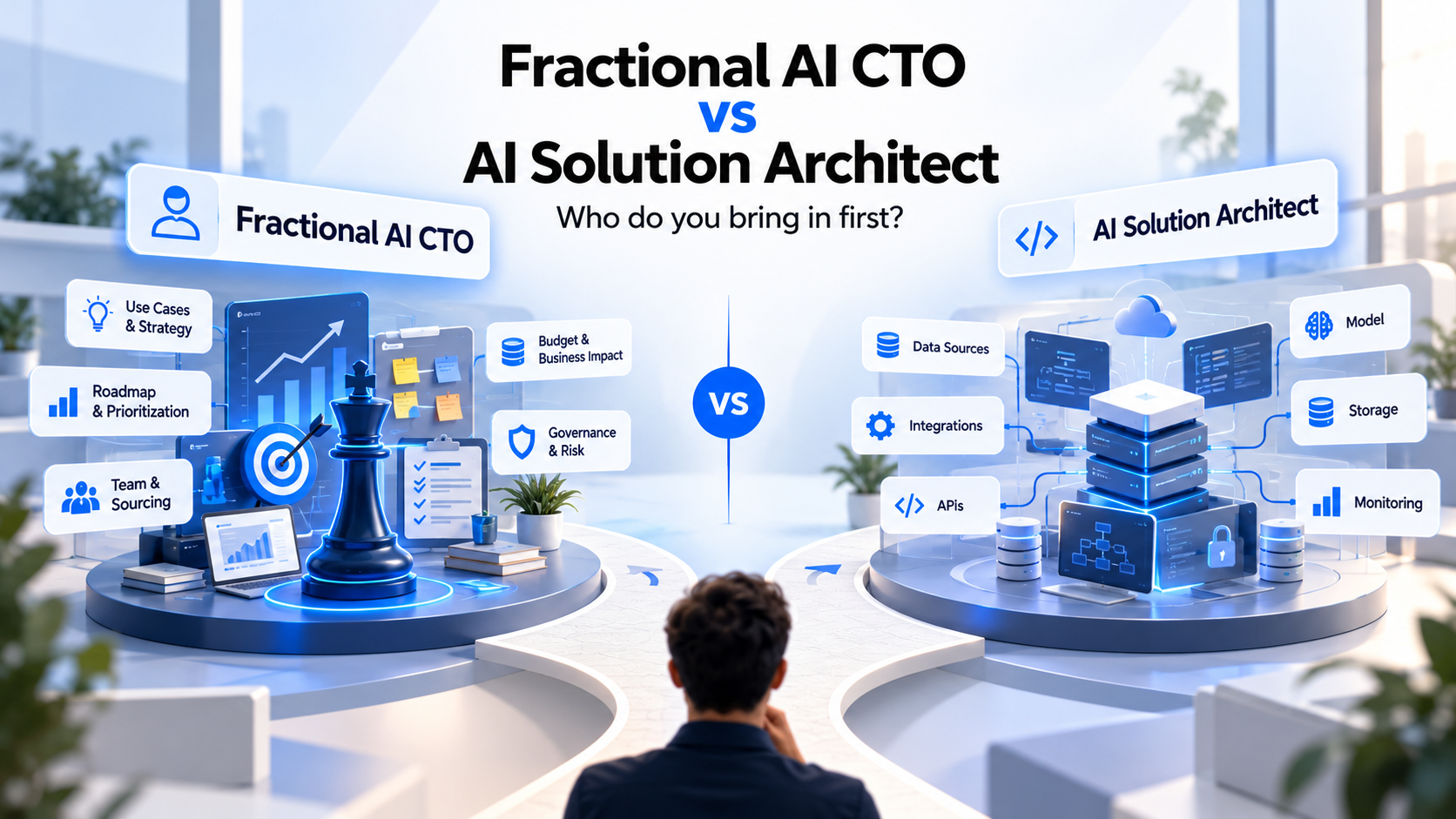
If you need senior AI leadership before you can justify a full-time executive, see fractional AI CTO vs AI solution architect.
Which governance roles does an AI organization need?
Delivery roles build systems; governance roles decide which systems may run, and on what terms. The NIST AI Risk Management Framework asks that "roles and responsibilities and lines of communication" for managing AI risk are documented and clear (GOVERN 2.1), and that executive leadership "takes responsibility for decisions about risks" (GOVERN 2.3).
| Governance role | Owns | Typical home |
|---|---|---|
| Accountable AI executive (CAIO, CTO or CDO) | AI portfolio, risk appetite, final escalation | Executive team |
| AI governance board or council | Approving high-risk use cases, policy, exceptions | Cross-functional: legal, security, data, business, engineering |
| AI risk / model risk lead | Risk classification, use-case inventory, review gates | Risk, compliance or the hub |
| Independent validator | Testing the system against requirements before launch | Separate from the build team |
| Privacy and security reviewers | Data handling, access, threat models | Existing privacy and security functions |
| Use-case owner | Business outcome and adoption for one system | The business unit using it |
| Human oversight owner | Day-to-day monitoring and the ability to intervene | The operating team |
Two of these are easy to miss. The independent validator matters because NIST's MEASURE function refers to "internal experts who did not serve as front-line developers for the system and/or independent assessors." And the human oversight owner is becoming a legal role: under Article 26(2) of the EU AI Act, deployers of high-risk AI systems must assign human oversight to "natural persons who have the necessary competence, training and authority." Following the AI Omnibus amendments published in July 2026, those high-risk obligations apply from 2 December 2027 for Annex III systems and 2 August 2028 for Annex I systems. This is a general summary, not legal advice; involve your counsel on how it applies to you.
How do external AI pods plug into your org structure?
An outside pod should slot into your structure, not sit beside it. Team Topologies' three interaction modes give a clean way to describe the fit:
- Collaboration: the pod works closely with your platform team or hub "for a defined period of time to discover new things." Typical in discovery and early build.
- X-as-a-Service: the pod consumes your platform (model gateway, retrieval, tracing) rather than building its own. Typical once a platform exists.
- Facilitation: the pod acts as an enabling team, coaching embedded engineers on evals or agent design.
   Accountable AI executive ---- AI governance board
              |
           AI Hub ---------------------------+
     standards | platform | evals            |
        /              \                     |
  Spoke: Ops        External pod (time-boxed)
  (internal)        - uses hub platform + standards
                    - passes the same review gates
                    - pairs with a named internal owner
                    - hands over runbooks and evals at exit
Four rules make this work in any of the four models:
- Same gates. The pod goes through the same risk classification, security review and validation as an internal team. The controls to demand in writing are in data security in offshore AI development.
- Same platform. Where a hub or platform exists, the pod builds on it. A pod that brings its own stack creates a system your team can't run.
- A named internal owner. One person on your side receives the system, joins the pod's working sessions and signs off on handover.
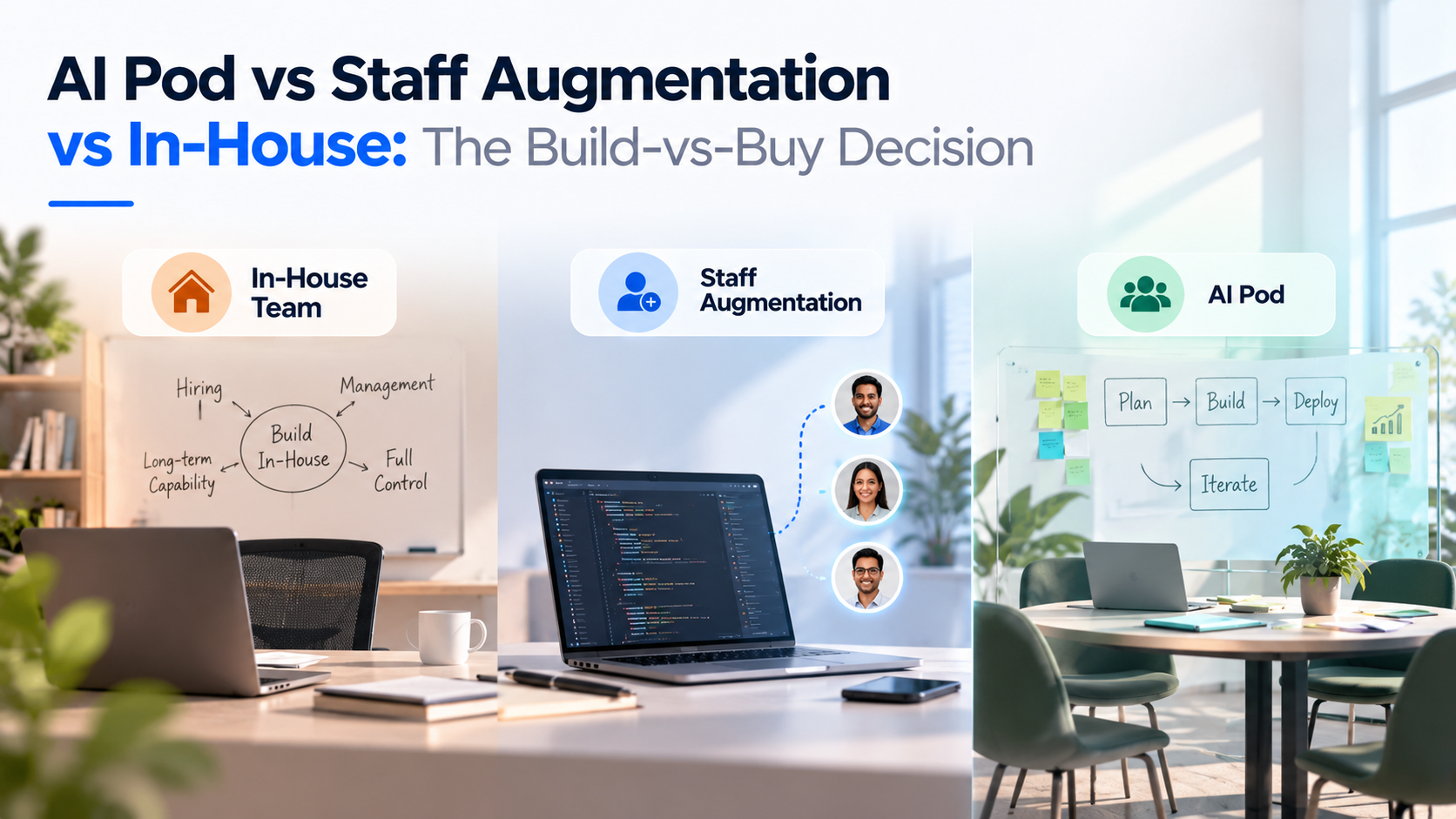
- A planned exit. Agree up front whether the pod hands over to a spoke, the platform team or a product team. The trade-offs between keeping, transferring and buying capability are in build vs buy AI capability.
Contract shape also matters here. A pod can be engaged for a fixed outcome or as ongoing capacity; see AI engagement models for how each allocates risk, and security and IP terms for what the contract should say about data and ownership.
What mistakes undermine AI org design?
- Copying a big-tech structure at small scale. A platform team for two use cases is overhead, not acceleration.
- A CAIO title with no budget. If delivery teams don't answer to the AI owner on standards, the role is advisory.
- Governance as an afterthought. Naming the governance board after the first production incident is the expensive order.
- Builders validating their own work. Keep at least one review step outside the team that built the system.
- No receiving team. Every external or central build needs a team that will run it in month six.
- Measuring the AI team on output, not adoption. Systems shipped is not the metric; systems used is.
How fwdpod approaches this
Fwdpod builds dedicated AI engineering pods for startups and enterprises, covering LLM development, RAG systems, AI agents and product delivery, with engineering delivery from India for buyers in the US, UK, EU and the Gulf. Pods are 4–6 experts organized around a single measurable outcome, and pod templates (Voice AI, Agentic Operations, RAG and Knowledge, Compliance AI and Custom) range from 8 to 16 weeks. How a pod would plug into your existing hub, platform team or governance board is something the team can walk you through on a first call. For help with org design itself rather than delivery, see AI consulting. To see how a pod would fit your structure, configure your AI engineering pod and receive a custom proposal within 48 hours, or talk to the team.
Key takeaways
- AI team structure comes down to four models: centralized CoE, hub-and-spoke, embedded, and platform plus product teams.
- Most organizations start centralized and move toward hub-and-spoke or platform models as use cases multiply; governance stays central in all of them.
- Where AI reports matters less than whether one senior owner has real authority, plus a cross-functional board above them.
- Name governance roles early, including an independent validator and a human oversight owner for each system.
- External pods should use your platform, pass your gates and hand over to a named internal owner.
Frequently Asked Questions
1. Is a center of excellence the same as an AI platform team?
No. A center of excellence usually builds AI solutions for business units and often owns governance as well. A platform team builds shared infrastructure, such as model access, retrieval, evals and monitoring, that other teams use to build their own features. A large organization can have both, with the platform team sitting inside the CoE or hub.
2. Does a mid-sized company need a Chief AI Officer?
Not necessarily. It needs one senior person who is clearly accountable for the AI portfolio and its risks. That can be the CTO, CDO or CIO if they have the time and AI expertise. A dedicated CAIO makes more sense once AI spans several business units and needs its own budget and executive attention.
3. Should AI engineers report to the business unit or a central team?
In a hub-and-spoke model, both: a solid line to the business unit for priorities and a dotted line to the central hub for standards, reviews and career development. If only the business unit rates their work, central standards tend to erode, so build hub input into performance reviews.
4. When should a company move from a centralized AI team to hub-and-spoke?
Common signals are a growing request queue, business units hiring their own AI staff anyway, and central builds that see low adoption. At that point, keep standards, platform and governance central and move delivery closer to the business units that use the systems.
5. Who should sit on an AI governance board?
Typically the accountable AI executive, plus leaders from legal, privacy, security, data, risk or compliance, engineering and the main business units using AI. The board approves high-risk use cases, sets policy and handles exceptions. It should meet on a schedule, not only after an incident.
6. Can an external partner run our AI center of excellence?
A partner can staff and run parts of it, such as delivery capacity, platform engineering or eval tooling. Accountability for AI risk, the use-case inventory and final approval of high-risk systems should stay with your own leadership, because those decisions cannot be outsourced.