Build vs Buy AI Capability: A Decision Framework for CTOs
Build vs buy AI capability is three decisions, not one. Use this six-factor matrix to choose SaaS AI, API builds or a team, plus a partner-builds-you-own path.
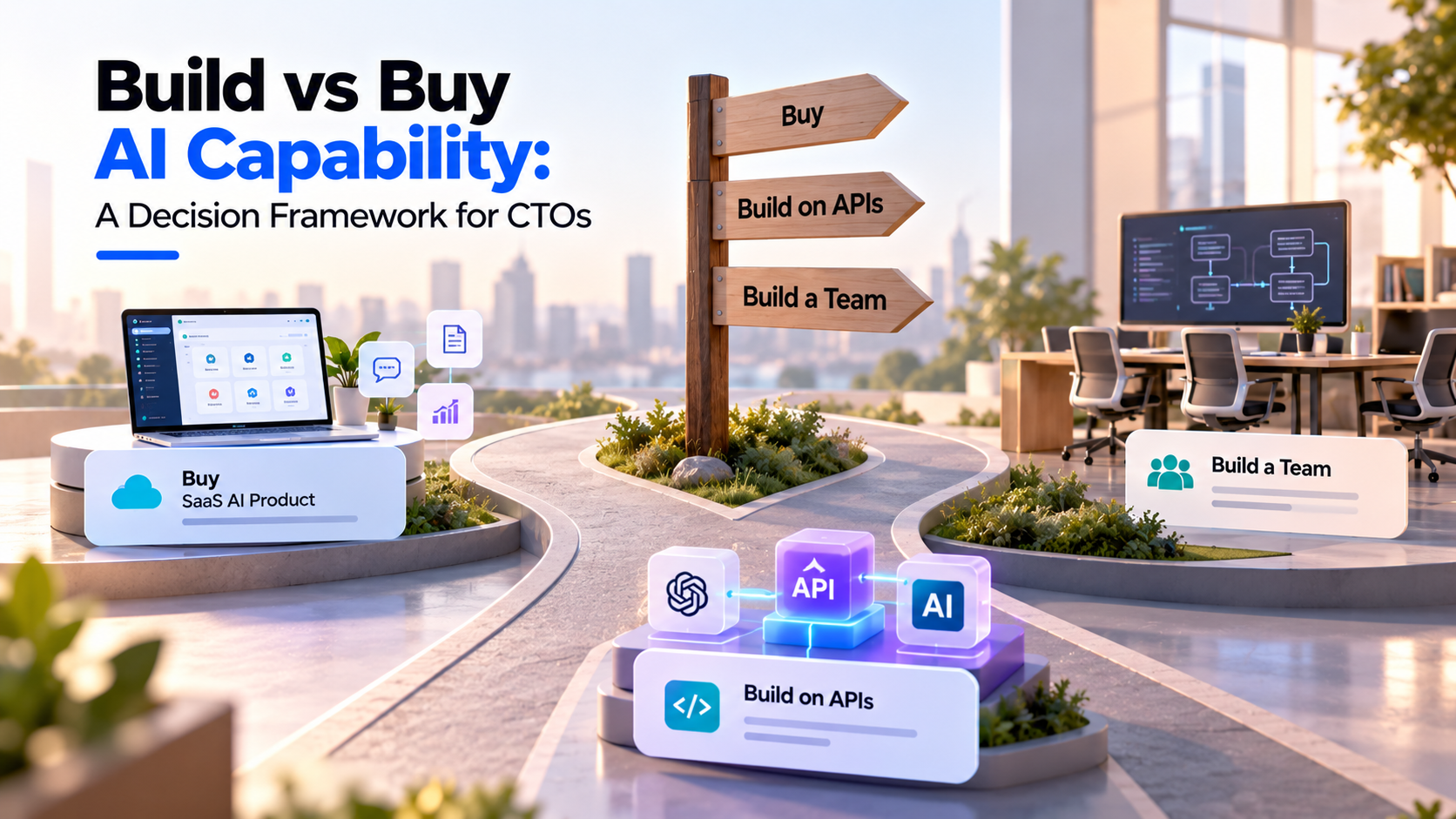
The build vs buy AI capability decision is really three decisions stacked on top of each other. First, buy a finished SaaS AI product or build your own application. Second, if you build, build on foundation-model APIs rather than training models yourself. Third, decide who does the building: an in-house team, a partner, or a partner that hands over to you.
Most teams get stuck because they argue about all three at once. A product manager says "just buy a tool", an architect says "we should own the model", and a finance lead asks why anyone needs to hire. They are each answering a different layer.
This guide, part of our AI strategy: pilot to production series, separates the layers, gives you a six-factor decision matrix (differentiation, data sensitivity, time to value, talent availability, control and lock-in, maintenance), and describes a hybrid route that many organizations end up on: a partner builds, you own everything from day one, and the capability transfers to your team later.
We have deliberately left cost out of the framework. Cost follows from the answers below, and it is only comparable once you know which layer you are pricing.
Why is build vs buy for AI three decisions, not one?
Classic build vs buy was a single fork: license the software or write it. Generative AI split that fork into layers, because almost nobody "builds" AI from scratch any more. Training a frontier model is out of reach for most companies, so "build" usually means building an application on top of someone else's model.
Gartner describes the same split in its guidance on deploying AI: AI embedded in software you already license, best-of-breed tools that departments bring in, and "built and blended" AI, where central teams combine foundation-model APIs with their own front ends and integrations. Gartner's analysts argue that the most effective AI for most organizations will combine these sources rather than pick one.
Here is how the three layers map to real choices:
| Layer | The "buy" end | The "build" end | The question you are really answering |
|---|---|---|---|
| 1. Product | SaaS AI tool or an AI feature inside software you already license | Your own AI application or feature | Is this use case generic, or does it carry our specific data, workflow or advantage? |
| 2. Model | Foundation-model APIs (hosted models from a model provider) | Fine-tuned, open-weight or self-trained models you run | How much control over the model do we need, and can we justify operating it? |
| 3. Team | A partner, pod or agency builds it | An in-house AI team builds it | Who should hold the engineering capability, now and in two years? |
Most organizations should buy at layer 1 for commodity use cases, build on APIs at layer 2 for everything differentiated, and make the layer 3 decision separately, on talent and timing rather than on principle.
Layer 1: When should you buy a SaaS AI product?
Buy when the use case is the same at your company as at every other company. Meeting notes, general writing help, code completion, first-line IT ticket triage and document search over a standard workspace fall here. A vendor with thousands of customers will improve the product faster than you can, and you get something usable in days.
Buying also has the best evidence behind it for first deployments. MIT NANDA's 2025 GenAI Divide research, as reported by Fortune, found that purchasing AI tools from specialized vendors and building partnerships succeeded about 67% of the time, while internal builds succeeded only one-third as often. Treat the exact figures as directional (Fortune reports the research drew on 150 leader interviews, a survey of 350 employees and an analysis of 300 public AI deployments, not a controlled study), but the direction matches what most engineering leaders see: first-time internal builds stall more often.
Signs you are outgrowing a bought tool:
- The workflow you need does not exist in the product, and the vendor's roadmap will not add it.
- The tool cannot reach the systems where the work happens (your claims platform, your ERP, your internal APIs).
- Your team spends more time working around the tool than using it.
- The data you need to send it is more sensitive than the vendor's terms or certifications allow.
- The AI output is part of what your customers pay you for, so a competitor can buy the same capability off the shelf.
That last point matters most. If a competitor can buy the same tool, it cannot be your differentiation.
Layer 2: When should you build on foundation-model APIs?
Build on APIs when the use case depends on your data, your workflow or your product, but you do not need to change how the model itself works. This is the default "build" for most companies in 2026: an application that calls a hosted model, grounded in your own data through retrieval, wrapped in your own business logic, evaluations and guardrails.
What you own in this layer is everything except the model weights: prompts, retrieval pipelines, tool integrations, evaluation sets, guardrails, the user experience and the operating runbook. That is usually where the differentiation lives anyway.
Two things change when you choose this layer:
Data terms become a vendor question, not a blocker. Major providers separate their commercial API terms from their consumer products. Anthropic, for example, states that by default it will not use inputs or outputs from its commercial products, including the Anthropic API, to train its models. Your security team still needs to review retention, residency and subprocessors, but "we cannot send data to an API" is often a terms question you can settle before you start.
Models become a dependency you must maintain. Hosted models are retired on the provider's schedule. OpenAI's deprecations page states that software relying on its models "may need occasional updates to keep working", and commits to at least six months' notice for generally available models, at least three months for specialized variants, and much shorter notice, such as two weeks, for preview models. Every model migration means re-running your evaluations. If you have no evaluation suite, every migration becomes a guessing game.
Going further down this layer (fine-tuning, running open-weight models, or training your own) is a separate decision with its own trade-offs. Our guides on OpenAI API vs open-weight models and on when to fine-tune vs use RAG cover that choice in depth.
Layer 3: Who should build it, an in-house team or a partner?
Once you have decided to build, the question becomes who holds the pen. This is a talent and timing decision more than a strategic one:
- In-house team when AI is core to the product for years, you can hire and retain the people, and you can afford the ramp time before the first release.
- Partner or AI pod when you need to ship before you can hire, when the work needs skills you will not need permanently, or when you want a working system to learn from before you design your own team.
- Partner builds, you own, transfer later when you want both: speed now and an internal capability later. This hybrid gets its own section below.
We compare the team models themselves (accountability, management load, knowledge retention, cost drivers) in our AI pod vs staff augmentation vs in-house comparison, so we will not repeat that here. What matters for this decision is that layer 3 is reversible in a way layers 1 and 2 often are not, provided you structure ownership correctly.
The build vs buy AI decision matrix
Score each use case, not your AI strategy as a whole. A single company will usually buy some capabilities, build others on APIs, and staff them differently.
| Factor | Leans buy SaaS AI | Leans build on model APIs | Leans in-house team (vs partner) |
|---|---|---|---|
| Differentiation | Generic task; competitors use the same tools | Output depends on your data, workflow or product | The capability is a lasting competitive advantage you must keep improving |
| Data sensitivity | Data is low-risk, or the vendor's certifications and terms cover it | Data is sensitive but can go to a model provider under commercial terms, or through your own cloud tenancy | Data or regulatory role requires tight internal control of the whole system |
| Time to value | Needed this quarter; a good-enough answer beats a perfect one later | Needed in months; a focused build can ship in stages | Can wait for hiring and ramp before the first release |
| Talent availability | No AI engineers and no plan to hire | Some engineering capacity, or a partner can supply it | You can hire, lead and retain AI engineers in your market |
| Control and lock-in | Comfortable depending on one vendor's roadmap and pricing | Want to own the app, prompts, data and evals while swapping models | Want the knowledge, not just the code, inside the company |
| Maintenance | Happy for the vendor to carry upgrades | Can own evals, model migrations and monitoring (yourself or via a partner) | Have a team that will run and improve the system after launch |
How to use the matrix
- List the use cases, one per row in a spreadsheet: for example "support reply drafting", "contract clause extraction", "internal policy assistant", "underwriting summary".
- Mark each factor with the column it leans toward. Do not average them. One strong signal can decide the outcome.
- Look for override factors. A "buy" lean on five factors does not survive a hard "no" on data sensitivity. A "build" lean does not survive "no one can maintain it".
- Decide layers 1 and 2 first, then layer 3. Deciding who builds before deciding what to build leads to hiring a team for a problem that a SaaS tool could have solved.
What each factor actually tests
Differentiation. Ask: "If our competitor bought the best tool on the market tomorrow, would they match us?" If yes, buy. If the value comes from your proprietary data, domain rules or product experience, that part has to be built, even if the model underneath is rented.
Data sensitivity. This is about more than privacy. It includes contractual limits on customer data, sector rules and your regulatory role. Under the EU AI Act, for example, Article 25 says a deployer or other third party can take on the obligations of a provider of a high-risk AI system if it puts its own name or trademark on the system, makes a substantial modification to it, or changes its intended purpose so that it becomes high-risk. Building can shift your compliance role, not just your engineering workload. (This is general information, not legal advice; involve your counsel for your specific systems.)
Time to value. Be honest about when the business needs results. If the answer is "before we could realistically hire", the build decision for layer 3 is already made for now, even if the long-term answer is in-house.
Talent availability. The question is not "can we hire one AI engineer?" but "can we hire the mix a production system needs": someone who owns evaluation, someone who owns data and retrieval, someone who owns integration and deployment. Our guide on how to hire AI engineers covers what that mix looks like.
Control and lock-in. There are two kinds of lock-in: vendor lock-in (a SaaS product holds your workflow and data) and knowledge lock-in (a partner holds the understanding of how your system works). Building on APIs reduces the first. Only deliberate ownership and handover reduce the second.
Maintenance. An AI system in production needs evaluation runs, prompt and retrieval tuning, model migrations, cost and latency monitoring, and incident handling. The NIST AI Risk Management Framework makes the third-party side explicit: its GOVERN 6 category calls for policies and procedures covering AI risks from third-party software, data and supply chain issues, and contingency processes for failures in third-party AI systems deemed high-risk. Whoever builds it, someone must own that list.
Is building AI getting easier than buying it?
Partly. McKinsey's State of AI 2026 survey (1,719 respondents, fielded May to June 2026) found that 32% of respondents said their organizations had decided against purchasing at least one software product or feature because they could build it in-house with agentic coding tools. Among high performers, nearly half said so.
Put that next to the MIT NANDA finding that internal builds fail more often, and the wider research on why AI pilots fail, and the lesson is not "always build" or "always buy". Writing the first version has become cheaper. Running it in production, with evaluations, monitoring, model migrations and governance, has not. The maintenance and talent rows of the matrix are where build decisions most often go wrong.
The hybrid path: partner builds, you own, transfer later
For many CTOs, the honest answer to layer 3 is "a partner now, our own team later". That works well if you design the transfer on day one. It fails if ownership is treated as a handover task at the end.
What "you own" should mean from the first week
- Repositories live in your source control organization, not the partner's.
- Cloud accounts and model API keys are yours, billed to you, with the partner granted scoped access.
- Evaluation sets and test data are stored and versioned in your environment. The eval suite is the most valuable artifact, because it is what lets a future team change the system safely.
- Infrastructure is defined as code in your repositories, so the environment can be rebuilt without the partner.
- Architecture decisions are written down (short decision records), including the options rejected and why.
- IP assignment is in the contract, with matching agreements between the partner and its own engineers. We cover the legal detail in our guide on who owns the IP when you outsource AI.
How the transfer should work
- Name an internal owner from the start. Even one senior engineer or product owner who attends design reviews changes how much knowledge stays in the building.
- Agree on transfer triggers, not just a date. For example: the system has run in production for a set period, the eval suite covers the agreed scenarios, and your first internal hires are in seat.
- Pair before you part. Internal engineers take on-call shifts and ship changes with the partner reviewing, before the partner steps back.
- Keep a tail. An optional support period after transfer covers the first model migration or incident your team handles alone.
- Check the commercial terms early. If you might later hire some of the partner's engineers or transfer a whole team, conversion and non-solicit clauses need to allow it.
Done this way, the hybrid gives you the speed of buying and the control of building. The partner's job becomes making itself unnecessary on an agreed timeline.
An illustrative scenario
This is a hypothetical example to show the matrix in use, not a client case.
A mid-sized insurer lists three use cases. Meeting summaries for staff are generic, low-sensitivity and needed now, so they buy an AI feature inside their existing collaboration suite. Claims-document extraction depends on their document types and business rules, involves personal data and feeds a core workflow, so they build on a hosted model API inside their own cloud tenancy. They have no AI engineers and need the extraction system within two quarters, so a partner builds it in their repositories, with an internal claims-systems engineer embedded from week one and a transfer planned once the eval suite and two internal hires are in place. A customer-facing underwriting assistant stays on the roadmap until the first system is running and the team has the evaluation habits to support it.
Three use cases, three different answers. That is normal.
Common mistakes in build vs buy AI decisions
- Deciding the strategy, not the use case. "We are a build company" leads to rebuilding commodity tools. "We only buy" leads to renting your differentiation from a vendor your competitors also use.
- Treating the model as the product. Most of the value, and most of the work, sits in data, integration, evaluation and workflow.
- Ignoring maintenance at approval time. A build is approved as a project and then run as a product. Budget people and time for model migrations and eval runs from the start.
- Letting the partner own the environment. If the repositories, keys and evals are not yours, you have bought a dependency, not a capability.
- Hiring before scoping. Recruiting an AI team before you know which layer you are building leaves engineers without a clear first problem. An AI readiness assessment is a cheaper first step.
How fwdpod approaches this
Fwdpod builds dedicated AI engineering pods for startups and enterprises, covering LLM development, RAG systems, AI agents and product delivery, with forward deployed engineering for buyers in the US, UK, EU and Gulf and engineering delivery from India. In the framework above, that sits at layer 3: the partner that builds on foundation-model APIs. Pods are typically 4–6 experts working around a single measurable outcome. Transfer options and ownership terms (repositories, cloud accounts, IP assignment) are things the team can walk you through on a first call. For how engagements are set up, see the AI engineering pods page; for pricing, contact the team. To get a custom proposal for your use case, configure your AI engineering pod.
Frequently Asked Questions
1. Is it better to build or buy AI for a first project?
For a first project on a generic use case, buying is usually safer and faster. MIT NANDA's 2025 research, reported by Fortune, found vendor-purchased tools and partnerships succeeded far more often than internal builds. Build first only when the use case depends on your own data or workflow and no product covers it.
2. Does building on the OpenAI or Anthropic API count as building or buying?
Both. You buy the model and build the application around it: prompts, retrieval, integrations, evaluations and user experience. For most companies this is the practical meaning of "build", because the differentiation sits in the application and data rather than in the model weights.
3. How do I avoid lock-in if I buy a SaaS AI tool?
Check that you can export your data, configurations and any outputs in usable formats, understand how the vendor uses your data, and keep an internal owner who knows the workflow the tool supports. For use cases likely to become differentiating, plan the point at which you would move to a build.
4. Can a small company without AI engineers build its own AI capability?
Yes, but usually not by hiring first. Small companies typically buy for generic needs and use a partner to build the one or two differentiated systems, keeping repositories, keys and evaluation sets in their own accounts. Internal hires can then take over a working system rather than starting from a blank page.
5. When should we bring an outsourced AI system in-house?
When the system is stable in production, its evaluation suite covers the scenarios that matter, and you have internal engineers who have shipped changes to it under supervision. Tie the transfer to those conditions rather than to a calendar date.
6. Does building our own AI system change our regulatory obligations?
It can. Under the EU AI Act, a company that puts its name on or substantially modifies a high-risk AI system, or changes an AI system's intended purpose so that it becomes high-risk, can take on provider obligations. Sector rules on data handling also apply whoever builds the system. This is general information, not legal advice; involve your counsel.
7. What should we build even if we buy most AI tools?
Your evaluation data and the integrations to your core systems. Evaluation sets tell you whether any tool or model works on your real cases, and integrations are rarely portable across vendors. Both keep future switching and building options open.