Top Agentic AI Development Companies in 2026
Compare the top agentic AI development companies in 2026 by segment, and learn how to evaluate vendors for security, testing, oversight and monitoring.
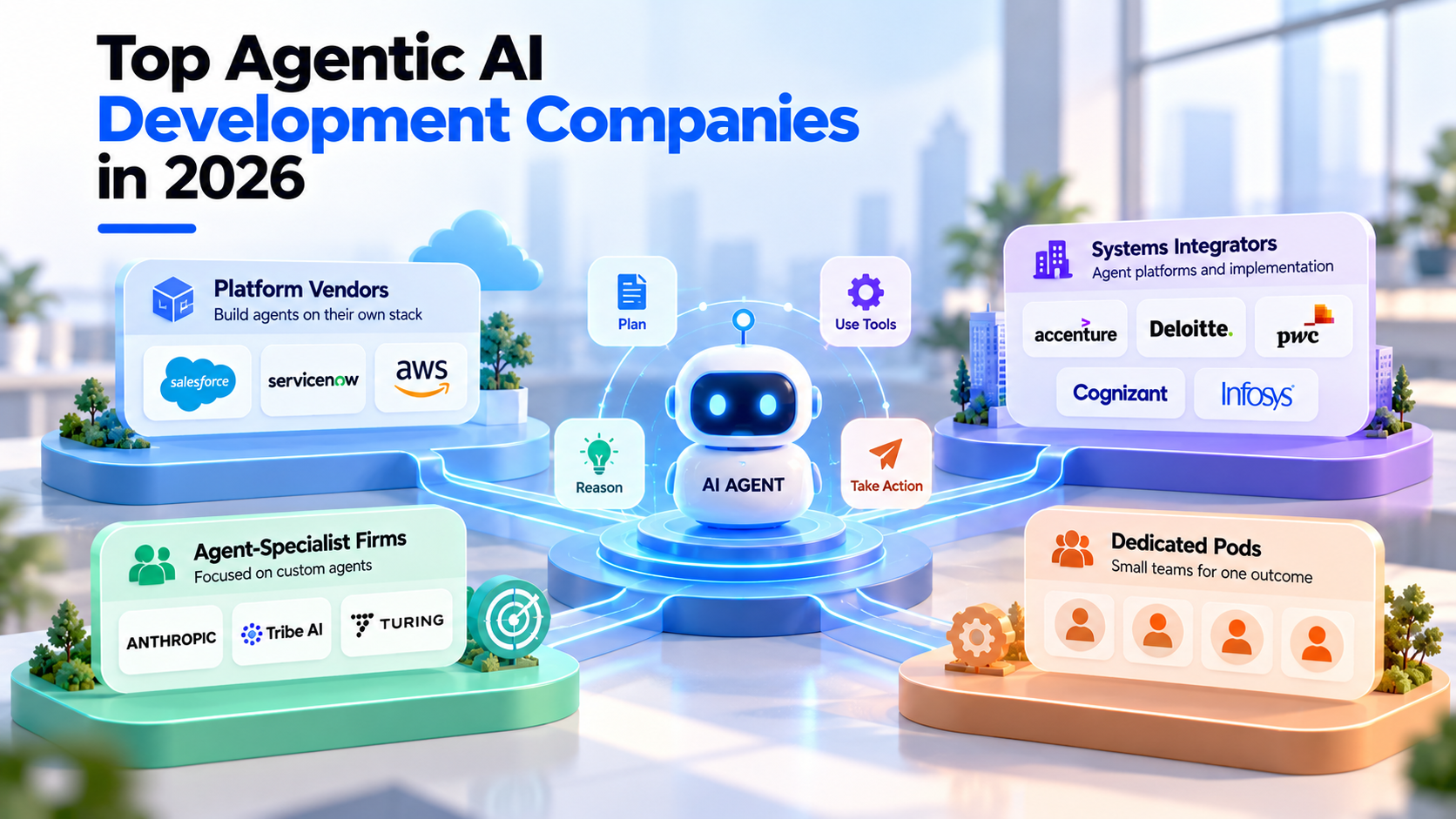
The top agentic AI development companies in 2026 sit in four segments. Platform vendors such as Salesforce, ServiceNow and AWS build agents on their own stack. Systems integrators such as Accenture, Deloitte, PwC, Cognizant and Infosys run agent platforms and practices. Specialists such as Ode with Anthropic, Tribe AI and Turing focus on agents. Small dedicated pods sit alongside them.
We are not going to rank them. No neutral, methodology-backed ranking of agent builders exists, and the usual proxies (headcount, "agents deployed", review-site stars) say nothing about whether an agent will behave in your systems. Instead, here is a verified shortlist by segment and the four checks that matter for agent work: evals, tool security, human oversight and observability.
Freshness note: every company detail below is cited to the company's own announcement, careers page or website, or to a named publication, as of October 2026. Agent offerings are being launched and renamed quickly, so this list is refreshed every six months. If you want general AI build partners rather than agent builders, see our shortlist of the best AI development companies in 2026. If you specifically want embedded engineers from the labs and platforms, our list of forward deployed engineering companies covers that market.
Why is "top agentic AI company" harder to judge than "top AI company"?
Because an AI agent does things. It calls tools and writes to systems, so a weak builder does not just give you a bad answer; it gives you a bad action.
There is also a labeling problem. In June 2025 Gartner predicted that over 40% of agentic AI projects will be canceled by the end of 2027, citing escalating costs, unclear business value and inadequate risk controls. In the same release it described "agent washing", the relabeling of existing products such as chatbots as agentic AI, and estimated that only about 130 of the thousands of agentic AI vendors are real (Gartner, 25 June 2025).
So the first job of any shortlist is to confirm a company actually builds agents that act, not chat interfaces with a new name. Our explainer on why AI agents fail in production shows what the gap looks like once a system is live.
The four segments at a glance
| Segment | Verified examples | What you get | Main trade-off |
|---|---|---|---|
| 1. Platform vendors with agent build teams | Salesforce, ServiceNow, AWS | Engineers who build agents on that vendor's platform | Deepest product knowledge, no neutrality on stack |
| 2. Systems integrators with agent practices | Accenture, Deloitte, PwC, Cognizant, Infosys | A proprietary agent platform plus implementation services | Scale and governance, but heavier process and possible platform pull |
| 3. Agent-specialist firms | Ode with Anthropic (built on Fractional AI), Tribe AI, Turing | Small senior teams focused on custom agents in production | Narrower bench; some are aligned with one AI lab |
| 4. Dedicated pods | Small fixed teams, often vendor-neutral | A cross-functional team owning one agent outcome | Quality varies most; references matter |
Segment 1: Which platform vendors build agents for customers?
If your agent will live mostly inside one enterprise platform, the vendor's own builders are the obvious first call.
Salesforce. Salesforce has advertised for forward deployed engineers who "design, build, and deploy agentic AI solutions directly inside enterprise customer environments" and own end-to-end build and deployment for its most strategic customers (Salesforce job posting, "Forward Deployed Engineer (Agentforce & Data Cloud)", June 2026). A Dublin posting adds that engineers "evaluate AI outputs with engineering rigor" and take work through to "deployed, validated, and observable in production" (Salesforce job posting, "Forward Deployed Engineer").
ServiceNow. ServiceNow's Principal AI Forward Deployed Engineer role, in a listing dated October 2026, scopes customer use cases across sales automation, CPQ, customer service and field service, then designs and ships agent solutions on the ServiceNow platform. The posting explicitly calls out guarding against prompt injection and data leakage, and monitoring and rolling back behavioral drift in production (ServiceNow careers).
AWS Generative AI Innovation Center. In July 2025 AWS added $100 million to the Innovation Center, doubling its investment, and named expanding agentic capabilities and advancing forward deployed engineering among its focus areas. AWS describes a global team of AI scientists, strategists and engineers, and cites customer agent work such as a Yahoo Finance supervisor agent that coordinates agents for news, financial data and SEC filings (AWS Machine Learning Blog, 15 July 2025).
What to know: these teams know the platform's agent tooling better than anyone and are measured on that platform succeeding. Postings for Salesforce's role refer to strategic customers, so ask early whether your account qualifies, or whether you will be routed to a partner.
Segment 2: Which systems integrators have real agent practices?
The large integrators now sell agents as a platform plus services. That gives you reusable components and governance, and it also means each firm has its own platform to place.
Accenture. Accenture's AI Refinery, built on NVIDIA AI Enterprise, gained an agent builder in March 2025 that lets business users create and adjust agents with built-in governance and guardrails. Accenture said it was working toward more than 50 industry-specific agent solutions in the following months, and more than 100 by the end of 2025 (Business Wire, 18 March 2025).
Deloitte. Deloitte launched Zora AI in March 2025: ready-to-deploy agents that "perceive, reason, and act", starting with a finance suite and built on NVIDIA AI. HPE was named as a Zora for Finance user. It is sold on a cloud subscription model (Deloitte press release, 18 March 2025).
PwC. PwC's agent OS, launched in March 2025, is an orchestration layer that connects agents regardless of platform or framework, with integrations including Anthropic, AWS, Google Cloud, Microsoft Azure, OpenAI, Salesforce and SAP, and deployment on major clouds or on-premises (PwC press release, 27 March 2025).
Cognizant. Cognizant Agent Foundry, introduced in July 2025, combines a framework, reusable agent templates built on its Neuro AI Multi-Agent Accelerator and implementation services, with integration guidance for Azure AI Foundry, Google Agentspace, Salesforce Agentforce and WRITER. Cognizant says governance, observability and performance tracking are built in "from the start" (Cognizant news release, 10 July 2025).
Infosys. Infosys Agentic AI Foundry, part of Infosys Topaz, launched in May 2025 with a repository of pre-built horizontal and vertical agents, support for building new agents and customizing existing ones, and an open architecture intended to avoid technology lock-in (Infosys press release, 28 May 2025).
What to know: integrators fit when the agent is one piece of a wider transformation. Ask which parts of the delivered agent depend on the integrator's platform, and what happens to them if you leave.
Segment 3: Which firms specialize in building AI agents?
Specialists are smaller and closer to the engineering. Most of them describe engineers who work inside the client's systems until the agent is live.
Ode with Anthropic (built on Fractional AI). Fractional AI built custom AI agents for specific workflows, with examples including voice and content moderation agents, and said it aimed for production systems rather than "flashy demos" (Fractional AI website). The joint venture behind Ode with Anthropic, announced by Anthropic, Blackstone and Hellman & Friedman in July 2026, acquired Fractional, which TechCrunch reports "has become the foundation of what is now Ode" (TechCrunch, 15 July 2026). The same report says Ode follows a "Claude-first" principle but is not limited to Anthropic's technology; our inference is that buyers should expect Anthropic's models to be the default choice.
Tribe AI. Tribe AI pairs "deep industry expertise with forward-deployed engineers who own the problem end to end" and works in three phases: map the problems worth solving, build inside the client's real systems until the solution is live, then redesign how people and agents work together (Tribe AI website).
Turing. Turing says it brings expertise from its work with frontier labs to Fortune 500 enterprises "for production deployment and scaling of agents" (Turing website).
What to know: specialists offer a sharper agent focus and shorter lines between you and the engineers. Check model alignment (a lab-backed firm will lean towards that lab's models) and how much of the team you meet in sales will actually build.
Segment 4: Where do dedicated pods fit?
A pod is a small, fixed, cross-functional team that owns one outcome, for example "an agent that resolves invoice exceptions with a human approving releases". It is not a body shop and not a large program. Pods suit a buyer who wants vendor neutrality, code ownership and a team that answers only to them.
This is the widest and most uneven segment, so we do not name a list here. Disclosure: the publisher of this guide operates in this segment; see the closing section. Judge any pod, including ours, on the four checks below.
Which company should I hire to build AI agents?
Choose the segment first, then the company. Most buyers fall into one of these situations:
- Your agent will run almost entirely inside Salesforce, ServiceNow or AWS. Start with that vendor's own agent builders or its named partners. They will be fastest on that stack.
- The agent is part of a multi-year transformation with many systems and stakeholders. A systems integrator with an agent platform fits, provided you get clear terms on platform dependency.
- You have committed to one model family and want a senior, agent-focused team. A specialist aligned with that lab, such as Ode with Anthropic for Claude, is a sensible route.
- You want model neutrality, full code ownership and one accountable team. An independent specialist or a dedicated pod is the better fit.
- You need to staff your own team instead. Skip vendors and read our guide to hiring agentic AI developers.
Whichever route you take, the company should pass the four agent-specific checks below.
What should you check that is specific to agent work?
General vendor criteria (references, security posture, contract terms) still apply. These four are where agent builders differ most, and where the risks in the OWASP Top 10 for Agentic Applications, published in December 2025, show up in practice: agent goal hijack, tool misuse and exploitation, identity and privilege abuse, cascading failures and human-agent trust exploitation among them (OWASP GenAI Security Project, 9 December 2025).
| Check | What to ask the company | Strong answer | Red flag |
|---|---|---|---|
| Evals | "Show me the eval suite from a past agent and how it gated releases." | Task-level test cases from real data, run on every prompt, tool or model change, with pass thresholds | "We test it manually" or only demo videos |
| Tool security | "How do you scope the agent's tools and credentials?" | Least-privilege credentials per tool, permissions enforced in code, risk rating per action, prompt-injection testing | The agent uses one admin account or a broad API key |
| Human-in-the-loop | "Which actions need human approval, and who decides that?" | Irreversible or high-value actions routed to a named approver, with enough context to judge | "The model decides when to ask" |
| Observability | "Can I see a full trace of one agent run?" | Every step, tool call and decision traced, sensitive data redacted, alerts on drift and loops | Logs of final answers only |
Evals are the clearest signal
A company that has shipped agents will have eval sets. Anthropic's guidance on building agents recommends "extensive testing in sandboxed environments, along with the appropriate guardrails" (Anthropic, "Building effective agents", December 2024). Ask for an anonymized example, not a slide.
Tool security is where agents differ from chatbots
An agent's risk is set by what its tools can do. Ask how the company designs tools and connects them; if it uses the Model Context Protocol, ask how server permissions are scoped (our primer on what MCP is covers the basics). The OWASP list's "identity and privilege abuse" and "tool misuse" entries are the failure modes to discuss.
Human checkpoints must be designed, not improvised
Anthropic notes that agents "can then pause for human feedback at checkpoints or when encountering blockers". A good builder decides those checkpoints with your process owner up front. Watch for the opposite risk too: OWASP lists human-agent trust exploitation, where a convincing explanation leads an operator to approve a harmful action. Approval screens should show evidence, not just the agent's summary.
Observability should be open, not proprietary
You will run this agent long after the build. OpenTelemetry's generative AI semantic conventions, still in development, now include spans for agent invocations and tool execution (OpenTelemetry). Ask whether traces export to your own monitoring stack or stay inside the vendor's tool.
Our step-by-step guide to building a production AI agent shows what each of these looks like when it is done properly, so you can recognize it in a vendor's answer.
How do you run a fair final round?
Give the last two or three companies the same small, real task: 20 to 30 anonymized cases from the target workflow, a read-only sandbox and two weeks. Ask each to return a working prototype, its eval results, its tool-permission design and one complete run trace. Price and timeline matter, but this exercise tells you whether the team can do agent engineering. Ask every finalist to quote against the same scope so the proposals are comparable.
Keep the agent's code, prompts, eval sets and tool definitions in your own repositories from day one, and put IP and data-handling terms in writing before any production data is shared.
More guides on agent architecture and delivery sit in our Agentic AI & LLM Engineering category.
How we approach this
We would rather you choose the right segment than choose us by default. If your agent lives inside Salesforce or ServiceNow, their own builders are a sensible first call. Fwdpod builds dedicated AI engineering pods for startups and enterprises, covering LLM development, RAG systems, AI agents and product delivery, with engineering delivery from India for buyers in the US, UK, EU and Gulf. Our pods are 4 to 6 experts working around a single measurable outcome, and our Agentic Operations pod template is one of five, with engagements ranging from 8 to 16 weeks. How we handle evals, tracing and tool permissions is something the team can walk you through on a first call. If you are comparing AI agent development services, put the four questions in the table above to us as you would to anyone else: talk to the team, including about pricing, or configure your AI engineering pod to receive a custom proposal within 48 hours.
Frequently Asked Questions
1. Is there an independent ranking of agentic AI development companies?
No. As of October 2026 there is no neutral, methodology-backed ranking of agentic AI development companies. Most published "top" lists are written by one of the companies listed. Compare companies within the segment that fits your situation, using evals, tool security, human oversight and observability as the tests.
2. What is the difference between an AI agent development company and a general AI development company?
An AI agent development company builds systems that take actions through tools, such as updating records or triggering workflows, across multiple steps. A general AI development company may focus on models, analytics or chat interfaces. Agent work adds tool permissions, approval steps and run tracing to the usual engineering.
3. How can I tell if a company is agent washing?
Ask to see an agent that calls real tools in a real system, its eval results and a trace of one complete run. Gartner uses "agent washing" for relabeling products such as chatbots as agentic AI without substantial agentic capabilities. If the company can only show a conversational demo, treat the claim with caution.
4. Should I use my platform vendor or an independent company to build AI agents?
Use the platform vendor when the agent runs almost entirely inside that platform and you want the deepest product knowledge. Use an independent company when the agent spans several systems, when you want to switch models freely, or when you want full ownership of the code and tool definitions.
5. Who should own the eval sets and prompts when an outside company builds my agent?
You should. Eval sets, prompts, tool definitions and agent code are what let you maintain, audit and change the agent later. Make ownership explicit in the contract and keep them in your own repositories from the start of the engagement.
6. How long does a vendor evaluation for an AI agent build take?
A focused evaluation can be run in a few weeks: a short written round to remove companies that cannot show agent evals or traces, then a paid or unpaid trial task of around two weeks for the final two or three, using real anonymized cases.
7. Do agentic AI development companies need experience with MCP?
Not always, but it helps. The Model Context Protocol is a common way to connect agents to tools and data. A company that uses it should be able to explain how it scopes server permissions and credentials, which is the security question that matters more than the protocol itself.