OpenAI API vs Open-Weight Models for Production: Control, Lock-In and Trade-offs
OpenAI API vs Open-Weight Models for Production: Control, Lock-In and Trade-offs. Get the trade-offs before you commit budget.
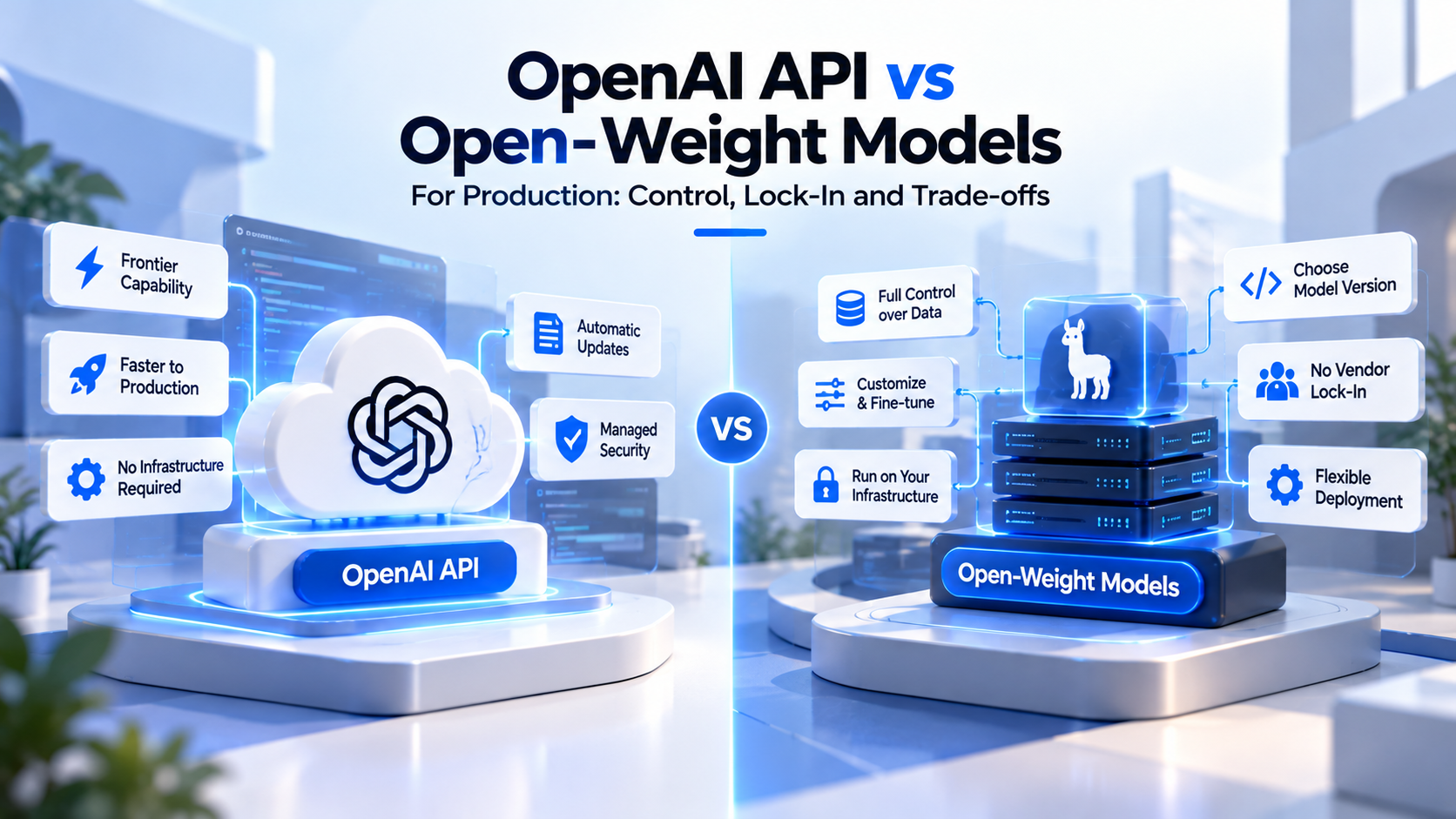
The short answer on the OpenAI API vs open-weight models: the API gets you to production fastest, with frontier capability and no infrastructure, but your data, model versions and roadmap follow OpenAI's policies. Open-weight models give you control over where data lives, which version runs and how it is tuned, in exchange for an ops burden and license terms you must own.
Most teams frame this as a capability question. In 2026 it is mainly a control question: who decides when your model changes, where prompts are stored, and whether you can still customize the model next year. This guide, part of our agentic AI and LLM engineering series, compares the two on the dimensions that matter after launch and ends with a decision table by workload.
What counts as an "open-weight" model?
An open-weight model is one whose trained parameters you can download and run on hardware you choose. That is narrower than open source: most releases publish the weights and a license, not the full training data or training pipeline. What you are allowed to do with the weights depends entirely on that license, which is why licensing gets its own section below.
The choice is also no longer "OpenAI or someone else." On 5 August 2025 OpenAI released two open-weight reasoning models, gpt-oss-120b and gpt-oss-20b, under the Apache 2.0 license. OpenAI says the larger one achieves near-parity with o4-mini on core reasoning benchmarks and runs on a single 80 GB GPU, while the smaller one can run on devices with about 16 GB of memory. So a team can stay with an OpenAI-built model and still self-host it.
How do they compare at a glance?
| Dimension | OpenAI API | Open-weight, self-hosted | Open-weight, via a managed host |
|---|---|---|---|
| Capability ceiling | Frontier models, updated by OpenAI | Strong and closing; varies by model and task | Same models, host's serving stack |
| Where prompts are processed | OpenAI infrastructure, with regional options | Your cloud, VPC or data center | The host's infrastructure, under its terms |
| Data retention | Abuse-monitoring logs up to 30 days by default; reduced options need approval | Whatever you configure | Set by the host's policy |
| Version control | OpenAI retires models on its schedule | You pin a version indefinitely | Host decides which versions stay listed |
| Fine-tuning | Self-serve platform winding down (see below) | Full control: LoRA, full tuning, your data | Depends on the host |
| License terms | OpenAI's service terms | Model license (Apache 2.0, custom community licenses) | Model license plus host terms |
| Ops burden | Low: call an endpoint | High: GPUs, serving, scaling, patching, monitoring | Medium |
| Main lock-in risk | API surface, model behavior, deprecations | Hardware commitments and in-house skills | Host-specific features |
How close is the capability gap?
Closer than most procurement decks assume, though it depends on the task. Stanford HAI's 2025 AI Index reported that on some key benchmarks the difference between leading open-weight and closed models shrank from 8% to 1.7% in a single year. Releases since then, such as Mistral's Apache 2.0 Mistral 3 family in December 2025 and OpenAI's own gpt-oss models, have kept that pressure on.
Benchmarks are not your workload, though. Where a frontier API is most likely to keep an edge is on long, multi-step agentic tasks, complex tool use and the hardest reasoning problems, and API models improve without any work on your side. For narrower tasks such as classification, extraction, summarization or routing, a mid-sized open-weight model, often after tuning, can match the result. The only reliable test is your own evaluation set, run against two or three candidates, before you commit.
Where does your data go with each option?
With the OpenAI API, OpenAI's data controls documentation states that API data "is not used to train or improve OpenAI models" unless you opt in. Abuse-monitoring logs are generated for all API usage and "retained for up to 30 days" by default. Two reduced-retention options exist, Modified Abuse Monitoring and Zero Data Retention, but both are "subject to prior approval by OpenAI." Stateful features add retention of their own: the Responses API keeps application state for 30 days by default when storage is on, and objects you create in some endpoints persist until you delete them.
Data residency has improved. OpenAI lists regions including the US, Europe (EEA and Switzerland), the UK, the UAE, India, Japan and others, but only the US, Europe and the UAE cover processing as well as storage; the rest are storage only. If you need OpenAI models inside your Azure tenancy, Microsoft's documentation for Azure OpenAI in Foundry states that prompts and completions "are NOT available to OpenAI" and that the models run in Microsoft's Azure environment.
With self-hosted open-weight models, there is no third party in the request path. Retention, logging, encryption and access are your controls, which is the attraction and also the work: you have to build and evidence them. For the controls to demand from whoever runs that infrastructure, see our guide to data security in offshore AI development.
What do open-weight licenses actually allow?
"Open-weight" says nothing about commercial rights. Read the license for the exact model and size you plan to ship, because terms can differ within one family.
- gpt-oss (OpenAI): Apache 2.0, a permissive license that allows commercial use, modification and redistribution.
- Mistral 3 (Mistral AI): Mistral states that "all models are released under the Apache 2.0 license" for Mistral Large 3 and the Ministral 3 sizes (3B, 8B, 14B). Some older Mistral models used other licenses, so check each one.
- Qwen (Alibaba): The Qwen3 dense models (0.6B to 32B) were released under Apache 2.0 in April 2025. eWeek reported in August 2026 that Qwen3.8-27B is Apache 2.0, while the much larger Qwen3.8-Max weights ship under a custom Qwen3.8-Max License. Its text requires a licensee that runs a "Model as a Service" or "AI Work Assistant" business to obtain a separate license from Qwen before use if the licensee and its affiliates exceed US$50 million in revenue over any 12 consecutive months; purely internal use is exempt as long as the model, its outputs and its capabilities are not made available to third parties.
- Llama 4 (Meta): A custom community license, not Apache. It requires a separate license from Meta for companies with more than 700 million monthly active users, requires you to display "Built with Llama," requires derivative model names to begin with "Llama," and incorporates an acceptable use policy. That policy withholds the license grant for Llama 4's multimodal models from individuals and companies based in the EU, though end users of products built on them are not restricted.
This is a general overview, not legal advice. Involve your counsel before shipping a product on any model license.
What ops burden do you take on by self-hosting?
With the API, latency and scaling are OpenAI's problem, within the rate limits and service levels of your account. Self-hosting moves all of it to you:
- Capacity planning. GPUs sized for peak load, not average, plus a plan for traffic spikes.
- Serving stack. An inference server (vLLM is a common choice), batching, quantization choices and caching, each of which changes latency and quality.
- Reliability. Health checks, failover and on-call cover for something that used to be an HTTPS call.
- Model lifecycle. Evaluating new releases, rolling them out behind flags and rolling back.
- Security patching of drivers, containers and the serving software.
Self-hosting can win on latency when the model sits next to your data and you control the hardware, and a small tuned model is often faster than a large general one. But it is an MLOps job, not a configuration change. If you don't have that skill set in-house, our comparison of LLM, RAG and MLOps engineers shows who owns which part.
Can you still fine-tune OpenAI models?
Less and less on OpenAI's own platform. OpenAI's deprecations page records that from 7 May 2026 organizations that have never fine-tuned can no longer create fine-tuning jobs; from 2 July 2026 the same applies to organizations that haven't run inference on a fine-tuned model in the past 60 days; and on 6 January 2027 active existing customers lose the ability to create new jobs. Inference on existing fine-tuned models continues "until the base models are deprecated."
Open-weight models keep every tuning option open, from lightweight adapters to full fine-tuning, on infrastructure you control. Microsoft also documents fine-tuning for Azure OpenAI models in Foundry. Before choosing a tuning route at all, check whether you need one: our guide on when to fine-tune, when to use RAG, and when to do neither usually saves teams from tuning they didn't need.
How does lock-in actually happen?
Rarely through contracts. It happens in three quieter ways.
Model behavior. Prompts, output parsers and evals get tuned to one model's quirks. OpenAI's stated minimum notice before retiring a generally available model is six months (three for specialized variants, shorter for previews), so your prompts will need re-validation on a schedule you don't set.
API surface. Provider-specific features become load-bearing. OpenAI's Assistants API, for example, was shut down on 26 August 2026 in favor of the Responses and Conversations APIs, so every team built on it had to migrate on OpenAI's timetable.
Fine-tuned assets. A tuned model tied to a base model that will be deprecated is a depreciating asset unless you can rebuild it elsewhere.
Practical ways to limit it:
- Put a thin model gateway in front of every call so the application never imports a provider SDK directly. vLLM, for example, ships an HTTP server that "implements OpenAI's Completions API, Chat API, and more," so an OpenAI-style client can point at a self-hosted model with minimal code change.
- Keep prompts, evals and training data versioned and provider-neutral. They are what you need to switch models, and the most valuable thing you own.
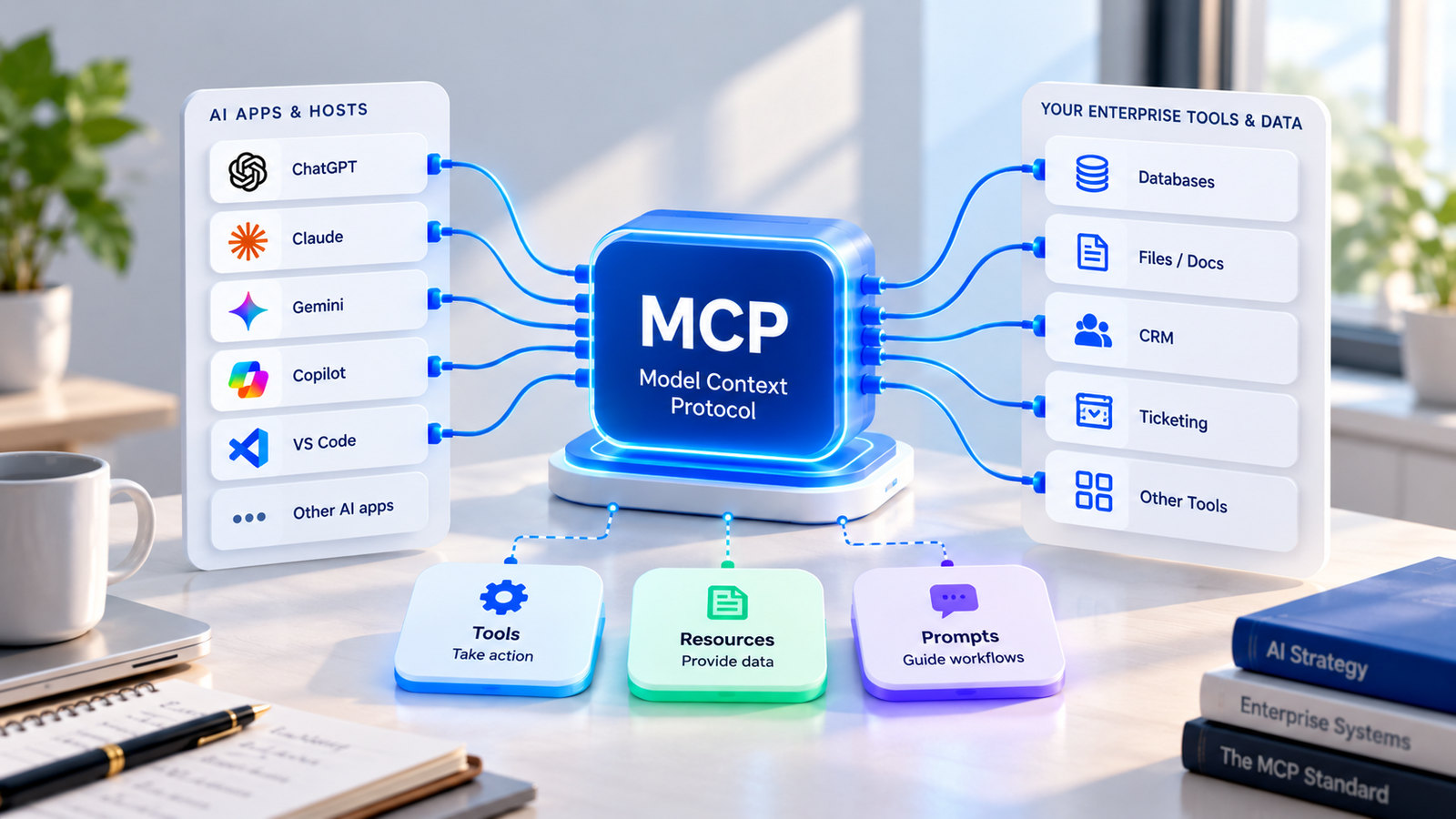
- Standardize tool integrations. Exposing internal systems through the Model Context Protocol keeps tools usable across model vendors.
- Avoid stateful provider features for core data unless they save real engineering time, and store conversation state in your own systems.
What drives cost on each side?
We don't publish figures here because they change monthly, but the drivers are stable. On the API, cost scales with tokens: prompt length, output length, retries, agent loops and the model tier you pick. Self-hosting turns that into mostly fixed cost: GPU capacity sized for peak, the engineers who run it, and utilization, because idle GPUs still cost money. High, steady, predictable volume on a narrow task favors self-hosting; spiky or low volume favors the API. Our build vs buy AI capability framework covers the wider cost-of-ownership question.
Decision table: which fits your workload?
| Your situation | Lean toward | Why |
|---|---|---|
| Early product, unproven demand, small team | OpenAI API | Fastest path to evals with real users; no infrastructure |
| Complex multi-step agents needing the strongest reasoning | OpenAI API (or another frontier API) | Capability ceiling matters more than control |
| Data must never leave your environment, or regulators ask where every prompt goes | Open-weight, self-hosted | No third party in the request path |
| OpenAI models required, but inside your cloud tenancy | Azure OpenAI in Foundry | Microsoft-hosted, not shared with OpenAI |
| High, steady volume on a narrow task (classification, extraction, routing) | Tuned open-weight model | Predictable cost, low latency, version you control |
| You need to fine-tune and don't already use OpenAI fine-tuning | Open-weight (or a cloud provider's tuning service) | OpenAI's self-serve tuning is closing to new users |
| Edge, on-device or air-gapped deployment | Small open-weight model (e.g. gpt-oss-20b, Ministral 3) | Only option that runs offline |
| Mixed workload | Hybrid with a gateway | Route hard tasks to the API, bulk tasks to open-weight |
The hybrid row is where most mature systems end up. A router sends the hard minority of requests to a frontier API and the bulk to a cheaper, faster open-weight model, with the same eval suite judging both. That pattern also makes the move from AI POC to production less painful, because the model is already a swappable component.
Looking to hire OpenAI API developers?
If you plan to hire OpenAI API developers, look for people who design for the exit as well as the launch: a gateway layer, provider-neutral evals, a plan for model deprecations, and enough serving experience to stand up an open-weight fallback. Fwdpod builds dedicated AI engineering pods for LLM development, RAG systems, AI agents and product delivery, with pods of 4 to 6 experts working around a single measurable outcome. Which model providers and open-weight serving stacks would suit your workload is something the team can walk you through on a first call. If you're unsure which model strategy fits, an AI consulting engagement can run the evaluation first. Configure your AI engineering pod to get a custom proposal within 48 hours, or talk to the team, including about pricing.
Frequently Asked Questions
1. Is gpt-oss the same model as the one behind the OpenAI API?
No. gpt-oss-120b and gpt-oss-20b are separate open-weight models that OpenAI released under Apache 2.0 in August 2025. OpenAI compares the larger one to o4-mini on core reasoning benchmarks. The frontier models served through the OpenAI API are not available as downloadable weights.
2. Does OpenAI train on data sent through its API?
Not by default. OpenAI's data controls documentation says API data is not used to train or improve its models unless you opt in. Abuse-monitoring logs are kept for up to 30 days by default, and options to reduce that require OpenAI's approval.
3. Can I switch from the OpenAI API to an open-weight model without rewriting my app?
Often with limited changes, if you planned for it. Inference servers such as vLLM expose OpenAI-compatible endpoints, so the client code can stay similar. The real work is re-tuning prompts and re-running evals, because each model responds differently to the same instructions.
4. Are open-weight models safe for regulated data such as health or financial records?
They can be, because self-hosting keeps data inside your controlled environment. Safety then depends on your own controls: access, logging, encryption, retention and audit evidence. The model being open-weight does not make a system compliant on its own.
5. What happens to my product when OpenAI retires the model I use?
You must move to a newer model before the shutdown date. OpenAI's stated minimum notice for generally available models is six months, shorter for specialized and preview models. Keep a regression eval set so you can validate the replacement quickly.
6. Is Llama free for commercial use?
For most companies, yes, under the Llama 4 Community License, but it carries conditions: attribution, naming rules for derivative models, an acceptable use policy, a separate license above 700 million monthly active users, and a restriction on the multimodal models for EU-based licensees. Have counsel review it.
7. Should a startup self-host from day one?
Usually not. Until you know your traffic, task mix and quality bar, an API lets you learn faster. Build behind a gateway with portable evals, and revisit self-hosting once volume is steady or data rules require it.